Portrait of the week

Portrait of the week | 16 April 2014

Home Nigel Evans, who had resigned as deputy speaker before being cleared of a bundle of rape and sexual assault charges against men, questioned the right of the Crown Prosecution Service to pursue cases that were ‘decades’ old and said that people should not have to spend their life savings defending themselves. Sajid Javid was appointed Culture Secretary, with additional responsibility for equalities, while Nicky Morgan was made women’s minister, with the right to sit in the cabinet when she is sent for.

Portrait of the week | 10 April 2014

Home Maria Miller resigned as Culture Secretary after a week of being the centre of a game of hunt-the-issue. She had paid back expenses, but only the £5,800 requested by the Commons standards committee, not the £45,000 suggested by the parliamentary commissioner for standards; she had apologised in the Commons, but her apology lasted only 32 seconds; her special advisers were accused of putting pressure on the Daily Telegraph not to report on her expenses embarrassment because she had power over newspaper regulation; the chairman of the 1922 Committee called the scandal ‘toxic’. Mrs Miller told her constituents: ‘I am devastated.

Portrait of the week | 3 April 2014

Home George Osborne, the Chancellor of the Exchequer, made ‘a commitment to fight for full employment in Britain’ and for the country ‘to have the highest employment rate of any of the world’s leading economies’. Wolfgang Schäuble, his counterpart in Germany, agreed that any EU treaty changes should ‘guarantee fairness’ to countries outside the eurozone. The government’s approach to selling off Royal Mail was ‘marked by deep caution, the price of which was borne by the taxpayer’ according to a report by the National Audit Office. The Office for National Statistics said that the next census would be conducted online. Dust from the Sahara fell on to England and Wales.

Portrait of the week | 27 March 2014

Home David Cameron, the Prime Minister, said that inheritance tax ‘shouldn’t be paid by people who’ve worked hard and saved and who bought a family house’ and that this would be addressed in the Conservative manifesto. Two opinion polls after the Budget, by Survation for the Mail on Sunday and by YouGov for the Sunday Times, had put Labour one percentage point ahead of the Conservatives. Nineteen Labour movement figures wrote to the Guardian warning the party not to hope to win the election on the basis of Tory unpopularity. The rate of inflation fell from 1.9 to 1.7 per cent, as measured by the Consumer Prices Index, or from 2.8 to 2.7 per cent as measured by the Retail Prices Index. The government said it would sell another 7.

Portrait of the week | 20 March 2014

Home In the Budget, George Osborne, the Chancellor of the Exchequer, said that the economy was working but the job was far from done. He expected further falls in unemployment and wages rising faster than prices this year. The economy, he suggested, would return this year to its size in 2008. Before the Budget, Nick Clegg, the Deputy Prime Minister, said that as many as 1.9 million working families could receive a tax-free childcare allowance worth up to £2,000 per child. Mr Osborne had announced that the help-to-buy scheme for new homes would be extended until 2020. He also let it be known that a garden city of 15,000 dwellings would be built near Gravesend on the high-speed line from the Channel.

Portrait of the week | 13 March 2014

Home Ed Miliband, the leader of the Labour party, promised that, if elected, his administration would hold a referendum on membership of the European Union only if there was a new transfer of power to Brussels, which he called ‘unlikely’. If Scotland votes for independence, the Royal Bank of Scotland and Lloyds might have to move their legal homes to London under European Union law, the BBC reported. BBC Three is to be closed as an on-air channel, to go online only. The future of BBC Four is also in question. Mark Carney, the governor of the Bank of England, told the Treasury Select Committee that interest rates could reach 3 per cent within three years.

Portrait of the week | 6 March 2014

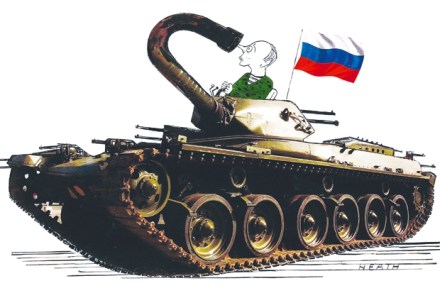
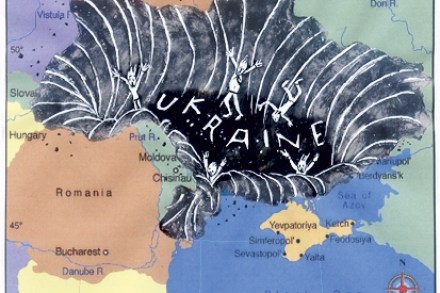
Home David Cameron, the Prime Minister, said Russia was to blame for ‘violating the sovereignty and territorial integrity of another country’ by invading Ukraine, so ‘we shall have to bring to bear diplomatic, political, economic and other pressures’. Britain, with Russia and the United States, is a signatory to the Budapest Memorandum of 1994, guaranteeing the ‘independence and sovereignty and the existing borders of Ukraine’. Before flying to Kiev, William Hague, the Foreign Secretary, said: ‘The United Kingdom will join other G8 countries this week in suspending our co-operation under the G8, which Russia chairs this year.

Portrait of the week | 27 February 2014

Home Moazzam Begg, a former Guantanamo detainee who won substantial compensation after suing the British government, was arrested in Birmingham on suspicion of terrorism offences relating to Syria. John Downey, accused of killing four soldiers in the IRA Hyde Park bombing in 1982, will not be prosecuted, because he was given, in error, a guarantee he would not face trial; an Old Bailey judge ruled it was in the public interest to make state officials keep their promises.

Portrait of the week | 20 February 2014

Home It would be ‘extremely difficult, if not impossible’ for an independent Scotland to join the European Union, José Manuel Barroso, the president of the European Commission, said on British television. Alex Salmond, the leader of the Scottish National Party, said that if an independent Scotland was not allowed to use the pound, it would cost the rest of the United Kingdom £500 million in transaction costs per year, and Scotland would refuse its share of the national debt. Mark Carney, the governor of the Bank of England, warned that uncertainty produced by a referendum on EU membership would mean that businesses held off from making investment. The Unite union called off a strike at the Faslane and Coulport naval bases in the Clyde.

Portrait of the week: as the waters continue to rise

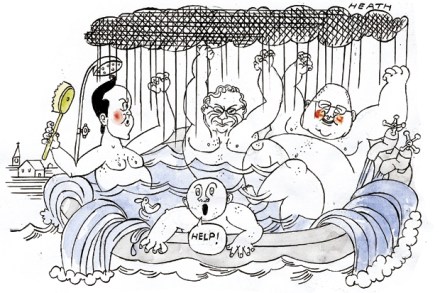
Home Floods grew worse in the West Country. The village of Moorland, Somerset, was abandoned. Then the Thames flooded, from above Oxford to Teddington. Eventually, David Cameron, the Prime Minister, declared from Downing Street: ‘Money is no object in this relief effort.’ Some 1,600 troops were deployed. By midweek 1,000 houses had been evacuated. A storm had broken the rail line from Cornwall at Dawlish, which would take months to mend, as would the broken line from Barmouth to Criccieth. Landslides closed lines between Tonbridge and Hastings, between Machynlleth and Welshpool, and from Portsmouth via Eastleigh. Villagers at Wraysbury, Berkshire, complained of looting of abandoned houses.

Portrait of the week: water, water, everywhere

Home The Somerset Levels continued to wallow in floods. The Environment Agency was widely blamed for not having dredged channels, and for putting the welfare of water voles before flood prevention. Its chairman, Lord Smith of Finsbury, said there were ‘tricky issues of policy and priority: town or country, front rooms or farmland?’ The Prince of Wales visited the area. At the Radcliffe Observatory in Oxford, 5.78 inches of rain fell in January, the most since its records began in 1767. Cuadrilla said it would drill and frack for shale gas at Roseacre Wood and Little Plumpton in Lancashire. Two men found 300 medieval silver coins in a field near Kirkcudbright. Lloyds Banking Group set aside another £1.

Portrait of the week | 30 January 2014

Home Britain’s gross domestic product grew by 1.9 per cent last year, the most since 2007, according to the Office for National Statistics. The last quarter’s growth was 0.7 per cent, a little less than the 0.8 per cent of the previous quarter. In the fourth quarter of 2013, construction actually declined by 0.3 per cent, and economic output was still 1.3 per cent less than in the first quarter of 2008. Ed Balls, the shadow chancellor, promised in a speech that Labour would restore the 50 per cent rate of tax on higher earnings.

Portrait of the week | 23 January 2014

Home George Osborne, the Chancellor of the Exchequer, said that he was in favour of increasing the minimum wage by an amount greater than that of inflation. The International Monetary Fund raised its expectation of growth for Britain in 2014 to 2.4 per cent, from a forecast of 1.9 per cent last October. Unemployment fell to 7.1 per cent. More than 3.3 million people between the ages of 20 and 34 were living with parents in 2013, 26 per cent of that age group, the Office for National Statistics said, and a number 25 per cent bigger than in 1996. London’s share of national output reached 22.4 per cent in 2012, according to official data.

Portrait of the week | 16 January 2014

Home David Cameron, the Prime Minister, said that English local authorities would be allowed to receive all the business rates collected from shale gas schemes, not just the 50 per cent they’d expect. Total, a French company, said it would invest about £30 million in drilling two exploratory wells in Lincolnshire. To head off higher borrowing rates, the government announced that ‘in the event of Scottish independence from the United Kingdom, the continuing UK government would in all circumstances honour the contractual terms of the debt issued by the UK government’. The annual rate of inflation, as measured by the Consumer Prices Index, met the target set by the government for the first time since November 2009, when it fell to 2 per cent (from 2.

Portrait of the week | 9 January 2014

Home George Osborne, the Chancellor of the Exchequer, made it clear in a speech that he intended to cut £25 billion after the next election, with about half of the savings coming from cuts in welfare payments. Nick Clegg, the Liberal Democrat Deputy Prime Minister, said that the means proposed were ‘unrealistic and unfair’ and showed that the Conservatives wanted to ‘remorselessly pare back the state for ideological reasons’. Nick Clegg told the Commons that official estimates suggest that more than 1,500 Syrians had entered Britain last year through the asylum system. Boris Johnson, the Mayor of London, said that Mr Clegg had ‘a very important ceremonial function as David Cameron’s lapdog-cum-prophylactic protection device’.

Portrait of the week | 3 January 2014

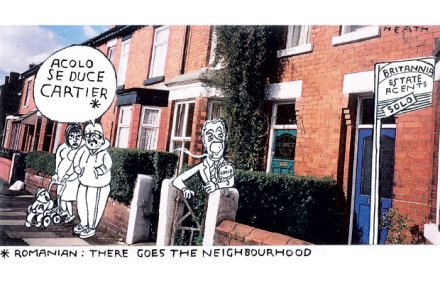
Home Six months of talks in Northern Ireland, chaired by Dr Richard Haass, a retired American diplomat, ended without resolving the contentious issues of flag-flying, sectarian parades or a policy on trying crimes committed during the troubles. Bus loads of Romanians and Bulgarians set off for London as restrictions on their right to work in Britain were lifted. Nigel Farage, the leader of Ukip, called for refugees from the conflict in Syria to be given asylum in Britain; Lord Howe, the health minister, said that some should be accommodated in the European Union. Tories were said to have persuaded Boris Johnson to undertake ‘short bursts’ of campaigning before the election. The Duke of Cambridge is to spend ten weeks studying agriculture at Cambridge University.

What happened in 2013, from Depardieu’s hug to Sachin’s last bow

January David Cameron, the Prime Minister, said he wanted to ‘negotiate a new settlement with our European partners’, and that before the end of 2017 would ‘give the British people a referendum with a very simple in or out choice’. Gérard Depardieu hugged President Vladimir Putin at the Black Sea resort of Sochi as he received a Russian passport. French troops were welcomed in the streets of Timbuktu as they drove back Islamist forces in Mali. HMV, the record shop, and Blockbuster, the DVD rental firm, went into administration. There were riots in Belfast. A helicopter crashed into a tower block at Vauxhall in London. The City of London approved a 620ft tower nicknamed the Scalpel.

Portrait of the week | 5 December 2013

Home George Osborne, the Chancellor of the Exchequer, said that average energy bills would be brought £50 lower through government intervention to reduce the obligation of energy companies to subsidise insulation. The government also said it would cut subsidies for onshore wind turbines and solar energy, and increase those for offshore wind farms. David Cameron, the Prime Minister, said that new arrivals from Bulgaria or Romania found to be begging or sleeping rough would be thrown out of the country and barred from returning for a year, unless they had a job. He then flew to China to further British trade. A bridge across the Thames from Temple to the South Bank, the idea of Joanna Lumley, and designed by Thomas Heatherwick, attracted government support.

Portrait of the week | 28 November 2013

Home Alex Salmond, the First Minister of Scotland, outlined Scottish National Party plans for independence, which included keeping the pound and armed forces of 15,000, replacing the BBC with the Scottish Broadcasting Service and introducing random breath tests. The Ministry of Defence said it would investigate claims that in 1972 an Army plainclothes undercover unit shot dead people in Northern Ireland unconnected with paramilitary activity. A bomb containing 132lbs of home-made explosives failed to go off properly in a car parked at Victoria Square in central Belfast. Rape at the hands of under-age perpetrators is seen as ‘normal and inevitable’ among children in some areas, according to the Office of the Children’s Commissioner for England.

Portrait of the week | 21 November 2013

Home The government announced proposals for the National Health Service, including a law to criminalise wilful neglect by doctors and nurses, and a scheme to post online the numbers of nurses on wards. By the end of October, 219 households had seen work completed to insulate their houses under the government’s Green Deal, launched last January. Nick Boles, the planning minister, suggested that David Cameron, the Prime Minister, might like to revive the National Liberal Party, an organisation affiliated to the Conservative party from 1947 to 1968. The Foreign Office summoned the Spanish ambassador after a Spanish ship entered waters off Gibraltar and undertook surveying activity for 20 hours.