Portrait of the week

Portrait of the week | 23 October 2014

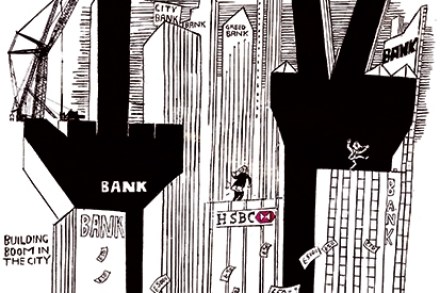
Home A hundred firemen could not prevent wooden cooling towers at Didcot B gas-fuelled power station in Oxfordshire from burning down. A consortium said it could power 2.5 million houses in Britain by 2018 with solar energy generated in southern Tunisia. The Bank of England indicated that interest rates would stay low for longer because of a poor outlook for the global economy. Government borrowing rose to £11.8 billion in September: £1.6 billion more than a year earlier. HSBC offered a mortgage at 0.99 per cent interest. The government is to pay a bounty of £55 to GPs for every patient they diagnose with dementia.

Portrait of the week | 16 October 2014

Home Checks began at British airports for passengers who might have come from west Africa with Ebola fever (even though there are no direct flights from the countries most affected). People who rang 111 with suspicious symptoms were to be asked whether they’d come from a high-risk country. Police arrested three men and three women from Portsmouth, Farnborough and Greenwich as part of an anti-terrorism operation. Of five men arrested the week before, two were released. The trial began before a jury at the Old Bailey of Erol Incedal on charges of preparing for acts of terrorism; parts of it will be held in secret.

Portrait of the week | 9 October 2014

Home Alan Henning, 47, a British volunteer aid worker taken captive in Syria by Islamic State, was murdered, and footage of his death, which included an appearance by a man with an English accent nicknamed Jihadi John, was posted online. David Cameron, the Prime Minister, said: ‘We will do all we can to hunt down these murderers and bring them to justice.’ Four men were arrested in London on suspicion of terror offences; MI5 sources suggested that the arrest might have ‘foiled the early stages’ of a planned attack. A 12-year-old girl in a wheelchair was saved from injury by her arm-braces when two men set a pit bull dog on her in a Northamptonshire wood. Fungicide injections derived from garlic were tried out on trees suffering from ash dieback in Northamptonshire.

Portrait of the week | 2 October 2014

Home The Commons, having been specially recalled, passed, by 524 votes to 43, a motion supporting ‘the use of UK air strikes to support Iraqi, including Kurdish, security forces’ efforts against Isil in Iraq’. Only after four days did RAF Tornados from Akrotiri in Cyprus find some targets in Iraq to bomb. In support of her contention that Isil’s ‘hateful ideology has nothing to do with Islam’, Theresa May, the Home Secretary, in a well-received speech at the Conservative party conference, quoted the Qu’ran: ‘Let there be no compulsion in religion’ (Sura 2:256).

Portrait of the week: Cameron visits UN HQ, Scotland checks its bruises, and a Swede sells his submarine

Home David Cameron, the Prime Minister, visited New York for talks at the United Nations; he said Britain supported the American air strikes on the Islamic State. ‘These people want to kill us,’ Mr Cameron said on NBC news. Mr Cameron met President Hassan Rouhani of Iran in New York, the first such meeting since the Iranian revolution in 1979. Mr Cameron was caught by cameras in New York saying to Michael Bloomberg, its former mayor, that when he rang the Queen with the Scottish referendum result, ‘She purred down the line.’ Alex Salmond resigned as First Minister of Scotland and leader of the Scottish National Party, with effect from November. This followed the referendum for Scottish residences, which rejected independence by 2,001,926 votes (55.

Portrait of the week | 18 September 2014

Home People living in Scotland voted in a referendum that asked: ‘Should Scotland be an independent country?’ A great deal of ill feeling had been generated as the referendum campaign went on. David Cameron, the Prime Minister, was told by backbench Conservative MPs that he faced a ‘bloodbath’ for joining the United Kingdom leaders of the Liberal Democrats and the Labour party in offering continued high levels of funding for Scotland.

Portrait of the week | 11 September 2014

Home England suddenly began to take the prospect of Scottish independence seriously after a poll of 1,084 people by YouGov put support for it at 51 per cent and opposition at 49 per cent. A survey by TNS showed 38 per cent of Scots backed independence compared to 39 per cent opposing it (with 23 per cent not knowing). The pound fell to its lowest for ten months against the dollar. George Osborne, the Chancellor of the Exchequer, in concert with Labour and the Liberal Democrats, promised a timetable for further devolution if voters in Scotland would only reject independence. The Prime Minister and the leader of the opposition agreed to cancel Prime Minister’s Questions and fly to Scotland, in the apparent belief that it would help. Nick Clegg, the Deputy Prime Minister, went too.

Portrait of the week | 4 September 2014

Home Britain’s terror threat level was raised from ‘substantial’ to ‘severe’ in response to fighting in Iraq and Syria, meaning that an attack on Britain was ‘highly likely’. Three days later, David Cameron, the Prime Minister, in a hesitant statement to the Commons, proposed that: police should be able to seize temporarily at the border the passports of people travelling overseas; there should be all-party talks on drawing up powers to prevent suspected British terrorists returning to Britain; those under terrorism prevention and investigation measures (Tpims) should be subject to ‘stronger locational constraints’.

Portrait of the week | 28 August 2014

Home Theresa May, the Home Secretary, said that Britons who went to Syria or Iraq to fight could be stripped of their citizenship, if they had dual nationality or were naturalised. Her words came during a search for the identity of the British man in a video of the beheading of the American journalist James Foley. David Cameron had returned to London from his holiday in Cornwall to confer with security officials, but decided against recalling Parliament. In revenge the Daily Mail carried photographs of him in a wetsuit, which gave him a phocine look. Lord Dannatt, the former Chief of the General Staff, suggested Britain should deal with President Bashar al-Assad of Syria, but Philip Hammond, the Foreign Secretary, said: ‘That would poison what we are trying to achieve.

Portrait of the week | 21 August 2014

Home David Cameron, the Prime Minister, writing of the Islamic State in northern Iraq, said: ‘If we do not act to stem the onslaught of this exceptionally dangerous terrorist movement, it will only grow stronger until it can target us on the streets of Britain.’ Anyone waving an Islamic State flag in Britain would be arrested, he said. He invoked Britain’s ‘military prowess’ but later said: ‘We are not going to be putting boots on the ground.’ British C-130 transport planes were used to drop aid; Tornados were used for surveillance in addition to a Rivet Joint surveillance aircraft; and Chinook helicopters remained on standby.

Portrait of the week | 14 August 2014

Home David Cameron, the Prime Minister, resisted calls for Parliament to be recalled to debate the crisis in Iraq. Philip Hammond, the Foreign Secretary, said that the government was not considering military intervention ‘at the present time’. Mark Simmonds resigned as a Foreign Office minister, but Downing Street hastened to say that his resignation, unlike Lady Warsi’s a week earlier, had nothing to do with government policy on Gaza, since he was complaining he could not afford to rent a flat in London for his family with the £27,000 allowance. A man sought by police investigating the theft of a fish tank from a furniture shop in Leeds hid in a bush and was attacked by a swarm of wasps. Unemployment fell 132,000 to 2.

Portrait of the week | 7 August 2014

Home The Duke and Duchess of Cambridge joined 50 heads of state at the St Symphorien cemetery near Mons to commemorate the invasion of Belgium in 1914. The Prince of Wales attended a service at Glasgow cathedral; the Duchess of Cornwall attended a service at Westminster Abbey where a lighted flame was put out at 11p.m., the hour that Britain had declared war on Germany on 4 August. Many people in Britain kept one light burning for an hour that evening. The Queen attended a private service at Craithie church, near Balmoral. In the grassy moat of the Tower of London, 888,246 ceramic poppies were being planted, one for each British and Colonial death in the first world war.

Portrait of the week | 31 July 2014

Home Britain is to halve to three months the time that EU migrants without realistic job prospects can claim benefits, David Cameron, the Prime Minister, said in an article for the Daily Telegraph. Workers for the Passport Office who belong to the Public and Commercial Services Union went on strike ostensibly to ‘end staffing shortages that have caused the ongoing backlog crisis’. Driverless cars will be allowed on roads from next year. Newham council in east London approved a £1 billion scheme for an ‘Asian Business Port’ to be built by the Chinese at the Royal Albert Dock. The Gherkin office block in London was put up for sale, with expectations of its fetching £650 million. People in Tring complained of the smell of sewage sludge on fields.

The MH17 disaster

Home David Cameron, the Prime Minister, told Parliament that President Vladimir Putin of Russia should end his country’s support for separatists in Ukraine, some of whom it had provided with a training facility in south-west Russia. Licences to export arms to Russia were found still to be in place. Theresa May, the Home Secretary, announced a public inquiry into the death of the Russian dissident Alexander Litvinenko, a former KGB officer who died in 2006 in a London hospital after he was poisoned with polonium. Nick Clegg, the Deputy Prime Minister, was criticised by some MPs from rival parties for appearing on television sampling tequila instead of somehow doing something about the crisis. Prince George of Cambridge celebrated his first birthday.

Portrait of the week: ministerial musical chairs, women bishops, giant snails

Home In a ministerial reshuffle, William Hague, who promised to leave Parliament at the election, was made Leader of the House, being replaced as Foreign Secretary by Philip Hammond, who was replaced as Defence Secretary by Michael Fallon. Sir George Young Bt, aged 73, was sacked as Chief Whip. Michael Gove was demoted to Chief Whip. David Cameron, the Prime Minister, said: ‘I wanted one of my big hitters, one of my real stars, one of my great brains, someone who has done extraordinary things for education in this country, to do that job.’ Mr Gove was replaced as Education Secretary by Nicky Morgan, who will keep her portfolio as minister for women. Disabled people got a minister all of their own, Mark Harper.

Portrait of the week | 10 July 2014

Home Theresa May, the Home Secretary, ordered a review, taking perhaps ten weeks, by Peter Wanless, the head of the National Society for the Prevention of Cruelty to Children, of how her department, the police and prosecutors handled historical child sex-abuse allegations. There would also be a large-scale inquiry by the retired judge Lady Butler-Sloss. These came in response to a ferment of speculation into what the late Geoffrey Dickens had alleged in 1984 in a folder of information he gave to Leon Brittan, then Home Secretary. In 2013 the folder was found not to have been kept. Rolf Harris, the entertainer, aged 84, was jailed for five years and nine months for 12 indecent assaults against four girls. Novak Djokovic beat Roger Federer to win the men’s singles at Wimbledon.

Portrait of the week | 3 July 2014

Home David Cameron, the Prime Minister, rang Jean-Claude Juncker to congratulate him on being nominated by EU heads of government as president of the European Commission. Mr Cameron had insisted the question should go to a vote at an EU summit, where 26 voted for Mr Juncker and two against: he and Viktor Orban, the prime minister of Hungary. Mr Cameron announced a review into why, in the face of resistance to antibiotics, few anti-microbial drugs have been introduced in recent years. Sir Elton John came out in favour of gay marriage for clergy: ‘If Jesus Christ was alive today, I cannot see him, as the Christian person that he was and the great person that he was, saying this could not happen.

Portrait of the week | 26 June 2014

Home David Cameron, the Prime Minister, fought a last-ditch battle against the appointment of Jean-Claude Juncker as president of the European Union. Jeremy Hunt, the Health Secretary, declared that to be ‘isolated’ could be the ‘right thing’. Attention was diverted by an opinion of Mr Cameron’s negotiating skills in Europe, given in a private conversation, secretly recorded along with several others leaked to the Polish press, by Radoslaw Sikorski, the foreign minister. Mr Sikorski, once, like Mr Cameron, a member of the Bullingdon Club at Oxford, spoke of ‘a kind of incompetence in European affairs. Remember? He fucked up the fiscal pact. He fucked it up. Simple as that.

Portrait of the week | 19 June 2014

Home With war engulfing Iraq, Britain set about reopening its embassy in Tehran, closed in 2011. William Hague, the Foreign Secretary, ruled out British military action. The government made it a crime to associate with the Islamic State of Iraq and Syria (or al-Sham), the salafist armed movement known as ISIS. About 400 Britons were thought to be fighting on their side. The government can intercept Facebook, Twitter and Google without individual warrants, because they are based externally, the Office of Security and Counter-Terrorism admitted in a law case. David Cameron, the Prime Minister, ran into heavy weather trying to prevent Jean-Claude Juncker being appointed president of the European Commission.

Portrait of the week | 12 June 2014

Home After an Ofsted inspection of 21 schools in Birmingham (none of them faith schools), against the background of allegations of attempts of a Muslim takeover in a so-called Operation Trojan Horse, David Cameron, the Prime Minister, joined Michael Gove, the Education Secretary, in seizing upon an observation by Sir Michael Wilshaw, Her Majesty’s Chief Inspector, that ‘all maintained schools and academies, including faith and non-faith schools, must promote the values of wider British society’. Five of the schools were put under ‘special measures’.