Portrait of the week

Portrait of the week | 25 June 2015

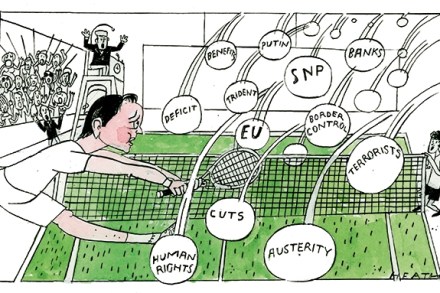
Home Tens of thousands took part in a demonstration in London against austerity, and thousands more in other cities. Russell Brand was heckled for being too right-wing: ‘Fuck off back to Miliband,’ protestors in Parliament Square cried. David Cameron, the Prime Minister, explaining his thinking on further benefit cuts: ‘There is what I would call a merry-go-round: people working on the minimum wage having that money taxed by the government and then the government giving them that money back — and more — in welfare.’ The government sold more shares in the Lloyds Banking Group, bringing its ownership to less than 17 per cent.

Portrait of the week | 18 June 2015

Home Talha Asmal, aged 17, from Dewsbury, West Yorkshire, died in a suicide bomb attack on forces near an oil refinery near Baiji in Iraq, having assumed the name Abu Yusuf al-Britani. A man from High Wycombe, Buckinghamshire, Thomas Evans, 25, who had changed his name to Abdul Hakim, was killed in Kenya while fighting for al-Shabab. Three sisters from Bradford were thought to have travelled to Syria with their nine children after going on a pilgrimage to Saudi Arabia. Britain had had to move intelligence agents, the Sunday Times reported, because Russia and China had deciphered documents made public by Edward Snowden, the CIA employee who has taken refuge in Russia. Payments expected by customers of the RBS group of banks failed to enter accounts overnight.

Portrait of the week | 11 June 2015

Home David Cameron, the Prime Minister, said of the EU referendum: ‘If you want to be part of the government, you have to take the view that we are engaged in an exercise of renegotiation to have a referendum and that will lead to a successful outcome.’ This caused a certain amount of uproar, with newspaper headlines saying things like ‘PM: Back me or I will sack you.’ Mr Cameron the next day said: ‘It’s clear to me that what I said yesterday was misinterpreted.

Portrait of the week | 4 June 2015

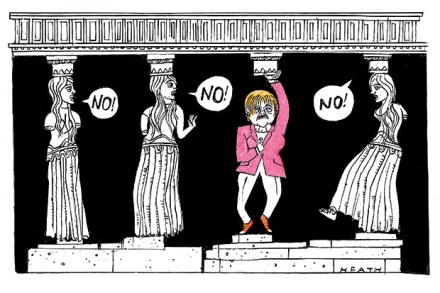
Home David Cameron, the Prime Minister, toured Europe trying to gain support for reforms to favour Britain’s position in the European Union. Angela Merkel, the Chancellor of Germany, said she did not rule out treaty changes in Europe and would be a ‘constructive partner’ of Britain in seeking reforms. Nick Clegg, the former deputy prime minister, was found to be on a list of 89 figures from the EU banned from entering Russia. Jeremy Hunt, the Health Secretary, said he would do something to reduce the cost of agency staff for the NHS in England, which amounted to £3.3 billion last year. The government, which has reduced its stake in Lloyds bank from 41 per cent to 19 per cent, said it would mount a sale of Lloyds shares to the public in the next 12 months.

Portrait of the week | 28 May 2015

Home A Bill to enable a referendum on whether voters wanted Britain to ‘remain’ in the European Union figured in the Queen’s Speech. Another Bill prohibited any rise in income tax rates, VAT or national insurance before 2020. Tenants of housing associations would be given the right to buy their homes. Provision for Scottish devolution was promised in fulfilment of the recommendations of the cross-party Smith Commission. A ‘powerhouse’ in the north was to come into being through cities being given powers over housing, transport, planning and policing. Laws on strikes would be tightened. Red tape for business would be reduced, and a new quango set up to invigilate late payment to small businesses. Apprenticeships would be encouraged and childcare expanded.

Portrait of the week | 21 May 2015

Home The annual rate of inflation turned negative in April, for the first time since 1960, with deflation of 0.1 per cent as measured by the Consumer Prices Index, so that a basket of goods and services that cost £100 in April 2014 would have cost £99.90 in April 2015. But, measured by the Retail Prices Index, inflation continued at a rate of 0.9 per cent. Marks & Spencer reported its first rise in annual profits for four years. Police trying to find the gang that broke into safe-deposit boxes in Hatton Garden last month arrested nine men. A botanist claimed unconvincingly that Shakespeare was depicted in the frontispiece of Gerard’s Herball dated 1597. Greggs, the baker’s, stopped selling loaves in many of its shops.

Portrait of the week | 14 May 2015

Home David Cameron, the Prime Minister, soon got used to the surprise of the Conservatives being returned in the general election with a majority of 12. He retained George Osborne as Chancellor of the Exchequer and made him First Secretary of State too. Theresa May, Philip Hammond, Michael Fallon and Iain Duncan Smith also stayed put, but Chris Grayling replaced William Hague, who had left the Commons, as Leader of the House, to be replaced as justice secretary by Michael Gove, who was replaced as chief whip by Mark Harper. Amber Rudd became Energy Secretary. John Whittingdale became Culture Secretary in place of Sajid Javid, who became Business Secretary. Boris Johnson was to attend weekly political cabinets.

Portrait of the week | 7 May 2015

Home The country went to the polls. David Cameron, the Conservative leader, prepared by going around with his sleeves rolled up. Ed Miliband, the Labour leader, said that his pledges had been cut into an eight-foot slab of limestone. Nick Clegg, the Liberal Democrat leader, took a bus for John O’Groats. Stuart Gulliver, the chief executive of HSBC, said it would take ‘a few months, not years’ to decide whether to move its headquarters out of Britain. Sainsbury’s reported a loss of £72 million for the year, after writing down a fall in the value of some of its shops. Three tons of cocaine, worth perhaps £500 million, were recovered from a ship intercepted 100 miles east of Aberdeen; the nine Turkish crew were arrested.

Portrait of the week | 30 April 2015

Home The British economy grew by 0.3 per cent in the first quarter of 2015, the slowest quarterly growth for two years. The Institute for Fiscal Studies pointed out many absurdities in party election promises, noting that most people would see tax and benefit changes that reduced their income; it said that the Conservative and Liberal Democrat plan to increase the personal allowance to £12,500 would not help the 44 per cent of people who now pay no tax, that Labour’s promised 10p tax band would be ‘worth a princely 50 pence a week to most income-tax payers’ and that it could not be sure whether the reintroduction of a 50p rate for high earners would raise any extra money for the Treasury.

Portrait of the week | 23 April 2015

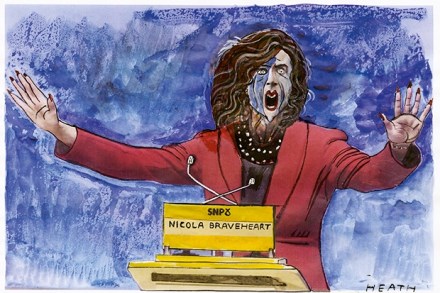
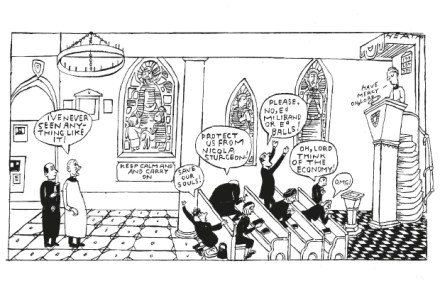
Home The prospect of a parliamentary alliance between Labour and the Scottish National Party injected an element of fear into the election campaign. The SNP manifesto promised to increase spending and to find a way to stop the renewal of the Trident nuclear deterrent. Nicola Sturgeon, the SNP leader, said she wanted to make Labour in government ‘bolder and better’. Lord Forsyth, a former Conservative Scottish secretary, said that the building up of the SNP, to take seats in Scotland, was a ‘dangerous view which threatens the integrity of our country’. Ed Miliband, the Labour leader, said the Tories should not be ‘talking up’ the SNP. Even the Democratic Unionists began to eye prospects for advantage in a hung parliament.

Portrait of the week | 9 April 2015

Home Tony Blair, the former prime minister, opposed a referendum on membership of the EU. In a speech at Sedgefield he said that, following the Scottish referendum, David Cameron, the Prime Minister, knew ‘the perilous fragility of public support for the sensible choice’. Opinion polls following a television debate by seven party leaders, which drew an audience of 7.7 million, were inconsistent. Nicola Sturgeon, the leader of the Scottish National Party, was held to have made a mark, while Leanne Wood, the leader of Plaid Cymru, and Natalie Bennett polled at between 2 and 5 per cent. Nigel Farage, the leader of Ukip, was seen to sweat profusely.

Portrait of the week | 2 April 2015

Home The nation greeted with well disguised enthusiasm the beginning of the general election campaign after the dissolution of parliament. David Cameron, the Prime Minister, stood at a little plywood lectern in Downing Street and said: ‘In 38 days you face a stark choice’ — between him and Ed Miliband, the leader of the Labour party. The Conservatives said they would create two million jobs in the next parliament. Their claims that Labour’s plans would cost each household £3,028 extra in taxes were met with baffled scepticism by the Institute for Fiscal Studies. Some business leaders indignantly rejected Labour’s claims on a poster that they supported the party’s opposition to a referendum on Britain’s membership of the EU.

Portrait of the week | 26 March 2015

Home David Cameron, who was cutting up lettuce in his kitchen, told James Landale of the BBC that he would not seek a third term as Prime Minister, even if he secured a second. Mr Cameron was heckled the next day by pensioners at an Age UK conference. He had mentioned Theresa May, George Osborne and Boris Johnson as possible successors. Mrs May, the Home Secretary, made a speech promising action against extremists, such as the use of ‘closure orders’ against premises (such as mosques) used by extremists, and a ‘positive campaign to promote British values’.

Portrait of the week | 19 March 2015

Home In a Budget intended to have ‘no gimmicks, no giveaways’, George Osborne, the Chancellor of the Exchequer, offered pensioners with annuities the chance to cash them in and blow the lot. Borrowing in the coming year would be a fraction of a billion less than feared and the annual deficit was to be eliminated by 2019. The income tax personal allowance was raised. Business rates were to be reviewed. Duty on beer, cider and spirits came down a touch, but not on wine. A higher bank levy was predicted to raise £900 million. North Sea oil and gas producers were offered tax reductions. About 15 million people would have to update their tax returns online through the year. The minimum wage would rise in October by 20p an hour to £6.

Portrait of the week | 12 March 2015

Home Philip Hammond, the Foreign Secretary, said that ‘a huge burden of responsibility’ lay with those who acted as apologists for those who committed acts of terror. Parliament approved new obligations for passenger carriers to restrict the travel to or from Britain of people named as a terrorist threat. The Charity Commission required the Joseph Rowntree Charitable Trust and the Roddick Foundation to give unequivocal assurances that they had ceased funding Cage, the advocacy group known for speaking up for Mohammed Emwazi, the British jihadist involved in videos of Islamic State murders. England were knocked out of the Cricket World Cup.

Portrait of the week | 5 March 2015

Home The man seen in several Islamic State videos of hostages being beheaded, nicknamed Jihadi John by the British press, was revealed as Mohammed Emwazi, aged 26, born in Kuwait but raised from the age of six in London. He was said to have had help with anger management at his secondary school, Quintin Kynaston Academy in St John’s Wood. An advocacy group called Cage produced a recording of him complaining that MI5 had questioned him after he had to turn back from a ‘safari’ in Tanzania in 2009. General Raymond Odierno, the chief of staff of the US army, said he was ‘very concerned’ about British defence cuts. Lance Corporal Joshua Leakey of the Parachute Regiment was awarded the Victoria Cross for bravery in Afghanistan.

Portrait of the week | 26 February 2015

Home Sir Malcolm Rifkind, the former Conservative foreign secretary, resigned as chairman of Parliament’s Intelligence and Security Committee and promised not to stand for Parliament in May after he and Jack Straw, the former Labour foreign secretary, were suspended from their parties. This followed their being separately secretly filmed apparently offering their services for payment to reporters from the Daily Telegraph and Channel 4’s Dispatches programme pretending to be acting for a Chinese company. Ed Miliband, the Labour leader, declared that Labour candidates would in future not to be allowed to have second jobs.

Portrait of the week | 19 February 2015

Home The annual rate of inflation fell to 0.3 per cent as measured by the Consumer Prices Index (or to 1.1 per cent by the Retail Prices Index). The Bank of England predicted a touch of deflation in the spring. Unemployment fell by 97,000 to 1.86 million in the last quarter of 2014. The FTSE share index rose to 6,914.62, close to its record of 6,930.2 on 30 December 1999. In a lecture at King’s College London, Sir John Sawers, who was until November head of MI6, said: ‘The Ukraine crisis is no longer just about Ukraine. It’s now a much bigger, more dangerous crisis, between Russia and western countries.’ Sex-and-relationships education should be compulsory in all state primary and secondary schools in England, the Commons Education Committee said in a report.

Portrait of the week | 12 February 2015

Home Philip Hammond, the foreign secretary, told Parliament that Britain reserved the right to supply arms to Ukraine, as ‘We could not allow the Ukrainian armed forces to collapse.’ The Prince of Wales, embarking on a six-day tour of the Middle East, said on Radio 2 that he ‘particularly wanted to show solidarity really, deep concern for what so many of the Eastern Christian churches are going through in the Middle East’. John Longworth, the head of British Chambers of Commerce, called for a referendum on membership of the European Union to be held in 2016, a year earlier than David Cameron, the Prime Minister, has promised, in order to end uncertainty. Boris Johnson, the Mayor of London, said the same.