Portrait of the week

Portrait of the week | 14 January 2016

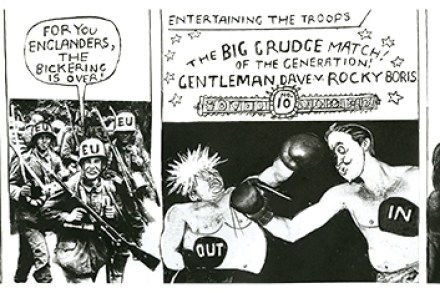
Home David Cameron, the Prime Minister, said that, on Britain’s place in the European Union, ‘what I would like to see is a deal in February, then a referendum that would follow’. The pound sank to its lowest against the US dollar since 2010, after Britain’s manufacturing sector shrank unexpectedly by 0.4 per cent in November. BP said it was cutting 4,000 jobs round the world, 600 of them from its North Sea operations. A split in the Anglican Communion over homosexuality ‘would not be a disaster, but it would be a failure’, said the Archbishop of Canterbury, the Most Revd Justin Welby, as 38 primates met at Canterbury. Trains from Lewisham were delayed by ‘strong sunlight’.

Portrait of the week | 7 January 2016

Home David Cameron, the Prime Minister, decided to allow ministers to campaign for either side in the referendum on membership of the European Union, once his negotiations had been concluded on Britain’s relationship with the EU. The government said it was commissioning 13,000 houses to be built by small builders on public land made available with planning permission. Junior doctors decided to go on strike after all, starting with a day next week, after talks between the government and the British Medical Association broke down. In an extraordinarily drawn-out reshuffle, Jeremy Corbyn, the leader of the Labour party, replaced Michael Dugher as shadow culture secretary with Maria Eagle, who was replaced at defence by the Trident-hating Emily Thornberry.

Portrait of the week | 31 December 2015

Home Thousands of houses were flooded in York, Leeds, Manchester and other parts of Lancashire and Yorkshire, after weeks of repeated flooding in Cumberland and Westmorland. On the River Foss in York, a flood barrier was lifted to avoid even more houses being flooded by keeping it in position. Tim Peake, the British astronaut in the International Space Station, tweeted a photograph of northern England as he passed overhead and said that his ‘thoughts are with all those affected by flooding’. After a fund-raising drive, two brothers from Leicestershire, aged 11 and seven, born without toes, were given silicone ten-toed feet to wear like galoshes over their own. The growth of Britain’s economy in the third quarter of 2015 was revised to 0.4 per cent from an earlier 0.

Portrait of the year | 10 December 2015

January David Cameron, the Prime Minister, said that only electing the Conservatives could ‘save Britain’s economic recovery’. Labour unveiled a poster saying: ‘The Tories want to cut spending on public services back to the levels of the 1930s,’ and Ed Miliband, the party leader, said he would ‘weaponise the NHS’. Two male ‘hedge witches’ were wed under the equal marriage law in a pagan ceremony in Edinburgh. Alexis Tsipras became prime minister of Greece, heading a Syriza coalition. In Paris, gunmen murdered 17 people, 11 at Charlie Hebdo, the magazine that had published cartoons of Mohammed. The price of Brent crude oil dipped below $50 a barrel, down from $107 a year earlier.

Portrait of the week | 3 December 2015

Home The House of Commons voted on air strikes in Syria. Labour MPs had been allowed a free vote by their party amid much ill-feeling. Members of the shadow cabinet shouted at Jeremy Corbyn, the leader of the opposition, when he tried to insist that the formal Labour party policy should be to oppose air strikes. Mr Corbyn said: ‘We’re going to kill people in their homes by our bombs.’ Hilary Benn, the shadow foreign secretary, said: ‘Inaction has a cost in lives, too.’ Peter Sutcliffe, the Yorkshire Ripper, who murdered 13 women, was said to have been successfully treated for schizophrenia and was being considered for transfer from Broadmoor hospital to prison.

Portrait of the week | 26 November 2015

Home David Cameron, the Prime Minister, announced, as part of the Strategic Defence and Security Review, plans for two 5,000-strong ‘strike brigades’ that could respond to terrorist attacks on Britain. Spending on defence would go up by £12 billion, keeping it above 2 per cent of GDP. The estimate for replacing Britain’s four Trident ballistic missile submarines rose from £25 billion to £31 billion. The Nimrod maritime patrol aircraft, scrapped in 2010, would be replaced with nine Boeing P-8s. Aircraft for the Navy’s two new aircraft carriers would be ready by 2023. The government made preparations for a vote in the Commons in favour of Britain bombing Islamic State targets in Syria.

Portrait of the week | 19 November 2015

Home After the killings in Paris, David Cameron, the Prime Minister, said that seven terrorist attacks on Britain had been prevented in the past six months. He met President Vladimir Putin of Russia at a G20 meeting at Antalya in Turkey. Mr Putin said: ‘We should join efforts in preventing terror. Unfortunately our bilateral relations are not of the best.’ Mr Cameron said in the Commons: ‘Raqqa, if you like, is the head of the snake… we need to deal with it not just in Iraq but in Syria too.’ He said funds from maintaining defence spending at 2 per cent of GDP would go to special forces, drones and fighter aircraft. MI5, MI6 and GCHQ would be able to recruit an extra 1,900 officers to their 12,700 staff.

Portrait of the week | 12 November 2015

Home David Cameron, the Prime Minister, outlined four changes he sought in Britain’s membership of the EU. He wanted to protect the single market for Britain and others outside the eurozone; to increase commercial competitiveness; to exempt Britain from an ‘ever closer union’; and to restrict EU migrants’ access to in-work benefits. Mr Cameron put the demands in a letter to Donald Tusk, the President of the European Council. David Lidington, the Europe minister, said that others in the EU could put forward ‘alternative proposals that deliver the same result’. In a speech to the Confederation of British Industry, Mr Cameron had said: ‘The argument isn’t whether Britain could survive outside the EU; of course it could.

Portrait of the week | 5 November 2015

Home The all-party Foreign Affairs Committee urged David Cameron, the Prime Minister, not to press ahead with a Commons vote on British air strikes against Islamic State positions in Syria. At its conference, Scottish Labour adopted a policy of opposition to Trident renewal, though Kezia Dugdale, its leader, remained in favour, while the Labour party in the United Kingdom as a whole favoured retaining the nuclear deterrent, though its leader, Jeremy Corbyn, opposes it. Britain was smothered in fog, except in Wales, where temperatures on 1 November reached a record 22˚C. A man had his ear bitten off in a pub in Aberystwyth on Halloween.

Portrait of the week | 29 October 2015

Home After it was twice defeated in the Lords on its plans to reduce working tax credits, the government announced a review of the workings of Parliament, to be led by Lord Strathclyde, the former leader of the House of Lords. Peers had voted for a motion by Lady Hollis of Heigham to delay the measures until the introduction of ‘full transitional protection’ for those who would suffer loss, and for a motion by Lady Meacher to delay them until the government had responded to an analysis by the Institute for Fiscal Studies. The IFS had said that three million working families would be on average £1,300 a year worse off.

Portrait of the week | 22 October 2015

Home Xi Jinping, the ruler of China, came, with his wife Peng Liyuan, a folk singer, for a state visit to Britain, to address both Houses of Parliament and to stay at Buckingham Palace. Tata Steel announced the loss of 900 jobs in Scunthorpe and 270 in Lanarkshire. This followed the liquidation of SSI, Britain’s second-largest steel-maker, and the appointment of administrators for parts of Caparo Industries steel operations. The fall of global steel prices and the dumping of steel by China were blamed; David Cameron, the Prime Minister, promised in the Commons to raise that with Mr Xi.

Portrait of the week | 15 October 2015

Home Two groups were launched, one in favour of remaining in the European Union and the other in favour of leaving. Vote Leave drew support from Conservatives for Britain, from Labour Leave and from Business for Britain. Lord Rose, chairman of the new group Britain Stronger in Europe, said: ‘To claim that the patriotic course for Britain is to retreat, withdraw and become inward-looking is to misunderstand who we are as a nation.’ The Metropolitan Police withdrew officers stationed outside the Ecuadorean embassy in London where Julian Assange sought refuge in 2012, a watch that had cost £12.6 million. Marlon James from Jamaica won the Man Booker Prize for A Brief History of Seven Killings, based on an attempt to assassinate Bob Marley in the 1970s.

Portrait of the week | 8 October 2015

Home David Cameron, the Prime Minister, told  the Conservative party conference in Manchester: ‘We need a national crusade to get homes built.’ George Osborne, the Chancellor of the Exchequer, announced that councils would be allowed to set their own business rates and keep all the money they raise. Lord Adonis, the Labour peer, moved to the crossbenches on being appointed by Mr Osborne to head the new National Infrastructure Commission, to assess needs and ‘hold any government’s feet to the fire if it fails to deliver’.

Portrait of the week | 1 October 2015

Home In his speech at the Labour party conference, much of it taken from material that had been on the internet for some time, Jeremy Corbyn, its new leader, told the British people that most of them shared his values, such as ‘fair play for all, solidarity and not walking by on the other side of the street’. ​Mr Corbyn urged: ‘Let us build a kinder politics, a more caring society together.’ Supporters of the Class War movement with fiery torches and pig masks attacked the hipsterish Cereal Killer Café in Brick Lane, east London​.​ The Queen Elizabeth the Queen Mother Hospital in Margate apologised after an RAF sergeant was moved away from other patients because staff said his uniform might cause offence.

Portrait of the week | 24 September 2015

Home In a speech at the Shanghai stock exchange, George Osborne, the Chancellor of the Exchequer, announced a feasibility study into the trading of Chinese and British shares in both countries. At least half of all British banknotes in circulation are held overseas or used in the black market, a Bank of England report suggested. The political impasse in Northern Ireland continued. Sir David Willcocks, the director of choirs, died, aged 95. Brian Sewell, the art critic, died aged 84. Jackie Collins, the author of titillating blockbusters, died aged 77. An outbreak of highly drug-resistant gonorrhoea was detected in the north of England, from Oldham to Scunthorpe.

Portrait of the week | 17 September 2015

Home In the shadow cabinet chosen by the new Labour leader, Jeremy Corbyn, the Exchequer went to John McDonnell, a left-winger who had run his campaign for the leadership. Although Mr Corbyn’s defeated rival Andy Burnham was given the Home Office portfolio, most appointments were from the left. Angela Eagle, the new shadow business secretary, was also named shadow first secretary of state and would perform at Prime Minister’s Questions when the Prime Minister was away. Her twin sister Maria Eagle got the defence portfolio. Even Diane Abbott was given international development. Mr Corbyn had received 59.5 per cent of 422,664 votes cast; of the 105,000 who had paid £3 to register as supporters, 88,499 voted for him. Tom Watson was elected deputy leader.

Portrait of the week | 10 September 2015

Home David Cameron, the Prime Minister, told Parliament that he had authorised the killing, on 21 August, by means of an RAF drone, of a British citizen near Raqqa in Syria, Cardiff-born Reyaad Khan, 21, an adherent of the Islamic State. Ruhul Amin, from Aberdeen, also an Islamic State activist, whose killing had not been approved in advance, died in the same attack, along with another Islamic State supporter who was with them. Mr Cameron called the strike a lawful ‘act of self-defence’. Khan was said by government sources to have been plotting an attack during the VJ Day commemorations in London on 15 August, and although that had been thwarted, he was thought still to have a ‘desire to murder’ people in Britain.

Portrait of the week | 3 September 2015

Home The Government decided after all to retain the rules preventing ministers and their departments from publishing campaign material, ‘with some exceptions’, in the month before the referendum on membership of the European Union. The Electoral Commission said the planned wording for the referendum, ‘Should the United Kingdom remain a member of the European Union?’ could favour the status quo, and proposed adding the words ‘or leave the European Union?’ The government said it accepted the change, but Parliament must decide. Net migration to the UK had reached the unprecedented level of 330,000 in the year to March, according to the Office for National Statistics.

Portrait of the week | 27 August 2015

Home Harriet Harman, the acting leader of the Labour party, said that 3,000 people had had any votes they cast in the Labour leadership contest set aside. Voters for the contest had been reduced from 610,000 to 553,954, mostly because people could not be found on the electoral register, but 1,900 alleged sympathisers with the Greens and 400 Conservatives had been debarred, not to mention Mark Serwotka, the general secretary of the Public and Commercial Services union. It was admitted that in mid-August the chimes of Big Ben were up to six seconds out. A 1950s Hawker Hunter jet in an air display at Shoreham in West Sussex crashed in a ball of fire on a main road, killing 11 people; the pilot was critically injured.

Portrait of the week | 20 August 2015

Home Andrew Burnham described calls from Yvette Cooper, a rival candidate for the Labour leadership, for him to withdraw from the contest as ‘quite strange’. The problem was how to prevent Jeremy Corbyn, a left-winger, from being elected by the alternative vote system by 610,000 party members and registered supporters. Gordon Brown, the former disastrous Labour prime minister, contributed by making a 50-minute speech in a small room at the Royal Festival Hall, during which he paced up and down continuously for an estimated 1 mile 1 furlong 5 chains and did not mention Mr Corbyn’s name. Kezia Dugdale, a Member of the Scottish Parliament, was elected leader of the Scottish Labour party; the party has only one seat in the Parliament of the United Kingdom.