Opera

A new opera that deserves more than one outing: Royal Opera’s New Dark Age reviewed

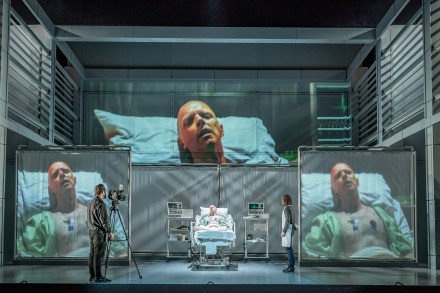
It’s quite a title sequence. Puccini swells on the soundtrack and words flash before your eyes. ‘Ecstatic!’ ‘Spellbound!’ ‘Passionate!’ ‘Dazzled!’ Champagne fizzes, ballerinas pirouette; for some reason Bryn Terfel hovers in the roof of the Floral Hall. The Royal Opera House is back in the game, bringing the uplift of live music-drama to an opera-starved Britain, and if you’re watching it online, the only remaining question is whether the offering on stage can possibly live up to the energy, colour and sheer affirmation of the Royal Opera’s on-screen intro. Don’t be silly. What we get is New Dark Age — a double bill that takes its name from its second half, the latest creation of director Katie Mitchell.

I pounded my car horn like a Neapolitan cabbie: ENO’s drive-in Bohème reviewed

The email from English National Opera was blunt: ‘Your arrival time is 18.25. If you arrive outside your allocated time slot, you may not be allowed entry.’ Perhaps, to habitual London drivers — if such people exist — negotiating the residential streets of Muswell Hill during a Saturday rush hour is all good clean urban fun. I couldn’t say. I just know that by the time I’d been marshalled into a parking space at Alexandra Palace, my no-claims bonus miraculously still intact, I was in no mood for an evening of updated and interval-free Puccini. Three hours later I was pounding my car horn like a Neapolitan cabbie.

Why imperfect operas like Don Carlo are more interesting than perfect ones

In the 62 years since I first heard and saw Don Carlo, in the famous and long-lasting production by Visconti at the Royal Opera, my feelings about it have grown ever stronger, both in passionate attachment and in critique. Imperfect operas, like other imperfect phenomena, can be more interesting than perfect ones, because they’re more thought-provoking, more enticing. The libretto, very freely based on Schiller’s play, was by two Frenchmen, and Verdi, eager to make a bigger splash than he had so far in Paris, made too much of one. The first performance, in 1867, ran so late that the members who lived outside central Paris missed their last trains, which were at 12.35 a.m. (Royal Opera and ENO: please take note).

The best recordings of Ravel’s L’enfant et les sortilèges

‘I don’t want to do my work. I want to go for a walk. I want to eat all the cakes… to shout at everybody!’ Which of us hasn’t felt like this at some point during the past ten weeks? The small child at the centre of Ravel’s L’enfant et les sortilèges speaks for us all as he rages against the restrictions of his suddenly enclosed and joyless world. Shut in the schoolroom until he finishes his homework, the little boy lashes out, spilling ink on the carpet, smashing the crockery, snapping the pendulum off the clock, tearing the wallpaper and terrorising the cat. But just as his tantrum is exhausted he finds that the tables have turned as the furniture, objects and animals that surround him come to life and scold him for his behaviour.

No one understood the ennui of lockdown better than Louis XIV and his courtiers

A few years ago I interviewed an eminent baroque conductor. Prickly and professorial, tired after a day of rehearsals, he batted question after question away until we landed on the subject of French baroque opera. No longer disinterested, now he was furious. He’d recently had a conversation with a major UK opera house, who had decided never again to stage anything by Lully, Rameau or Charpentier. Why? ‘It doesn’t sell.’ Since then we’ve had precisely one professional production of this repertoire in this country. It’s not the first time that English audiences have been suspicious of foreign imports. Back in the 18th century, when the cultural invasion came from Italy, feelings on this subject ran high.

It costs a lot of money to look this cheap: Metropolitan Opera’s At-Home Gala reviewed

Desperate times call for desperate measures. With the world’s opera houses currently dark, the New York Metropolitan Opera tackled the crisis the way it knows best — by assembling the most glamorous possible list of vocal megastars and presenting them at astronomical expense. But dollars can’t get around social distancing, and in lockdown even the greatest voice is only as good as the mic on a smartphone. Cue four hours of free-to-view party pieces from 43 of the world’s greatest singers, broadcast live from their homes without orchestra, without editing and without excuses.

The musical vaccination we all needed: ETO’s Cosi fan tutte reviewed

Anyone familiar with Joe Hill-Gibbins’s work will brace instinctively when the curtain goes up on his new Figaro. He’s the young British director who smeared the Young Vic with jelly and custard (The Changeling) and transformed it into a giant mud pit (A Midsummer Night’s Dream), covered the Almeida in blood and more mud (The Tragedy of King Richard the Second) and bathed his cast in a stomach-turning blend of salad cream, ketchup and baked beans at the Edinburgh Festival (Greek).So when the curtain rises on a white-walled corridor whose sterile purity is broken up only by four equally white doors you do mentally reach for a mop. But Hill-Gibbins’s plans for Figaro are surprisingly clean and surprisingly, well, dry.

A lost opera from the most powerful musician you’ve never heard of: La ville morte reviewed

Who was the most influential figure in 20th-century classical music? Stravinsky? Pierre Boulez? What about Bernstein or Britten? John Cage or Karlheinz Stockhausen? Powerful public figures all. But there’s a case to be made for a very different kind of character — less king than kingmaker, a musical éminence grise.With a Who’s Who of pupils that included Leonard Bernstein and Aaron Copland, Elliott Carter and Astor Piazzolla, Philip Glass, John Eliot Gardiner and Daniel Barenboim, Nadia Boulanger is the most powerful musician you’ve never heard of, ‘the most important teacher since Socrates’, as one composer only partly joked. Photographs show us a stern, spectacled, almost invariably elderly figure.

Eurotrash Verdi: ENO’s Luisa Miller reviewed

Verdi’s Luisa Miller is set in the Tyrol in the early 17th century, and for some opera directors that’s a problem. After all, they’re busy people. They probably never had time to read Wolf Hall, or to speak to any of the 100 million people worldwide who watched Game of Thrones. It’s self-evident to them that modern audiences will be unable to empathise with anything involving swords, castles or feudal hierarchies. Which is why they work hard to imagine new contexts that can make these hopelessly dated dramas address contemporary life as we live it, right here, right now. Counts, village maidens and men in ruffs? Baffling. But a clown strapped to a gyrating crucifix being stabbed with arrows by a group of dancers in flesh-coloured swimming caps and black fetish wear?

Are we going to have to start taking Calixto Bieito seriously? ENO’s Carmen reviewed

Calixto Bieito’s Carmen: three words to make an opera critic’s heart leap. Until quite recently, Bieito was the operatic provocateur of the century — the director who opened Verdi’s Un ballo in maschera with a row of men defecating on stage, and who presented Mozart with a side order of torture porn. Veterans of his Carmen told of fellatio and gratuitous nudity; it all sounded very promising. Add the malicious pleasure of seeing what unrevivable horrorshow ENO had lumbered itself with now — what steaming paella of body fluids it was about to dish up to an audience who’d paid for an evening of good tunes and sultry senoritas — and the review practically writes itself.

More misogynistic than the original: ENO’s Orpheus in the Underworld reviewed

It’s Act Three of Emma Rice’s new production of Offenbach’s Orpheus in the Underworld, and Eurydice (Mary Bevan) is trapped in the backroom of a Soho peep show. But that doesn’t really matter because Jupiter (Willard White), a cigar-toking love walrus in a silk bathrobe, has transformed himself into a fly and is about to ravish her, once he’s worked out the practicalities of doing so while three millimetres long. Eurydice’s more than game. ‘Zzzz, zzz,’ she sings, draping herself lasciviously over the mattress. ‘Zzzz, zzz,’ buzzes Jupiter, wings popping erect. Rice’s puppeteer darts about with a toy fly on a string, dressed in a black catsuit and (the killer detail) a beatnik beret.

More Grace Kelly than Grace Jones: Welsh National Opera’s Carmen reviewed

How do you take your Carmen? Sun-drenched exotic fantasy with a side order of castanets, or cool and gritty, sour with violence and politics? Jo Davies’s new production for Welsh National Opera seems unable to make up its mind. Sternly rejecting colour and fantasy, it then fails to commit to an alternative, leaving both its heroine and audience stranded in an unlovely theatrical no-man’s land. Programme notes place us in contemporary Brazil, in a favela painted in unvarying textures of brown and steel. But there’s little in the action to confirm this. Who are the soldiers that guard the compound with desultory inefficiency, and what is their relationship to the women they wolf-whistle and the children who run riot around their feet?

Why are so many operas by women adaptations of films by men?

Opera’s line of corpses — bloodied, battered, dumped in a bag — is a long one. Now it can add one more to the list: the broken, abused body of Bess McNeill. The heroine of Lars Von Trier’s uncompromising 1996 film is a curious creation. Striving against the restrictions of her austere, Presbyterian community on a remote Scottish island, she marries oil-worker and ‘outsider’ Jan. But when an accident on the rig leaves him paralysed, a promise to her husband and a bargain with God leads her into increasingly degrading and dangerous sexual encounters. Savant or innocent, saviour or sacrificial victim — Von Trier leaves it unclear.

Secret pleasures

Should a secret pleasure ever be shared? Spoiler alert: Susanna’s secret, unknown to her husband Gil, is that she smokes. And when, in his opera Il segreto di Susanna, Ermanno Wolf-Ferrari finally gets her alone with her longed-for cigarette, he makes it feel like nothing in heaven or earth could top the sensuous bliss of that first solitary drag. Clarinet and flute coil languidly upwards, the air hazes over with muted strings, and the celeste adds the little spasms of tingling pleasure that Wolf-Ferrari’s contemporary Richard Strauss saves for love at first sight. Salome has nothing on this. By rights, Il segreto di Susanna ought to carry a government health warning.

An overcooked blowout

Think back to when you were 12, and the sensation of re-opening your favourite book. (This is The Spectator; I’m assuming you were all bookish 12-year-olds.) The Silver Chair, perhaps, or The Phoenix and the Carpet — some fantastic alternative world, anyway, filled with characters who felt like old friends. The lumbering iron giants, powered by fire and water. The scary-funny vegetable-monster. The terrifying but magnificent queen, and her eerie batsqueak of sexual-ity. And of course, the bit where pillows turn magically into birds and flit about the room. This new project from the designer/director team Barbe & Doucet initially feels like being pulled into one of those beloved classics. We’re in a grand hotel circa 1900, and it looks fabulous.

Chilling out | 11 July 2019

Think of the children in opera. Not knowing sopranos and mezzos, pigtailed and pinafored or tightly trousered-up to look child-like, but actual children. There are Mozart’s Three Boys, Menotti’s Amahl, possibly Debussy’s Yniold and Handel’s Oberto and, if you stretch a point, Marie’s little son in Wozzeck. But that’s about it. Until, that is, you come to Benjamin Britten. It’s a rare Britten opera that doesn’t include a child. Whether it’s Grimes’s doomed apprentice, the chattering powder monkeys of HMS Indomitable, teenage vision Tadzio in Death in Venice, Tytania’s fairies or the watchful Miles and Flora, they are ever-present, but why?

Saved by the chorus

We’ve cried wolf with Handel. Ever since the modern trend began for staging the composer’s oratorios we’ve hailed each one in turn as the composer’s ‘most dramatic’. We’ve said it of Theodora, Saul, perhaps loudest (and most persuasively) of Jephtha. The trouble is that now, nearly 40 years since we last saw Belshazzar on an English stage, this magnificent drama of warring armies and nations, grieving parents and defiant children returns and we’ve spent all our superlatives. So you’ll just have to trust me when I say that it’s really quite good. A narcissistic sybarite of a king rules over a land bloated with corruption, rife with factions.

Send in the clown

The tears of a clown have often fallen on fertile operatic ground. Think of Rigoletto and I Pagliacci; or The Yeomen of the Guard, where mock-Tudor merriment turns to ash in the mouth of the jester Jack Point. But what if the composer himself is the buffoon? Jacques Offenbach was the court jester of France’s Second Empire, and if he’s still (inaccurately) regarded as an essentially frivolous talent, well, let’s be blunt: his 100-plus stage works do include sentient vegetables, scenes of mass flatulence and at least one opera in which the title role is taken by a performing dog.

Sunny delight | 6 June 2019

So it’s the start of the summer opera season at Wormsley and we’re sitting there in evening dress in the middle of the Getty estate, looking at a beautifully detailed replica of a rundown English village hall. It’s superbly done: the canvas chairs and austerity-drab paintwork in Paul Curran’s new production of The Bartered Bride could surely have been found in any number of church halls in this corner of the Chilterns, at least in the 1950s when this production seems to be set. And then, having gone to painstaking lengths to relocate this definitive Slav national opera to rural England, Garsington flips our expectations straight back at us and has it sung in Czech. Well, it wouldn’t be country-house opera without a few absurdities.

Oh, I do like to be beside the seaside

It was bucketing it down in Venice, yet the beach was heaving. Families, lovebirds, warring kids, a yappy mutt, all strewn across a sandy expanse, basking on beach towels. Balls were bounced, crosswords filled, timelines scrolled. Out of this idleness, songs would bubble up, light billowy airs — speaking now to suncream mundanities, now to geological anxieties — whisked up to our ears as if on a cooling breeze. We were in the Lithuanian Pavilion inside a dilapidated former military storehouse in a corner of north Venice, being given a god’s-eye view on an extraordinary new opera, Sun & Sea (Marina), by a Lithuanian trio: composer Lina Lapelyte, director Rugile Barzdziukaite, and writer Vaiva Grainyte.