Opera

A night at the circus

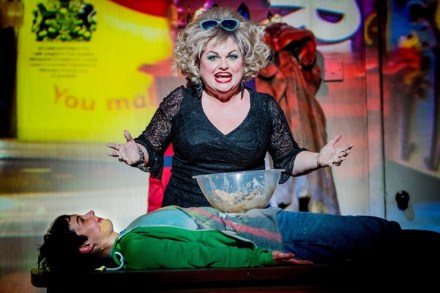
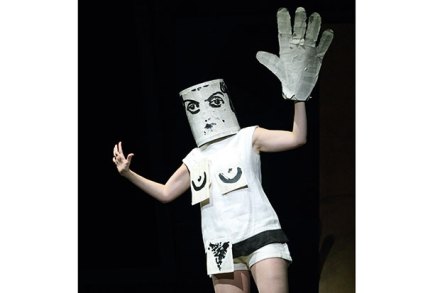
The Royal Opera’s latest production is Shostakovich’s The Nose and to paraphrase Mark Steyn, whatever else can be said about it, you certainly get a lot of noses for your money. Noses are tossed from character to character, noses kneel in prayer and noses stroll casually past in the background. They poke through curtains, mingle in crowds, and form a high-kicking, tap-dancing all-nose chorus line. At one point, a little tiny nose toddles unaided across the vast, almost-empty stage. Around them swirls bustling, multicoloured madness: bearded ladies and moustachioed cops, women dressed like dayglo matryoshka dolls, and a couple of pigtailed cartoon Chinamen who might have wandered in from an Ellen Kent production of Turandot. It’s a regular circus.

High and low

‘Besides feeble writing, there is a mixture of tragic-comedy and buffoonery in it, which Apostolo Zeno and Metastasio had banished from serious opera’. You can always rely on Charles Burney (the celebrated musicologist, who spent most of the 18th century being professionally underwhelmed) to find fault. But writing here about Handel’s Xerxes he has a point. The opera’s blend of lighter and more serious elements, though typical of Venetian opera, was by no means the norm for the Londoners who were its audience. They didn’t like it then, and nearly 300 years later it’s something we still seem to struggle with, as English Touring Opera’s latest season makes unexpectedly clear.

Sinful treat

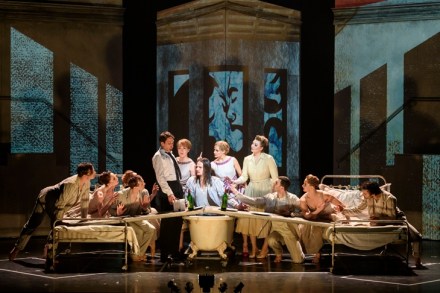
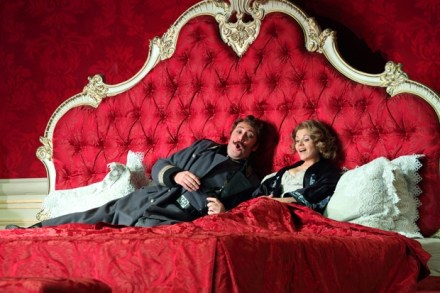
Shiny swags of gold cloth hang in front of the curtain before David McVicar’s production of Der Rosenkavalier, and that’s good. You want a touch of luxury in a Rosenkavalier. This is 20th-century opera’s great sinful, indulgent treat. Think of it and you think of Karajan and Schwarzkopf: huge creamy voices, silken Viennese strings, and New York Met production budgets. In truth, when Der Rosenkavalier gets under your skin, none of that matters. It’s not the glittering set pieces that turn out to be the real heart of the thing; not even the final Trio or the justly famous sequences in which the Marschallin ponders the transience of youth.

Hole in the heart | 6 October 2016

Richard Jones’s new production of Don Giovanni at ENO bears some passing resemblances to the opera as envisaged by its librettist and composer. Mainly, however, it goes its own way, refusing most of the time, especially at key moments, to listen to the music Mozart wrote, with consequences that Jones no doubt regards as ‘creative infidelity’. When we enter the auditorium we see a contemporary streetlight and a phone booth, straight out of Jones’s production of Siegfried at the Royal Opera 20 years ago. The curtain rises on a huge ‘Wanted’ poster of Christopher Purves, followed by a depressing series of bleak rooms, in one of which the Commendatore is bedding a prostitute and wearing white boxers, signifiers of nudity at ENO.

Losing heart | 29 September 2016

The subtitle for Mozart’s Così fan tutte may be ‘The School For Lovers’, but it’s as a school for directors that the opera is most instructive. From four lovers and two different romantic pairings, the composer spins a parable whose moral is as elusive as its morals. Faced with so much ambiguity (and so little political correctness) directors tend either to sand down the rough edges with laughs, or fling a capacious concept over the whole lot. It says something about the awkward profundity of this most inscrutable and affection-resistant of the Mozart-Da Ponte collaborations that it can take it. It says even more that you so rarely see an outstanding production.

Pole apart

Alas, poor André Tchaikowsky. A survivor of the Warsaw Ghetto, with an assumed name that probably did his musical career as much harm as good (he was born Robert Andrzej Krauthammer), he died of cancer in 1982 shortly after his only opera, The Merchant of Venice, was rejected by ENO. He’s remembered today principally for bequeathing his skull to the Royal Shakespeare Company for use as a prop, in which capacity he starred alongside David Tennant in Hamlet in 2008. That skull had a tongue in it and could sing once.

Super Norma

The Royal Opera has opened the season with a triumph, and in one of the most difficult of operas, Bellini’s Norma. Not only is the work itself extraordinarily demanding on its three leading singers, but it is the one opera which is now so indelibly linked to one singer that all later performances are defined by whether they are in the same mould or whether they are resolutely different. One can’t envy listeners who have never heard Callas, in one or another of her many recordings of Norma, because it is so overwhelming an experience, but it would make life less disappointing than it already tends to be. I preferred not to go to Bartoli’s recent performance in Edinburgh, having heard her interpretation on CD.

Saintly sins

They say that the devil gets all the best tunes, and on the basis of this week’s opera-going it would be hard to disagree. Performances by Cape Town Opera and Opera Rara turned their attention on two historical icons: South Africa’s anti-apartheid campaigner and president Nelson Mandela, and ancient Assyria’s murderous and would-be incestuous queen regent Semiramis. No prizes for guessing who came out on top. When it comes to art, evil takes it nearly every time. Who wouldn’t choose The Rake’s Progress over The Pilgrim’s Progress, Don Giovanni over Don Ottavio, sex over sanctity? For a good man, Nelson Mandela has inspired a lot of really, really bad art.

My idea of fun

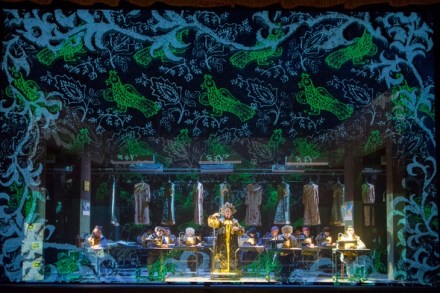
We don’t really do operetta in Britain these days — and at this stage in the game, I don’t really need to tell you why, do I? We’re simply too philistine in these benighted islands, goes the argument; too coarse, too provincial, too clodhoppingly Anglo-Saxon ever to grasp the ineffable lightness and sophisticated wit of Offenbach, Lehar and Strauss. So anyway, here’s Offenbach’s Croquefer, or The Last of the Paladins: a one-act comedy set in the time of the Crusades, which climaxes with the leading characters belting out a stormy ensemble as they succumb to a collective attack of explosive diarrhoea. Basses heave; the brass section emits ripe, flatulent parps. There’s your Gallic sophistication for you, right there.

What’s love got to do with it?

Tchaikovsky’s The Queen of Spades is probably his greatest opera, certainly the one in which his characteristic strengths are on display. Pondering on them inevitably leads one to think about what the operas lack, too, and it turns out be quite a lot. Unlike the finest opera composers, of whom there are regrettably few, he can’t create complete characters: what he is interested in is characteristics, especially — or perhaps only — obsessions, even if the obsession, as with Eugene Onegin, is with not being obsessed with anything, until close to the end.

Dorset’s winning formula

Dorset Opera seems to receive far less coverage than the rest of the country-house summer shows, although it is in most respects well up to the standard of any of them except Glyndebourne, which is in a category, social and artistic, of its own. The Dorset productions take place in the Coade Theatre of Bryanston School, and are the result of a brief but what must be an incredibly intense period of preparation, with some big names in the major roles, and the smaller parts and chorus taken by a large collection of young singers who are strenuously trained for the week-long rehearsals. I like going on the last day, when one opera is performed at 2 p.m. and another at 7 p.m.

Snakes and ladders | 4 August 2016

In Luis Buñuel’s 1962 film, the ‘exterminating angel’ of the title is a mystery illness. A debilitating virus — much worse even than man flu — that attacks the social immune system and shuts down your ability to act, to think, to be. It prevents you from remembering how to behave at middle-class dinner parties. You arrive at a friend’s house twice. You forget to leave. Open doors become terrifying, impassable geometric objects. Your handbag contains not keys but feathers and chicken legs. Occasionally it kills. The bug is Buñuel’s metaphor for a society gripped by cowardice. Composers can catch it. Not Thomas Adès, though. There is bravery (insanity?

French connection | 28 July 2016

It takes a particularly wilful wit to alight on Berlioz’s Béatrice et Bénédict as the perfect operatic nod to a Shakespeare anniversary. To walk past Verdi’s Otello, Falstaff and Macbeth, to pass over Purcell’s Fairy Queen, Gounod’s Roméo et Juliette and Bellini’s I Capuleti e i Montecchi and instead opt for this curiously and idiomatically French piece of musical flummery, in which Shakespeare’s Much Ado About Nothing finds itself stripped of any sour notes and whipped up into a sugary dramatic froth, is bold indeed. If it weren’t for the revival of Britten’s A Midsummer Night’s Dream, opening at Glyndebourne later this season, it might even look a bit like taking le piss.

On full beam

What’s the best first opera for a sceptical adult first timer? It’s a favourite topic among opera buffs, and once you get past the assumption that novices need to be spoon-fed familiar tunes, the consensus — slightly surprisingly — often settles on Jenufa. Surprisingly? Well, yes: Janacek still isn’t guaranteed box office (maybe people conflate that spiky Czech name with a mental picture of Eastern bloc bleakness). In fact, this is a piece that can upend every lazy prejudice about the form: a concentrated plot, a concise running time, and no heroes or villains, just believable characters with painfully human failings. And all set to music that never judges, never sentimentalises: simply cuts raw and direct to the heart.

First thing’s first

Leonore is the first version of Beethoven’s Fidelio, and Stephen Medcalf thinks it’s better. ‘What Leonore gives us is more discursive but more dramatic,’ he declares in the programme of this Buxton Festival production. Well he would, wouldn’t he? He’s the director. You’d hope he’d have some faith in the piece. And what’s undeniable is that with Leonore you get more Beethoven for your buck than in Fidelio. True, there’s no ‘Abscheulicher!’ and no glowing declaration of universal brotherhood from the Minister.

Fifty shades of grey

Grey men in grey overcoats walking through grey architecture. If you had to pick an image to reflect the current mood, the prevailing fashion in opera productions, this would be it. We may have outgrown the overtly Nazi settings of a few years back, but stepping into their highly polished boots are a whole platoon of non specifically fascist, 20th century exilic fantasies — all brutality, brutalism and barbed wire. Glyndebourne’s Poliuto, the Royal Opera’s Guillaume Tell, Idomeneo and Nabucco, even English National Opera’s Force of Destiny, the list goes on, and now boasts a new member in David Bösch’s Il trovatore. At least Bösch isn’t going gentle into that all obliterating fascist night.

Light and shade | 30 June 2016

Comedy and tragedy sit close beside one another in Mozart’s operas. Whether it’s the grinning horror of the Così finale — lovers joined, perhaps for ever, to the wrong partners — or the violence and mental instability so barely contained in the flimsy comic fabric of La finta giardiniera, there’s a continuum of emotion that belies the easy binaries of opera buffa and opera seria. Two new productions explore the shifting light of the composer’s chiaroscuro world, letting sunshine into the near-tragedy of Idomeneo and glancing into the darker corners of Le nozze di Figaro.

The eyes have it | 23 June 2016

Tchaikovsky knew what he thought of the title character of his Eugene Onegin. ‘I loved Tatyana, and was furiously indignant with Onegin who seemed to me a cold, heartless fop,’ he wrote to a friend; and directors, by and large, have been happy to leave it at that. And why not? Dishy but emotionally unavailable Regency dandies have been a growth area in recent years — blame it on Colin Firth, if you like — and Eugene Onegin is probably the standard repertoire opera you’re least likely to see subjected to a directorial updating, in the UK at any rate. Michael Boyd’s new production at Garsington certainly doesn’t update anything.

Wardrobe malfunction

It is at the Coliseum that I have seen the most wonderful Tristan and Isoldes of my life, both of them under Reginald Goodall, in 1981 and, even more inspired, in 1985. Neither was particularly well produced, but nothing stood in the way of the musical realisation, as complete as I can ever imagine its being. After last year’s quite glorious Mastersingers, I had the highest hopes of Edward Gardner’s conducting of this new production, but they were dashed — in the case of the music, not drastically; but the idiocy of the costumes and the production is so gross that no performance could survive it. The settings are fashionably by Anish Kapoor, but though they aren’t repulsive they do nothing to help our understanding of the drama.

No laughing matter | 9 June 2016

Rossini is the meat-and-two-inappropriately-shaped-veg of summer opera; he’s the wag in the novelty bow tie, the two satyrs shagging enthusiastically among the lupins and lobster on the cover of this year’s Glyndebourne programme. His comic bel canto frolics are the natural soundtrack to this off-duty opera-going, a champagne-perfect combination of frothy plots and fizzing coloratura. So why are they so hard to pull off? Perhaps it’s the pressure of expectation. It has been more than 30 years since Glyndebourne last staged Il barbiere di Siviglia, and hopes were high for Annabel Arden’s new production. For the first half-hour it looks as though they’re going to be met.