More from The Week

The right stuff | 29 September 2007

Ostensibly, Gordon Brown’s first Labour conference speech as Prime Minister on Monday was grandly non-partisan: there was not a single mention of the Tories or of David Cameron. In practice, the Conservative party generally, and Mr Cameron specifically, were present in every line. Though presented as a lofty civic oratory by the father of the nation, this was in fact a brutally partisan speech by an expert Scottish machine politician. Everything was achieved by implication, but heavy implication. First, Mr Brown presented himself as a sort of Sarkozy from Fife, translating ‘love France or leave it’ into an extended discourse on playing by the rules, British values, the need for migrants to speak English and ‘British jobs for British workers’.
Tamzin Lightwater’s conference diary

Sunday: All eyes on the opening ceremony for what I’m sure will be a truly memorable performance by world-renowned professional speechmaker William Hague. Owing to his impressive array of commitments on the premier after-dinner circuit, we don’t get to hear his celebrated humming routine for free too often these days, so book your seats in the hall early for a barnstorming display of one-liners (and something to do with foreign policy). Theresa May introduces ‘an inspiring presentation of our Social Action projects’. Bit of a problem with this one, I’m afraid. You would think candidates in marginal seats might be grateful for the chance to take their minds off leafleting by renovating the odd village hall in the name of Being the Change.

There may be trouble ahead

Extraordinary measures are sometimes necessary to quell the madness of crowds. When Diana, Princess of Wales’s mourners threatened to vent their angry grief on the institution of monarchy itself, it became necessary for the Queen to speak directly to her people. Extraordinary measures are sometimes necessary to quell the madness of crowds. When Diana, Princess of Wales’s mourners threatened to vent their angry grief on the institution of monarchy itself, it became necessary for the Queen to speak directly to her people. As the run on Northern Rock gathered momentum on Monday and panic-stricken depositors threatened to vent their anger on the government, there were only two possible responses.

Sir Menzies Campbell will either be sacked or will end up in the Cabinet

There is just one consolation for Sir Menzies Campbell as he prepares for his second and probably last conference as Liberal Democrat leader: they will not come after him in Brighton. It is too late, now, to knife the leader. Gordon Brown could call an election at any moment, and there is no time for regicide. Sir Menzies has been saved by the sheer desperation of his predicament. So much fun has been had blaming David Cameron for Labour’s lead in the opinion polls that few have looked closely at where Mr Brown’s new voters are really coming from. The Conservatives have, in fact, held on to their voters reasonably well. The Lib Dems, by contrast, have suffered an exodus.

Vote for honesty

The long quest to find a purpose for the Lib Dems is the modern equivalent to the probably apocryphal story about the child asking his mother about Lord Randolph Churchill: ‘What is that man for?’ The long quest to find a purpose for the Lib Dems is the modern equivalent to the probably apocryphal story about the child asking his mother about Lord Randolph Churchill: ‘What is that man for?’ As the third party meets in Brighton for its annual conference, the heart sinks at the prospect of more debates on tedious political marginalia. But Sir Menzies Campbell should abandon his present reservations and heed those of his colleagues now encouraging him to push for a referendum on the EU reform treaty by joining in the parliamentary ambush of the ratification process.

Change must still be the message

The great paradox of the Tory party is that its predicament in recent years reflects not failure, but success. For 18 years it was in government, for 11 of them under one of the most influential prime ministers in history. The Conservatives dominated the 20th century: Austen Chamberlain and William Hague were the only two party leaders in those triumphant 100 years not to reach No. 10. So it is scarcely surprising that the Tory movement, in its DNA, believes the default position in this country to be a Conservative government.

Politics | 8 September 2007

It’s not hoodies. It’s not single mums. It’s not even jittery City whizz kids down to their last ten million. No, it’s lefties we should be furrowing our collective brow about. We shouldn’t worry about the threat they pose to society (even though successful countries can survive anything except civil war and socialism). It’s the fact that they appear to be suffering a crisis of faith. It is a crisis which disproves the claim that while the Right won the economic arguments, the Left has at least won the social ones. And it helps explain why our Labour Prime Minister demanded ‘British workers for British jobs.’ And why the question should be not, ‘Why is David Cameron lurching to the right?’, but, ‘Why is everybody?

The right mission

Tony Blair — remember him? — was better at diagnosis than cure. ‘I think most people would say that in virtually every aspect of their life things are better than they were 30 or 40 years ago,’ he told the Sunday Telegraph in November 2005. Tony Blair — remember him? — was better at diagnosis than cure. ‘I think most people would say that in virtually every aspect of their life things are better than they were 30 or 40 years ago,’ he told the Sunday Telegraph in November 2005. ‘This whole question of respect and law and order, though, is the one area where you’d say we’re probably more fearful, and that is because we can’t deal with these types of new crime in the old ways.

Global warning | 1 September 2007

He who would read newspapers must expect to spend his days in the darkest despair, for they contain nothing but war, murder and medical advice. Popular wisdom, however, tells us that every cloud has a silver lining: though my experience of life leads me to conclude that, in general, the relationship between clouds and silver linings is exactly the other way around (I think Buddhists would agree). Be that as it may, I found a real reason for optimism the other day while reading the French daily, Liberation, that started out Maoist and ended up in the hands of Edouard de Rothschild. As everyone knows, the population, thanks to its inability to control itself, and indeed its hostility to the very idea that it ought to control itself, is growing ever fatter.

Global Warning | 25 August 2007

The historian Sir Lewis Namier once said that in a drop of dew could be seen all the colours of the rainbow, presumably as a reply to those who accused him of writing more and more about less and less. However, it is definitely true that in the smallest interactions can be seen the temper of the times: in our case, the bad temper of the times. I was waiting for my wife in a car park in France recently when I noticed that the car next to me was British. In the car, door open, was a little boy of eight or nine. He was extremely handsome, and had a heart- melting smile. While his parents went shopping — for fast food as it turned out — he had been entrusted to the care of a man, evidently the friend of his parents, of about 40 and of quite transcendent vulgarity.

A travesty of justice

On Tuesday, Jack Straw, the Justice Secretary, claimed that, in the case of Philip Lawrence’s murderer, Learco Chindamo, ‘we were misled by the system’. That is true: it is monstrous that the 26-year-old Chindamo, who stabbed the head teacher to death in December 1995, will now escape deportation to Italy, the country of his birth. On Tuesday, Jack Straw, the Justice Secretary, claimed that, in the case of Philip Lawrence’s murderer, Learco Chindamo, ‘we were misled by the system’. That is true: it is monstrous that the 26-year-old Chindamo, who stabbed the head teacher to death in December 1995, will now escape deportation to Italy, the country of his birth.

How Dear Bill became editor

In 1974 the Daily Telegraph was teetering on the edge of unaccustomed conflict. Maurice Green’s long and successful reign as editor was ending at the very moment when the paper’s editorship was rising in significance. In 1974 the Daily Telegraph was teetering on the edge of unaccustomed conflict. Maurice Green’s long and successful reign as editor was ending at the very moment when the paper’s editorship was rising in significance. The Tories were to lose two elections that year. A challenge to Ted Heath’s leadership, probably from Keith Joseph, already looked inevitable. How would the Telegraph lean? Green himself was a premature Thatcherite who as early as 1973 told friends she would be the next Tory leader. But who would succeed Green?

Brown’s magic is a trick

As he contemplates the surf on his Breton holiday beach this weekend, David Cameron has an opportunity to reflect on how swiftly the tides of politics can change. Just three months ago the Conservative leader enjoyed record gains in the local elections, winning more than 800 seats in a nationwide test of public opinion and recording general-election-winning levels of support. That result was the culmination of an 18-month period during which Mr Cameron had changed his party, modernised its policies and maintained a solid opinion-poll lead over Labour, an achievement which had eluded the Tories for more than 13 years. Since then, however, voters have cooled towards Mr Cameron, and warmed towards Gordon Brown. As a new Labour leader, Mr Brown has made an impressive start.

Riviera notebook

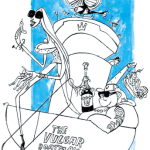
The shiny new ‘Vodka Palaces’ lie scattered across the bay of St Tropez like the discarded toys of a spoiled child. The shiny new ‘Vodka Palaces’ lie scattered across the bay of St Tropez like the discarded toys of a spoiled child. Each year they seem to grow bigger, as do the gorgeous girls who cluster on deck and throng the boutiques and clubs — taller anyway. Many of the boats are owned by Russian billionaires — how did they become so rich so fast? — and it seems that three or four dazzlers hang on the arm of each stocky oligarch. What did the Russian government feed their pregnant women and toddlers two decades ago that made these women sprout into tall and skinny beanstalks?

Global warning | 18 August 2007

Do I grow cleverer with age, or does the world grow more stupid? Today, for example, I read what a police spokeswoman said after a man on a motorbike had been shot dead on the M40 motorway. The police, she said, were not treating it as a case of road rage; they were treating it as a case of murder. So from now on killing someone who annoys you while you are driving — a pedestrian, shall we say, or an old lady puttering along who holds you up on your way to a supremely important meeting — is not really murder, but an understandable and therefore excusable response to frustration, at least in the merciful eyes of the police, who will treat the victim, that is to say the poor sufferer from road rage, with all due consideration.

Global warning | 11 August 2007

You — or perhaps it would be more accurate to say I — can’t get away anywhere from crime and criminality. You — or perhaps it would be more accurate to say I — can’t get away anywhere from crime and criminality. I was walking down a country lane in one of the most beautiful shires of England. The sun was shining, the birds were singing, the lambs were gambolling in the fields, the trees were decked out in the tender green of spring, my dog was at my side: for a moment, I felt almost glad to be alive. Then I met the local magistrate, who was also out walking his dog. When two men in their late fifties meet, their first talk is of the wickedness — the unprecedented wickedness — of youth (lament being the consolation of age).

Politics | 11 August 2007

Brown has handled the crises well, but let’s not forget he is to blame for many of them There has been something almost Biblical about the challenges which Gordon Brown has had to contend with since moving into 10 Downing Street. It started with the curiously unseasonal weather, which plunged London into darkness one July lunchtime. Then floods which submerged Middle England, and now livestock pestilence, albeit at just two farms. There have been no locusts or frogs (yet), but it already seems as if the gods are testing the Prime Minister’s crisis-management skills. They found Mr Brown ready, waiting for them. He realises that crises mean showtime in modern politics, and that how a leader reacts to them shapes his reputation.

The disease and us

Given the boost in the opinion polls enjoyed by Gordon Brown following the recent floods, a cynic might wonder whether the outbreak of foot-and-mouth disease in Surrey has been staged in order to give the Prime Minister an excuse to break off his holiday in Dorset and earn brownie points by taking control of a national crisis while David Cameron (who has since called off his own holiday) was lounging around on a Breton beach. That, we concede, is far-fetched, but it is not wrong to wonder whether the nation’s reaction to foot-and-mouth — which is rarely fatal in animals and causes no human symptoms whatsoever — is not a little out of proportion to the threat it poses.

Brown’s Darfur triumph is also his test

Those who have exchanged fierce views on the invasion of Iraq have a fresh challenge this week: how to react to the UN resolution, tabled by Gordon Brown and Nicolas Sarkozy with support from George W. Bush, to send 19,000 peacekeeping troops to the Darfur region of western Sudan. This is one deployment of foreign troops, we trust, of which all but the most ardent pacifist or isolationist will approve. Over the past four years 200,000 Sudanese have keen killed in rebel fighting and a further two million turned into refugees. If this is not a humanitarian disaster on a scale which justifies international intervention, it would be difficult to conceive of one which did.

Reasons for Mr Cameron to be cheerful

Gordon Brown will not holiday abroad this summer. Not for him the allure of a Tuscan palace or the sunbeds of Sharm el-Sheikh. The Prime Minister has instead created perfect happiness inside his home in Fife: a room wired up to the 10 Downing Street computer system where he can monitor the government he now controls. He intends to do nothing else this month, save for a quick visit to the south coast. Besides, he already seems well on his way to his main summer destination — the implosion of the Conservative party. In the space of a few weeks the opinion polls have turned around, and Labour has a seemingly impregnable nine-point lead.