From the archives

Chemical weapons

From ‘War by Poison’, The Spectator, 8 May 1915: By the consent of all men who are not savages, the use of poison is ruled out in war, and has been prohibited by custom for centuries. And war by poison is being practised not only in Europe; in German South-West Africa the Union troops, as we are informed by a Colonial Office Paper, have come across many wells poisoned with arsenic… ‘Poisoned wells’! The very phrase calls up visions of warfare with the wildest and most fanatical tribesmen in the world, but not with the inhabitants of the most highly organised country in Europe.

An empire for Islam

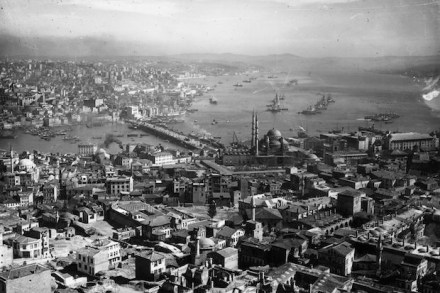
From ‘The Khalifate’, The Spectator, 1 May 1915: It seems that the Ottoman Empire is likely to crumble away, and in that event, whether it happens soon or late, the question of the Khalifate will cause many searchings of heart to the Mohammedan world. In an intimate and most important sense Britain is concerned in this matter. The spiritual security and satisfaction of Moslems vitally concern the British Empire.

Florence weeps

From ‘Soldiers of Italy’, The Spectator, 24 April 1915: It is winter in Florence. The sun shines, but snow lies low on Monte Morello, and the tramontana blows cold as ice, out of a piercingly blue sky. The streets and squares are crowded. Bells are ringing, bands playing, troops marching. The soldiers are coming back from Tripoli. There is to be a reception at the station. A burst of cheering, a scattering of flowers, a blare of music. Here they come. Bronzed, hardy-looking men these, in their war-worn uniforms, swinging along among the crowds and flowers. But the welcome is not altogether joyous. There are wet eyes amongst the onlookers. Wives and mothers whose men are not among the marching soldiers turn away to hide their tears.

Am I still an Englishman?

From ‘Some reflections of an alien enemy: the contradiction between being and feeling an Englishman, by a Czech’, The Spectator, 17 April 1915: What I most regret having lost is my previous unawareness of there being any difference between me and Englishmen. In saying we, I used to mean we English people; somehow or other I find myself now compelled to distinguish between me, a foreigner, and you, English people. Quite proper that it should be so; yet at the same time I feel as though I had lost my birthright. The disappearance of my instinctive sense of identity with my fellow-men, quite irrespective of their nationality, fills me with sadness. An invisible, yet for all that quite tangible, barrier seems to have arisen around me.

Before Dad’s Army

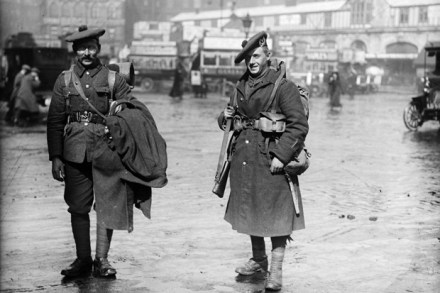
From ‘Our Home Guards’, The Spectator, 10 April 1915: There is nothing of the national picnic; or of playing at soldiers about the Home Guards. Those who enter the corps mean business, and not a good time in the open air under a series of military aliases. Some of the special features of the movement are most interesting. Mr Harris in his letter mentions the example of Bradford. In this city the Volunteer movement has created something like a social and moral revolution. It has given the city a corporate military feeling akin to that which existed in the great Flemish towns in the 14th century.

Sober into battle

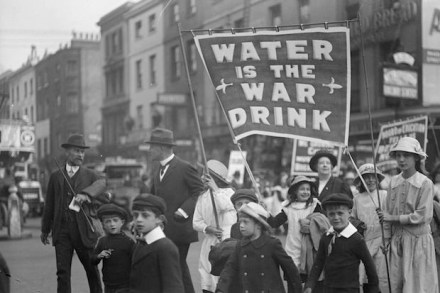
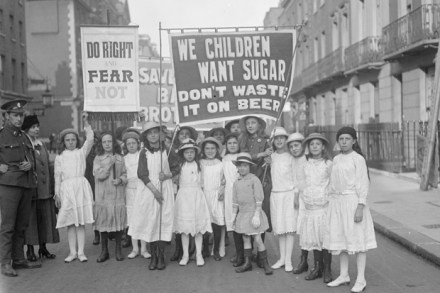
From ‘News of the Week’, The Spectator, 3 April 1915: The chief obstacle to prohibition, as we point out elsewhere, is not the temporary interference with individual liberty. It is the difficulty of how to deal with the great trade and industry which will be rendered partially or temporarily derelict by prohibition. But here ‘boldness, boldness, and again boldness’ is the only possible solution… We must never forget that the cutting off of expenditure upon liquor will very soon greatly increase our financial resources, not merely from indirect saving, but from the greater all-round efficiency which will come from an undrugged nation.

Better off out

From ‘President Wilson’s Mistake’, The Spectator, 27 March 1915: The Americans have a world of their own in which to take sides physically, and are perfectly entitled to say to Europe: ‘You must do your own police work and restrain your own malefactors. Europe must not expect from us more than abstract sympathy in regard to a European struggle.’ On the whole, and in spite of ex-President Roosevelt’s generous and chivalrous attitude, we are strongly inclined to think that this is the right attitude for Americans to adopt. At any rate, it is the attitude that they do adopt.

What the censors miss

From ‘Unofficial News’, The Spectator, 13 March 1915: The exclusion of war correspondents from the firing line has greatly reduced the volume of unofficial news available for the enlightenment of the general public. What remains, moreover, has to run the gauntlet of the Censorship. How some of it manages to get through is a mystery which we cannot pretend to fathom. Fortunately all that appears on the tape does not always appear in the newspapers.

Officers’ off hours

From ‘News of the Week’, The Spectator, 13 March 1915: We are glad to note that officers in uniform have been forbidden to visit night clubs in London. The gambling night clubs have ruined several young officers, and the dancing clubs are almost quite as undesirable in these times. But why does the order apply only to officers in uniform? Surely, if discipline requires that officers should keep away from these places, they ought to be forbidden to go whether in uniform or in ordinary clothes.

Too short for the trenches?

From ‘The “Willing” Badge’, The Spectator, 6 March 1915: A final ground for giving badges to those who have offered themselves and been rejected must be mentioned. Under any scheme for the presentation of badges a register should be kept giving in general terms the ground on which each man was rejected — namely, medical reasons, such as heart weakness, and so on; physical defects, as, for example, some small deformity or some defect of vision; or, again, some such ground as inability to reach the standard of height or the standard of chest measurement. In the last two cases it may well be that the government will come to see that after all small men can fight and march quite as well as big men, and endure hardship even better.

From the archives | 26 February 2015

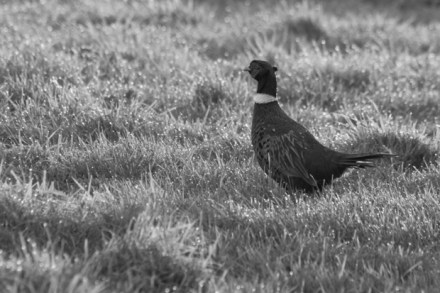
From The Spectator, 27 February 1915: Observers of birds have been much interested by the evidence, which seems to be fairly satisfactory, that pheasants in as remote a part of England as Westmorland were disturbed by the firing in the North Sea on the day of Sir David Beatty’s action and showed many signs of excitement. The first evidence came from the Revd W.M.L. Evans, of Busby, Lincolnshire, who related in a letter to the Times how on Sunday morning his clerk met him with the announcement ‘There be rare goings-on in the North Sea the morn.’ When asked to explain the clerk said ‘The pheasants is all over the place with their fuss’; and many other villagers confirmed this statement.

From the archives | 19 February 2015

From ‘The psychology of drill’, The Spectator, 20 February 1915: One is tempted to divide all men under drill into two classes — the precipitate and the tardy. Every one who has listened to a drill instructor’s words knows that the first part of a command is cautionary. For instance, in ‘Right-turn’ there is a pause between the two words, and the movement to the right takes place on the word ‘turn’. Some men cannot prevent themselves from moving at the word ‘right’. Others are late on the second word. Surely this tendency must correspond to some constitutional temperament or innate mental quality.

From the archives | 12 February 2015

From ‘Prohibition in Scotland during the War’, The Spectator, 13 February 1915: At present the economic waste caused by drunkenness in Scotland is enormous. We are not going to attempt to calculate how many hours in the working year are lost through the inefficiency caused by alcohol, but unquestionably in the aggregate the total is huge… even if when the war is over Scotland gives up prohibition and once more flings open the doors of the public-house, she will have done herself a great deal of good by the temporary prohibition. Thousands of men and women throughout the length and breadth of the land will have realised how perfectly easy it is to get on without the consumption of alcohol.

From the archives | 5 February 2015

From ‘News of the Week’, The Spectator, 6 February 1915: Germany proclaims a paper blockade of all the British coast, to be carried out, when possible, by submarines! This new act of war is really too childish for discussion. It means no fresh development whatever. The Germans, as before, will try to destroy our ships with submarines and by sowing more mines, and they will doubtless have one or two small successes. The main course of trade will not, however, be in the least interfered with. As regards our food supplies, we are a thousand times more alarmed by the Labour Members’ menacing motion for fixing a maximum price for wheat, and by the government’s willingness to inquire whether it would not be a good thing to prevent the free access of corn to our shores.

From the archives | 29 January 2015

From ‘Reprisals’, The Spectator, 30 January 1915: There has been a tendency among some newspapers, and perhaps still more among private persons, to demand that the murder of non-combatants on the East Coast by German ships of war and Zeppelins should be visited with reprisals. ‘Murder is murder,’ they say in so many words, and should be treated as such. If we do not punish the Germans, no one else will or can, and the murderers will go free… The argument bears a strong likeness to arguments used over and over again in history. At the beginning of the Indian Mutiny it was firmly believed by most people — some excellent men among them — that reprisals alone would teach the mutineers the lesson they required.

From the archives | 22 January 2015

From ‘Economic quackery’, The Spectator, 23 January 1915: Ever since the war began there has been a tendency to rely upon the government, instead of relying upon ourselves and upon the operation of economic laws. The political mischief resulting is the establishment of what is virtually an uncontrolled Cabinet autocracy. The economic mischief, though it has already made itself evident in one important particular, may only be realized years hence. The instance to which we refer is the case of sugar. The public and the government worked themselves up into a panic at the beginning of the war over the price of sugar, with the result that Mr McKenna was permitted to gamble in sugar with many millions of the nation’s money.

From the archives | 15 January 2015

From ‘Music and the war’, The Spectator, 16 January 1915: The war, so far, has not thrown up any supreme musical product. It would be an affectation to pretend that the taste of the average British soldier is elevated. As in the Boer War, his repertory is confined to music-ball tunes and songs of an extreme and lugubrious sentimentality… The average ‘Tommy’ does not sing folk-songs or graceful chansons populaires, e.g., ‘Meunier tu dors, ton moulin va trop vite’, like our allies, but at least he does not submit to dictation from above: be chooses for himself.

From the archives | 8 January 2015

From ‘Lord Curzon’s speech’, The Spectator, 9 January 1915: We are glad to record, though in no way surprised to find, that Lord Curzon takes a very serious and very clearly defined view of the duties of the Opposition during a period of national crisis. He recognised that part of these duties in war time can never, as in peace, be the effort to substitute one set of politicians for another in the work of government. On the contrary, in war the support of the King’s Government in all the measures which they may think necessary for ensuring the safety of the country becomes the essential duty of the Opposition. But while this is so, it is in no way to be desired that the Opposition should forgo its function, nay, obligation, of criticism...

From the archives | 1 January 2015

From ‘News of the Week’, The Spectator, 2 January 1915: The first German aeroplanes which have visited us since the beginning of the war appeared on Thursday and Friday of last week. On Thursday week, about eleven o’clock in the morning, an aeroplane circled over Dover and dropped a bomb, which fell in a garden and did very little damage. British aircraft started up from the ground in pursuit, but the German aeroplane disappeared in the mist over the sea, after having been visible for only a few seconds.

From the archives | 11 December 2014

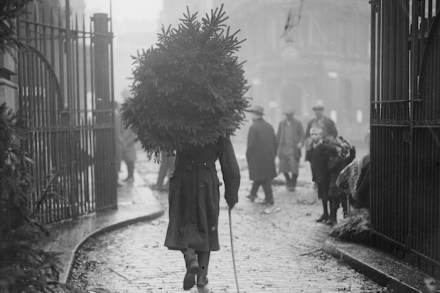
From ‘The Vantage Point of Peace’, a leading article in the Spectator of 26 December 1914: We are not going to write a Christmas article on palm boughs and olive branches and the Angel of Peace. Not only is there no peace in sight for the world at the moment, but any talk of peace before our enemies are beaten, or even half beaten, and while their ambition, their hatred, and, if you will, their folly are at full blaze, could only tend to prolong the war. What we and our allies have got to let the world know just now is that, in General Grant’s words, altered to suit the season, we pro- pose to ‘fight it out on these lines all winter’ — yes, and all spring and all summer and all autumn, too, if necessary.