Features

‘People can’t take a joke these days’: Michael Heath on wokeness, The Spectator and turning 90

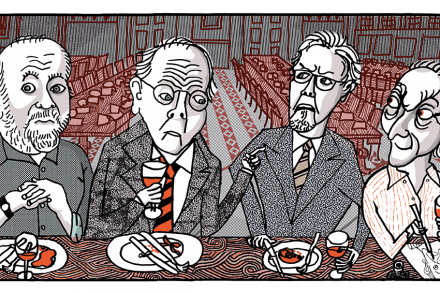
When I joined The Spectator, the office was in Bloomsbury, in a four-storey Georgian house, and the further down the building you went, the more stylish, the more Spectator (I thought), everything became. On the top floor, blinds drawn, sitting in the half-dark, was Kimberly Fortier, the American publisher, often in long meetings with media alpha males. She was married to the publisher Stephen Quinn and having an affair with the home secretary, David Blunkett, but was always looking to widen her portfolio. One floor down was Boris Johnson, then editor, mostly immersed in meetings of his own with assistant editor Petronella Wyatt. We’d sometimes find him on the landing, staring mistily into the middle distance. ‘Petsy looks like a Bond girl. Doesn’t she look like a Bond girl?

Satanic verses: the origins of Roman Catholic black metal

In his youth in the early 2000s, Emil Lundin became obsessed with the idea of recording the world’s ‘most evil album’. The lanky, long-haired Swede formed a black metal band and set to work. He faced an immediate obstacle. In making history’s most nefarious musical creation, he could hardly use Swedish, with its sing-song tones. English was also out of the question: he didn’t want to sound like Abba. That left Latin, the native tongue of the occult and, it is said, of demons. In a quest for suitably devilish lyrics, he pored over arcane texts. That led him to Latin editions of Sayings of the Desert Fathers – bad-ass early Christian monks – and St Augustine’s Confessions.

How the occult captured the modern mind

The British science-fiction writer Arthur C. Clarke, author of 2001: A Space Odyssey, proposed a ‘law of science’ in 1968: ‘Any sufficiently advanced technology is indistinguishable from magic.’ Clarke’s proposition had a quality of rightness, of stating the obvious with sparkling clarity, that propelled it into dictionaries of quotations. The timing was perfect: Concorde would soon be flying over rock festivals packed with hippies obsessed with ‘magick’. Naturally Clarke’s readers understood the difference between aerodynamics and sky gods.

Hex appeal: the rise of middle-class witches

In King James VI of Scotland’s Daemonologie, written in 1597, he vigorously encourages witch-hunting and, in particular, the tossing of witches into the sea. Only the innocent would sink. As a way of identifying witches, it was clear and presumably efficient. These days, we have no such clarity. But witches walk among us. I’m not talking about women in black pointy hats, but something far scarier: the middle-class witch. In the past, she might have been called a depressive, a spinster or a divorcée. Now, she’s probably a middle-aged woman in the Home Counties with a TikTok account, a litany of spells and deep trauma. Modern witchcraft has always invited confusing cliches. Blame L. Frank Baum.

The gym, the hairdresser, the campaign trail: the inside story of Kemi’s first year

On the day of the local elections in May, when the Tories suffered a historic setback, Kemi Badenoch went to the gym and got her hair done. A screenshot of the Tory leader’s diary, leaked by a disgruntled Conservative, shows she planned a Harley Street dental appointment at 9 a.m., followed by 90 minutes at a boutique pilates gym at 11 a.m., followed by an hour-long visit to the hairdresser at 1 p.m. Plenty of politicians take it easy on election day, but the leak is significant because it shows someone still wants to wound her. For her internal enemies, she remains on probation. ‘Thousands of loyal Conservative party activists went out that morning in a desperate attempt to door-knock voters,’ an internal critic charged.

My debt to the teacher who introduced me to Wagner

We saw the world end in Berlin, again. Another Ring Cycle – hurrah! – in the beautiful Staatsoper theatre on Unter den Linden. Christian Thielemann led the house’s superb orchestra from the dawn of Creation in Das Rheingold to the downfall of the Gods in Götterdämerung. It was a brisk Ring, coming in at seven minutes over 14 hours. The playing was magnificent, the singing of a very high order and the anti-mythological staging by Dmitri Tcherniakov startling. Particular praise must go to the Sieglinde of Lithuanian soprano Vida Mikneviciute – try saying that after a few scoops of pilsner. Thrilling hardly does her justice.

The irreplaceable Lady Annabel Goldsmith

During Jane Austen’s time, their roles would be reversed. Lady Annabel Goldsmith, who left us last week at 91, would be Darcy, with Mark Birley and Sir James Goldsmith as Elizabeth Bennet. Both her husbands were womanisers, well-born, but of inferior birth to her. I met her around 60 years ago, and she was as aristocratic as they come, and as down to earth as her puckish irreverence would take her. A quick smirk, a raised eyebrow would turn into something prurient and funny. Wonderfully mischievous, she enjoyed revving it up when the Austro-Australian Princess Michael would complain about me at Annabel’s annual summer party. Annabel would listen to the Austrian, then seek me out, come very close and whisper: ‘The Kents simply adore you.

‘Trump isn’t easy’: Piers Morgan on his friends – and foes

When I meet Piers Morgan, he warns me he’s glued to the ‘moment in history’ happening on his TV screens that morning. He is watching Hamas release the remaining Israeli hostages as part of the peace deal negotiated by his old friend Donald Trump. The two have known each other for 17 years, first meeting when Morgan appeared in – and won – Trump’s Celebrity Apprentice in 2008. He tells me that Trump’s final words to him on the show were: ‘Piers, you’re a vicious guy. I’ve seen it. You’re tough. You’re smart. You’re probably brilliant. I’m not sure. You’re almost certainly not diplomatic. But you did an amazing job. And you beat the hell out of everybody… You’re the Celebrity Apprentice.

Prince Andrew: from playboy to PlayStation

Oh God, not that. That’s all we need, I thought, reading in a long account of Prince Andrew’s current travails that ‘according to visitors to Royal Lodge’, he now ‘spends much of his time playing video games’. Even before all the unpleasantness with Jeffrey Epstein’s child-rape allegations, one of the Prince’s more embarrassing qualities was his appearing as an ‘ambassador’ for this or that – usually accompanied by a helicopter trip to a golf course. Now he’s reduced – no chopper, no putting green; woe is him – to being an ambassador for adults who play video games. As an adult who plays video games, and even writes about them from time to time, I generally welcome news of figures in public life who do the same. Not on this occasion.

The westerners helping Hamas win the propaganda war

After two years of war, and despite Israel’s many successes on the battlefield, Hamas can also claim a kind of victory – at least for now. The terror group has survived and is once again exerting control in the areas of Gaza under its authority. Public executions, whippings, stonings and kneecappings have returned. In the first five days of the ceasefire, Hamas executed at least 100 Gazans. Hamas’s survival was achieved not only through its remaining fighters and its holding of hostages, but also thanks to a chorus of western apologists. A coalition of so-called progressives and professional activists has excused, rationalised and defended the group’s actions across universities and in newspaper editorials.

The battle for Farage’s mind

If New Labour was Margaret Thatcher’s greatest achievement, then Reform UK is perhaps Tony Blair’s. Distaste for the three-time election winner is a thread which connects much of the party’s leadership. Nigel Farage clashed with him at the European parliament in 2005. His deputy, Richard Tice, did the same as a Question Time audience member four years before. Their colleague Danny Kruger was once set to stand for the Tories against Blair in Sedgefield – but was forced out after promising a ‘creative destruction’ in public services. Such ‘creative destruction’ is precisely the approach Reform wants to take to the post-Blair political world.

The Ultras: meet Britain’s new Islamo-socialist alliance

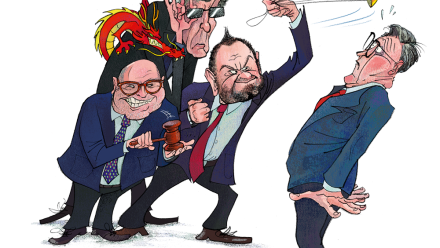
Ayoub Khan seemed delighted. Last Thursday, it was announced that fans of the Israeli football club Maccabi Tel Aviv would be banned from attending their match against Aston Villa next month, an outcome that Khan, the MP for Birmingham Perry Barr, had been lobbying for since September. That night, Khan took himself on a broadcast round to celebrate. Keir Starmer had said the ban was the ‘wrong decision’, but on Newsnight Khan told him to back off. ‘The Prime Minister should stay out of operational matters,’ he said. ‘That’s not a matter for him, sitting in No. 10.’ It has been a satisfying 15 months for Khan since his election.

Can anyone stop J.D. Vance becoming president?

As Donald J. Trump flew to the Holy Land on Sunday to declare peace, his Vice-President took to the airwaves to address the rumbling civil conflict on the home front. J.D. Vance did not rule out invoking the 1807 Insurrection Act in order to quell the violent protests against Immigration and Customs Enforcement officials in several American cities. ‘The problem is the fact that the entire media in this country, cheered on by a few far-left lunatics, have made it OK to tee off on American law enforcement,’ he told NBC News. ‘We cannot accept that in the United States of America.’ This is now Vance’s familiar role. He’s not bad cop to Trump’s good, exactly, more the administration’s favourite pitbull.

Labour’s class war on moorland

This year has been a bad one for wildfires in Britain. In June, nearly 30,000 acres burned near Carrbridge in the Highlands. In August, a careless camper, I’m told, ignited 5,000 acres in the North York moors, setting off 18 unexploded shells, shrapnel from one of which narrowly missed a gamekeeper. The pollution from wildfires was ten times worse this year than in the wetter weather of last year. Yet Keir Starmer’s government has chosen this autumn to ban the one practice that has been preventing more such dangerous fires: the managed burning of heather on much of England’s moorland. In doing so, it has ridden roughshod over advice from scientists, firefighters, land managers, farmers and environmentalists, ignoring or misrepresenting evidence along the way.

The parents gaming special educational needs

As a foster carer and adopter, I’ve spent more mornings than I care to count coaxing my 13-year-old daughter into her uniform and then into the car. She has fetal alcohol spectrum disorder, the UK’s most underdiagnosed neuro-developmental condition, which leaves her with a brain wired for impulsivity, memory lapses and emotional storms that no local school can contain. Each day, I drive her across several counties to the only specialist placement that can meet her needs. Four hours a day, every week day. While I’m grinding through the traffic, taxpayers are footing bills that could fund whole classrooms. Councils and schools spent a record £2.26 billion on special educational needs and disabilities – ‘Send’ – transport last year.

French parents do it better

I arrived in Paris as an au pair in 2022. I was in my early twenties and armed only with GCSE French and a suitcase that could barely fit in my chambre de bonne – nine square metres of ‘characterful’ living space under the eaves, with a window just large enough to glimpse the Eiffel Tower if I leaned out at a dangerous angle. How did I end up here? After graduating, I wanted to immerse myself in a new city and polish my French. A few years on and I am still nannying, though I have returned to London. It seems I’ve become a career nanny by accident. But I’ve come to understand more about the different styles of parenting in the UK and France than I ever thought possible – and feel sure that British parents could learn a lot from our friends across the Channel.

Why Sheridan Westlake is the Tories’ best weapon

Who is responsible for Labour’s recent woes? For some Conservatives, the answer is obvious – Sheridan Westlake. He is that rarest of beasts: an effective Tory operator who has served every leader since John Major. Flaxen-haired with an impish grin, he is spoken of by colleagues as part myth, part political mastermind. Yet ask him what he does, and the stock answer is modest: ‘I simply do the photocopying.’ ‘He just likes getting up in the morning and kicking socialists. He’s in it for the love of the game’ The resignation of Angela Rayner last month is widely attributed within Conservative Campaign Headquarters (CCHQ) to an effective campaign by the party’s attack team.