Cinema

They do more than just ninny about in elaborate hats, thank Christ: Suffragette reviewed

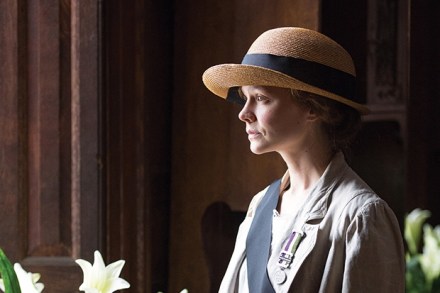
Suffragette is one of those films in which the parts are greater than the sum. Or, in this instance, the part, singular, as it’s Carey Mulligan’s central performance that gives this the emotional power it might otherwise lack, and the sense of involvement it might otherwise lack, and she therefore saves the day, thank Christ. This is a story that deserves to be told, and it would have been a tragedy had it entirely got away. Here we do, at least, see that these women didn’t just ninny about while wearing elaborate hats, as the stereotype sometimes has it, but were astoundingly heroic and brave, enduring endless rounds of prison and hunger strikes and being force-fed.
Speech impediment | 1 October 2015

Who goes to big-screen Shakespeare? Not theatre-goers much, and with reason. Apart from the odd corker by Kurosawa, arguably Olivier and Orson Welles — and let’s bung in Zeffirelli for those with a sweeter tooth — the Bard is a better scriptwriter when the words are dumped and the plots he nicked from elsewhere are updated. See 10 Things I Hate About You (the Shrew as high-school comedy), Forbidden Planet (Prospero in outer space) and, best of all, West Side Story (in fair Manhattan where we lay our scene). There is, as it happens, a semi-respected English-language version of Macbeth by Roman Polanski, who used the cloak of art to get Lady M’s kit off (in his diaries, Kenneth Tynan perved over Francesca Annis’s ‘fesses tristes’).

Incomprehensible genius

London’s Goethe-Institut has a two-month season of films of Rainer Werner Fassbinder (whose 70th anniversary it’s celebrating), but only five movies, each one alternating with a film influenced by him from another country. Considering that Fassbinder created about 60 films, it seems rather a slim effort. Still, half of his output is available on DVD, at no vast cost, and, having revisited many of the films in the past few days, I am more struck than ever by how great he was, and how, thanks to innumerable kinds of pressure, he only intermittently did justice to his phenomenal creativity and energy. He exasperates as often as he enthrals and moves.

Home is where the heart is | 24 September 2015

99 Homes is an American drama about house repossession. Bummer, you might think, but here is what you don’t yet know: films about house repossessions can be electrifying. Or at least this one is. Set in 2008 or thereabouts, against the backdrop of the real-estate bust and ensuing foreclosure crisis, this has much to say about a system that allows the rich to get richer while the poor get shat on (basically), but, above and beyond that, it is also nail-bitingly tense, as gripping as any thriller, and it will totally tear your heart out. In terms of impact, it may even be the Cathy Come Home of our times.

High and mighty

‘Ain’t about what’s waiting on the other side,’ sang Miley Cyrus. ‘It’s the climb.’ She’s not usually a musician to be turned to for profound insight but in this case pop’s wild child has captured the absolute crux of this year’s Gravity wannabe, the visually spectacular 3D Everest, which kicked off the Venice Film Festival two weeks ago to a mixed reception. That’s because, even though in the case of the 1996 Mount Everest disaster (in which eight people died) what was waiting on the other side for most people was a cold and lonely death, it was indeed all about the climb.

Dual control | 10 September 2015

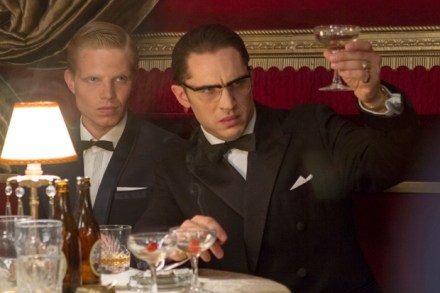
Legend is a biopic of the Kray twins starring Tom Hardy as Reggie and Tom Hardy as Ronnie, so it’s buy one get one free, and this offer will sell the film. It sold it to me, who would otherwise have little interest in the Krays, and was never moved to correspond with either (see Harry Mount's Arts Feature; I did once write to David Cassidy, but did not receive a reply). So it’s Hardy’s performance(s) that’s the draw, and Hardy is dazzling because Hardy is dazzling, not because Legend is especially dazzling.

Family matters | 3 September 2015

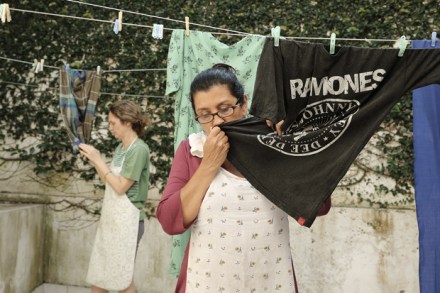
The Second Mother is a Brazilian film concerning a wealthy family, their live-in housekeeper, and the arrival of the housekeeper’s daughter, who throws the household into upheaval. If pushed, I’d say it’s about class and the female experience but, before you run for the hills, you should know it is socio-economic warfare beautifully written and it is socioeconomic warfare exquisitely performed and it is socioeconomic warfare undertaken with humour and heart, and if you’re still not sold, more fool you. The housekeeper — who is also nanny, maid, gardener and dog-walker — is Val, as played by Regine Chase, who is dynamite; who engages in the first frame and then simply carries on doing so.

All from nothing

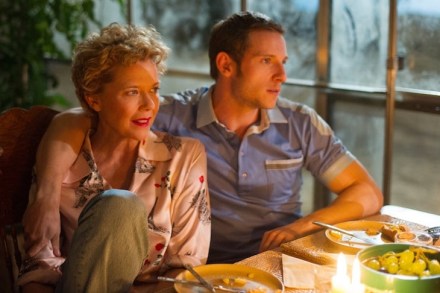
Andrew Haigh’s 45 Years stars Charlotte Rampling and Tom Courtenay as a long married couple whose relationship is disturbed by a letter relating to his first girlfriend, a German who died in the Swiss alps 50 years earlier. Aside from that, not much happens. A shopping trip to Norwich is about as exciting as it gets, on the action front. But this is one of those ‘inaction films’, as I call them, in which nothing happens, but everything happens; it is simple yet absorbingly profound. And it will resonate. It will resonate afterwards and it will resonate the next day and it will resonate the day after that. In fact I am still resonating, and rather wish I wasn’t, so I could move on with my own life. It’s rare for a film to affect me in this way.

Male order | 20 August 2015

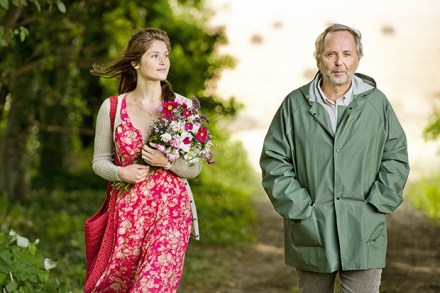
Gemma Bovery is a modern-day refashioning of Gustave Flaubert’s literary masterpiece Madame Bovary, and while such refashionings can work well in some instances — Bridget Jones as Pride and Prejudice, for example, or West Side Story as Romeo and Juliet, if we want to go further back —this is not one of those instances. Instead, this is that other kind of instance; the one that desperately makes you wish they’d left well alone. It’s based on the graphic novel by the writer-artist Posy Simmonds which, in turn, was based on her comic strip in the Guardian.

Great expectations | 13 August 2015

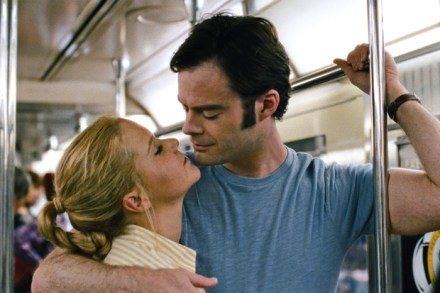
Trainwreck is a romcom as written and directed by Amy Schumer, the American comedy prodigy whose Comedy Central sketch show is properly hilarious and transgressive, from what I’ve seen. Indeed, if nothing else, I beseech you to watch one particular sketch, as viewable on YouTube, where a group of famous Hollywood actresses gather to celebrate one of their number’s ‘last fuckable day’, explained as follows: ‘In every actress’s life, the media decides when you’ve finally reached the point you are not believably fuckable any more....’ So my hopes for this film were sky-high. My hopes were that it would take the standard, misogynist romcom tropes and give them the pitiless thrashing they so deserve.

The Trump doctrine

Were you ever not very nice at school? A bit of a tosspot to others, perhaps. Ever so slightly a jerk now and then and here and there? Were you inclined to take advantage of the weak, the vulnerable, the defenceless and lonely, to tease and wound and give not a single thought to the profound and lasting consequences that may come back to bite you in the posterior decades later? No, neither was I. At least I don’t think I was. Still, The Gift is enough to give you pause. If you are affected by any of the issues in this film, best log on to Friends Reunited, locate anyone to whom you may once have said even the teensiest mean thing. Just in case. And grovel, abase yourself, say you’re really really sorry and mean it. Because you just never know.

Dedicated follower of fashion

Iris is a documentary portrait of Iris Apfel, the nonagenarian New York fashion icon. Nope, me neither, but that’s irrelevant, as all you truly need know is she is a joy, a wonder, and terrific, as is this film. It’s the final work of documentary film-maker Albert Maysles, who died last year, at 88, and although Iris obviously loves the camera, and plays to the camera, and it is often Iris doing Iris, as Iris does Iris so brilliantly, who cares? Also, you just can’t take your eyes off her. You can’t. The opening shots show Iris, who is 93, in her Park Avenue apartment, in all her glory. Accessories make an outfit, is a fashion tip often proffered, but why make an outfit, when you can blast it out of the water?

Sweeney Plod

The Legend of Barney Thomson is the directorial debut of actor Robert Carlyle, and it’s one of those black comedies about a serial killer in which, as the bodies pile up, plausibility edges closer and closer to the window until it flies out completely. (No. Wait. Come back! I’ll massage your feet!) This wouldn’t, in fact, matter at all if there were something else to hang onto; if the characters were involving, or the story was told with wit, zip and panache, but it just monotonously drones on. The central figure is a barber so I guess you could say this is Sweeney Plod rather than, you know, that other one.

To tell you the truth…

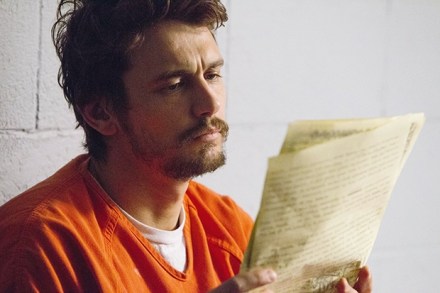
True Story is based on the book True Story, which is itself based on a true story, so there is a lot of truth knocking about, I guess you could say, but absolutely none of it is at all interesting. It sounds as if it will be fascinating, as it’s about the disgraced New York Times reporter Mike Finkel’s relationship with Christian Longo, a man accused of murdering his wife and three children, but it goes absolutely nowhere. At one stage someone says to Finkel about Longo, ‘He doesn’t deserve to have his story told,’ to which Finkel replies, ‘Everyone deserves to have their story told,’ to which I would have said, had I been asked, ‘None of you deserves to have your story told. Now, all of you, go away and behave.

Chorus of disapproval | 9 July 2015

If heartwarming, against-the-odds, triumph-over-adversity, wrong-side-of-the-tracks films float your boat and you are in no way demanding then The Choir is your boat floated, pretty much, but otherwise it’s nothing we haven’t seen before, hundreds of times. This is one of those films that appears to have never watched any other films, or it surely wouldn’t have bothered. My own particular boat, as you’ve probably already surmised, was not floated. It didn’t even leave the dock. Chances are, it may even be all rusted up by now. I was initially attracted to seeing this film because 1) I do adore Dustin Hoffman and 2) I do adore choirs and 3) I honestly had no idea quite how rubbish it would be. Dustin Hoffman. Choirs. What’s not to love?

Eyes wide shut | 2 July 2015

Asif Kapadia’s documentary about Amy Winehouse, whom Tony Bennett describes as ‘one of the truest jazz singers that ever lived’, and who died of alcohol poisoning at 27 (FFS), is masterly and gripping, which is a pity, as you can’t look away. You will want to look away, and may even yearn to do so once the heroin comes into play, and the crack, and that husband and that gig in Belgrade, when she was all unsteady, shuffling and broken beneath the big hair, but you can’t. Oh, Amy, I kept thinking, if only — if only — you’d said, ‘Yes, yes, yes’. It is almost unbearable in this way.

Maestro maker | 25 June 2015

The writer and director Peter Bogdanovich has made three of my favourite films of all time (The Last Picture Show, Paper Moon, What’s Up, Doc?) but I don’t think I’ll be adding his latest, She’s Funny That Way, to the list. It’s a screwball comedy of the old school and, although it is slightly intriguing at first, where is all this manic activity going? You get your answer after 96 minutes. The answer is: absolutely nowhere. Set in New York, it stars the British actress Imogen Poots laying on a Brooklyn accent with several trowels and also a spade. (Oh, how one yearns for just the one trowel.) She plays Izzy Patterson, a ‘call girl’ — never ‘prostitute’ in these instances — and straight off I’m in trouble.

A sting in the tail

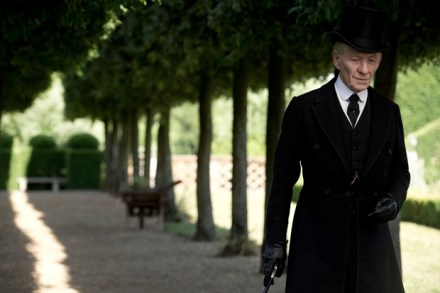
Mr Holmes stars Ian McKellen as the great detective in his old age and while it could have proved a touching character study — who are you, not just when your mind starts to fail, but when the mind for which you are famed starts to fail? — it veers off in so many tedious directions that the end product is lumbering and leaden and will require 22 espressos thrown back in quick succession beforehand, along with several Red Bulls, if you are to have any hope of staying awake. (I did not know this beforehand, and therefore dozed quite significantly.) You know, if I were invited to give a talk at some film school, which still hasn’t happened, weirdly, I would say, ‘Kids, before you point a single camera, sit down and ask yourselves: what is this film about?

Dead behind the eyes

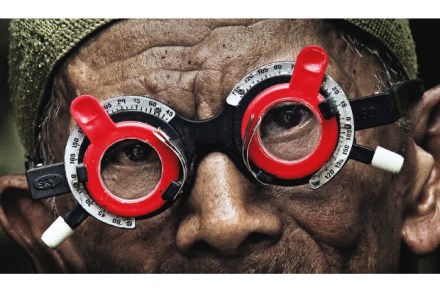
With Joshua Oppenheimer’s The Act of Killing you’d be minded to think that’s it, that’s the Indonesian genocide (1965–66) done, but now he’s returned with a second film that is equally stunning, equally riveting — in its horrifying way — and equally unforgettable. To have one such film in you, but two? I think it is now safe to conclude: there are good documentary makers and there are excellent documentary makers and then there is Joshua Oppenheimer, who is amazing.

Boring Boorman

Queen & County is John Boorman’s follow-up to his 1987 semi-autobiographical film Hope & Glory, although why a sequel now, after 28 years, I don’t know. (We’re not in regular contact.) I can only tell you that if you absolutely loved the first film, as I did — and still do — the news I’m about to deliver is not great, but there’s no avoiding it, so here you are: this is tonally confused, emotionally unengaging, doesn’t seem relevant in any way, and as for Bill, who was once so bright and charming and promising, he’s nothing special any more. I don’t know what I expected him to turn out like, but dull? I didn’t see that coming, I confess.