Any other business

A new bank from a very old stable

My racing correspondent, Captain Threadneedle, thought that banking and racing went together. He wanted Barclays to buy the Tote: perfect synergy, he thought, with matching systems, merged accounts, an overlapping customer base and a marketing slogan that would write itself: ‘You can bet on your overdraft with Barclays.’ He was, as we now know, before his time — and then the banks (Barclays included) took to betting on their own account, splashing out on doubles, trebles and accumulators, collecting piles of toxic betting slips and deservedly losing their boots. It has been left to Weatherbys, a very old name in racing, a new name in banking, to vindicate the Captain’s insight and to solve the equation.

The new economy

Minsky’s moment has arrived There is a big political prize dangling over the economic crisis. Whoever now devises a coherent economic programme will mould British society for a generation. Labour won the post-Great Depression prize in 1945 by creating the paternalistic welfare state and won again in 1966 — a short-lived victory — with Harold Wilson’s modernising ‘white heat of technology’. In 1979, Margaret Thatcher won the prize that arose from the failures of the preceding paternalism and technocratic modernism with her vision of free-market individualism. From then until Northern Rock was nationalised, all economic policy was recognisably some shade of Thatcherism.

Are electric cars really the next big step for mankind?

Putting Lord Mandelson into an electric Mini may not seem to bear much comparison with putting a man on the moon, but there are interesting parallels. In 1961, the US government embarked on the Apollo space programme, with the ambition of landing astronauts on the moon by the end of the decade. By 1969, it had achieved exactly what it set out to do. But it was a risky project, with no guarantee of success. To land on the moon, scientists had to solve three problems: how to rendezvous and dock with another spacecraft, how to work outside a spacecraft, and how to survive prolonged periods of time in space.

Any Other Business | 25 April 2009

Eddie was a model public servant: that’s why Gordon was so rude to him In Tokyo in the mid-Eighties, I bumped into a very senior Japanese investment banker who had just been to London to negotiate an operating licence. ‘We met...’ he paused for effect, bowing slightly at the neck and adopting what I can only describe as obsequious grimace, ‘...Eddie-George-san!’ All the other Japanese present nodded vigorously and sucked their teeth in accord. Lord George, who died last Saturday aged 70, was a big player on the world banking stage long before he became Governor of the Bank of England in 1993. He was also a model public servant: modest, calm, courteous, firm-principled, and a master of market technicalities.

Standing Room | 25 April 2009

Twenty years ago I remember driving down Pacific Coast Highway in California with two of my children strapped into their car seats behind me. They were having a humdinger of a row. They were arguing because India had picked her nose and had proudly managed to produce a bogey the size of an ant. While busy admiring her handiwork, her younger brother Archie had snatched the highly prized treasure from her finger and was attempting to eat it. They were fighting so much I eventually had to swerve onto the hard shoulder, clamber into the back seat and sternly lecture them both on the delicate etiquette of nose-picking. ‘Whoever picks it, gets to eat it. Understand?’ I admonished sternly. ‘No stealing one another’s bogies. Ever.

Can mercenaries defeat the Somali pirates?

Jim Cowling has chosen the right moment to launch his new business. An experienced security consultant, he has just set up a company called Shipguard, with a small office in Clerkenwell. The product: providing the men, the know-how, and if necessary the weapons, to defeat the pirates that are the scourge of Somali waters. ‘We’re one of the groups throwing our hats into the ring,’ says Cowling. ‘This is going to be the next Iraq in terms of where mercenaries are going. Iraq is being wound down, and guys are looking around and latching onto piracy.’ He is far from alone. In the past year, as pirates have menaced the Gulf and the Indian Ocean demanding bigger and bigger ransoms, so dozens of companies have sprung up to fight them.

The state of the railways

The Treasury thought the railways were in terminal decline. John Major’s government thought they were a political nuisance — vexed commuters meant lost voters. Privatisation would get the railways off the government’s back, and breaking them into 100 pieces would mean that if one piece was on strike, the other 99 would not be. In the event, they refused to go away, and have maintained an obstinate tendency to put on business. Successive governments have had to cope with the consequences, and we must soon be due for the next set of answers. For New Labour, sweeping into power a dozen years ago, the first and easiest answer was to abandon its costly threats to buy the railways back.

Standing Room | 18 April 2009

It’s at trying times like these that my latent inner-bimbo gene struggles to reassert itself. It’s at trying times like these that my latent inner-bimbo gene struggles to reassert itself. Sod equal rights, sod women’s lib and to hell with emancipation. When my car mysteriously vanished outside Waitrose last Friday night I was immediately engulfed by a pathetically primal desire to play the role of helpless victim. I’d parked in good faith — albeit in a bay that had not one, but two large suspension notices; I’d carefully read both signs and deduced that the middle spaces were up for grabs.

No meltdown — but a deep sense of unease

On the eve of South Africa’s election, Janice Warman says its economy remains relatively attractive to investors, despite doubts about incoming president Jacob Zuma In South Africa, everything is not as it seems. If you drive along the edge of the Atlantic Ocean from Muizenberg in Cape Town, you will see a sea of glittering shanty roofs that seems to stretch all the way up to Table Mountain — the vast slum that is Khayelitsha. Drive in and it looks different. There is electrification, and portable toilets. There are two-lane metalled roads as well as dirt tracks.

No time to relax for BA’s fighter pilot

British Airways staff have sometimes been accused of ‘working without enthusiasm’, says Judi Bevan — but you certainly couldn’t say that of chief executive Willie Walsh Before meeting Willie Walsh, I take a stroll round Terminal 5, marvelling at the vast, elegant haven of calm and efficiency it has become compared with the pandemonium of last March’s opening. All looks serene until I ask the nice young press officer with me whether passengers are now allowed two pieces of hand luggage. We approach one of the check-in desks, where she politely introduces herself and asks the young woman behind it if this is indeed the case.

Standing Room | 4 April 2009

I live in fear of that peculiar sharp intake of breath I seem to hear whenever I ask service men actually to service anything I own that doesn’t work. I live in fear of that peculiar sharp intake of breath I seem to hear whenever I ask service men actually to service anything I own that doesn’t work. It’s not a promising sound. Dishwashers that stop washing dishes, internet servers that fail to serve, waste disposals that spew sewage wrist-deep back up into the sink, cars that make curious grinding noises — all these are problems I want dealt with speedily and with total confidence. I also want the person in charge of mending them to have a far superior knowledge of the buggered piece of machinery than I do. That is their job; their specialist field. Not mine.

What do we want? Bankers. When do we want them? Now

At last, a government response to the financial crisis that is actually working. Am I referring to last November’s VAT cut? Of course not; it has been as ineffectual as we all said it would be. Those loan guarantee schemes for struggling small businesses? Nope, still very little sign of them, I’m afraid, months after they were announced and re-announced. Quantitative easing? Oops, sorry, much of the first wheelbarrow load of new-minted cash has disappeared abroad, to foreigners who jumped at the opportunity to offer their gilt holdings back to the Bank of England — while the Bank has been struggling to sell new gilts to investors perturbed by signs of a rift between the Governor and Downing Street. No, on most fronts, things are more pear-shaped than ever.

City Life | 4 April 2009

‘From this filthy sewer, pure gold flows’: that was in 1835, but it could be today Alexis de Tocqueville, the great French political commentator, visited Manchester in 1835 when the city was the capital of the world’s textile industry. He wrote: ‘From this foul drain, the greatest stream of human industry flows to fertilise the whole world. From this filthy sewer, pure gold flows. Here humanity attains its most complete development and its most brutish.’ This was ten years before Benjamin Disraeli coined his famous ‘two nations’ phrase about the rich and the poor in his novel Sybil. Disraeli was referring to England as a whole, but — thanks to his involvement in the Chartist movement — I suspect he had Manchester in mind.

Rotten oranges and blighted hopes

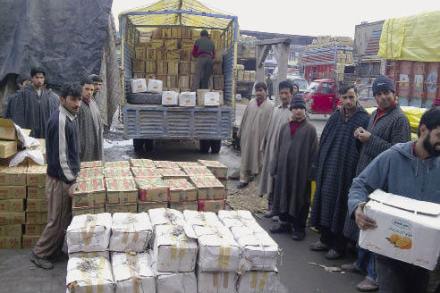
Ishaq Chowdhary pulled the top off a wooden crate to show oranges fringed with powdery white mould. It was a freezing morning at the fruit market in Srinagar, capital of the Indian state of Jammu and Kashmir, and market workers, huddling traditional fire-pots beneath their gowns, are sipping tea and starting to unload the day’s deliveries. The previous afternoon, five trucks rumbled into the market carrying oranges, pomegranates, bananas and grapes from Pakistan-administered Kashmir. When the first consignment of Pakistani goods rolled across the Aman Setu bridge, or ‘bridge of peace’, 100 days earlier, they were welcomed by cheering crowds.

And Another Thing | 28 March 2009

Richard Strauss died 60 years ago this year. Not only is he one of my top ten favourite composers, he is also the one I would most like to be cast away with on an island so that I could pluck out the heart of his mystery. His subtleties are infinite, especially his constant, minute innovations, always designed to improve existing models but rejecting crude revolutions, so noisily intrusive in his time. I would like to explore his early works, like the tone poem Macbeth and his symphonies, Brahmsian exercises never performed today, and get to know all his operas including the weird Guntram (1892) and his last great masterpiece Capriccio, written 60 years later. But plucking that complex heart requires a knowledge of German.

Standing Room | 28 March 2009

Last week I was invited to join Radio 2 to discuss the European parliament’s most recent time-, energy- and money-wasting wheeze Last week I was invited to join Radio 2 to discuss the European parliament’s most recent time-, energy- and money-wasting wheeze: a pamphlet asking staff to refrain from using titles such as Miss or Mrs. Apparently these titles are considered archaic and a hangover from the past, as they ‘indicate’ a woman’s relationship to a man. According to Strasbourg, Ms is the politically correct prefix all us women should adopt; for despite being impossible to pronounce without sounding as though one is impersonating an angry mosquito, using Ms doesn’t — God forbid — denote a woman’s marital status.

And Another Thing | 21 March 2009

One of my favourite parts of London, in easy walking distance of my house in Newton Road, is what I call the Ardizzone country. This stretches from the edges of Little Venice into Maida Vale and is, or was until the crunch, in the process of rapid gentrification. I call it after the artist because, from 1920 until his death in 1979, he lived (on and off) at 130 Elgin Avenue, and made hundreds, perhaps thousands, of little sketches of its people. He had not much artistic training, apart from a spell under Bernard Meninsky at the Westminster School of Art, but he had an extraordinary skill at doing rapid figure drawings, which he deepened by clever hatching and watercolour washes.

Green shoots are out there somewhere

Recessions end. Even the Great Depression of the 1930s, about which we have heard so much recently, eventually ran its course, though it took a world war to get business booming again. ‘Thatcher’s wasteland’ of dole queues, urban riots and closed steel mills in the early 1980s gave way swiftly to a world of rampant yuppies and triumphant admen. But when both the British and the world economy finally emerge, dazed and blinking, from the savage recession now upon us, it will look very different.

Corporate governance

It all started at one of the Prime Minister’s monthly press conferences. Suddenly, in answer to a question, Gordon Brown named Sir Fred Goodwin, the now notorious former chief executive of Royal Bank of Scotland, as the man who broke the bank. After the conference the press machine of Number 10 must have gone into action, for the next morning’s papers were full of pictures and stories of Fred, naming and shaming him as the father of the credit crunch. The publicity machine continued remorselessly day after day, as time went by and he and the other hapless chairmen and chief executives of failed banks were hauled before Commons committees to make abject apologies. It was a circus not seen since the days of the Soviet show trials.

Standing Room | 21 March 2009

Last Saturday I was sent a stiff, glossy brochure informing me of imminent changes in my local podiatry services. NHS Westminster plans to invest £540,000 in this pressing ‘service redesign’ and being a taxpayer and local resident they wanted my views. I had a questionnaire to fill out and return. Alongside the requisite ‘Are you male or female?’ boxes to tick, I was asked the following: Do you have a physical or mental health condition that has lasted at least 12 months or is likely to last at least 12 months? Yes or no? Although I quite fail to comprehend the correlation between having some rubber-gloved nurse gouge out a verruca and a potential bipolar episode, I paused only momentarily before taking an optimistic standpoint and ticking ‘no’.