World

Trump reveals the limits of American power

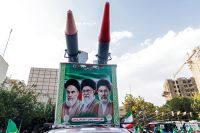
Donald Trump’s quest for regime change in Iran has backfired horribly. The President misunderstood the resilience of the 47-year-old Islamic Republic of Iran, the strategic calculations of one-time ally Israel and the physical and political geography of the Strait of Hormuz. Vice President J.D. Vance appears now to be positioned as the public face of failure. The decision to launch the assault on Iran was underpinned by Israeli confidence that Iran’s leadership could be toppled and that the United States’ overwhelming firepower would produce shock and awe. It came in the immediate aftermath of plans to acquire Greenland, incorporate Canada, assert dominance over the Panama Canal and topple the then Venezuelan government. Cuba is no doubt next on Trump's list.

iran
Anthony Scaramucci on Trump, Corruption & America at 250

Anthony Scaramucci on Trump, Corruption and America at 250

37 min listen

To mark the 250th anniversary of the 1776 Declaration of Independence, Anthony Scaramucci joins The Spectator to provide his assessment of the health of the nation. As we approach the halfway point of the second Trump presidency, what's his impact been on America's reputation? Will the Democrats' attempts to emulate Trump help or hinder them? And why are American conservatives so obsessed with Britain – or rather, Britain's supposed decline? Declaring Trump "an aging queen" under whom "the spirit of hypocrisy lives on" in America, the former White House communications director joins Freddy Gray and Tim Shipman for this special Coffee House Shots/Americano crossover to mark the Fourth of July. Produced by Patrick Gibbons and Natasha Feroze. https://www.youtube.com/watch?

Germany is quietly falling apart

In Germany, the trains have stopped running on time, bridges have been shut over safety fears, and the country's largest carmaker, Volkswagen, is cutting a sixth of its workforce. The government's response amounts to a shrug, dressed up as reform. It seems like Germany is on a bad streak – and the AfD looks set to reap the rewards. Why does a country that still thinks of itself as Europe's engine room seem to have lost the ability to fix its own bridges? Take the railways, the infamous Deutsche Bahn. A few weeks ago, they ground to a total halt. Every train in the country stood still, because the radio system that lets drivers talk to signal boxes – a system that appears to date, in spirit if not in silicon, from the Kaiserreich – simply stopped working.

Trump’s America is losing its mojo

The heat is on. The R&B group Kool and the Gang may be co-headlining the historic "A Capitol Fourth 250th Weekend Celebration," but that isn’t doing anything to cool the flaring political tempers in Washington during a record heatwave. Instead, the two-week-long "Great American State Fair" on the National Mall to celebrate American emancipation from British tyranny has turned into the birthday party gone wrong. The first sign that things were going awry for the party planners came a few weeks ago with the clumps of algae that began clotting the reflecting pool in central DC, which President Trump had tasked a company called Green Water Solutions to renovate. The company was true to its name. Green Water produced green water.

In praise of the American Loyalists

As the United States marks 250 years since the country's unilateral declaration of independence, most of the Fourth of July celebrations have focused on the rebels. But Benjamin Franklin and Thomas Jefferson have hogged the limelight for too long. What about the American Loyalists, those who defied the intense social pressure and stayed loyal to the British Crown? Loyalists were often bad writers who simply lacked the flair of radicals such as Thomas Paine In popular imagination, the American Revolution was a contest between the Americans and the British. In reality, however, only about 40 percent to 45 percent of the colonial population joined the rebellion. Around a fifth stayed loyal. The rest backed neither side.

America 250 loyalists

Can the Kremlin afford to fix Russia’s oil crisis?

For a country that pumps roughly nine million barrels of oil a day – the third highest of any country in the world – Russia has managed to achieve something genuinely remarkable: it cannot keep its own gas stations stocked. More than half of its regions are now reporting shortages, the consequence of a Ukrainian drone campaign that has struck with increasing frequency and precision at the refinery infrastructure on which the country's civilian economy depends. The sometimes hours-long lines that have appeared – even in Moscow, for what may be the first time in the war – carry a symbolic weight that no amount of official reassurance from the Kremlin has managed to dispel. How this has come about is obvious enough.

oil

The confessions of J.D. Vance

There were many reasons why 2016 was a strange year. One of them was the halfhearted effort by people on both sides of the Atlantic to try to understand why voters had voted the "wrong" way in the Brexit referendum and the US presidential election. The book that was touted as an explainer for all of this was Hillbilly Elegy, a memoir by someone called J.D. Vance about his upbringing in rural Ohio. After the election of Donald Trump, Vance’s description of family breakdown, de-industrialization, poverty and drug abuse was said to explain why so many Americans had voted for Trump. There was much that was patronizing about all this – mirrored in France by the attention paid to Didier Eribon’s Returning to Reims.

How Brand Scotland conquered America

In his highly entertaining history of alcohol and the British, Empire of Booze, Henry Jeffreys observed how one effect of the Napoleonic Wars was to make Scotland a popular destination for English holiday makers. What with the continent being isolated and everything, there weren’t many more exotic places for the richer, more adventurous traveler to visit. I’m a huge admirer of how the Scots put national identity to its most benevolent and noble purpose: using it to milk wealthy Americans of their money The country was until then largely unknown to many people south of the border, something also true of its trademark drink.

The truth about Gavin Newsom

Gavin Newsom has spent the last two years building a national profile for himself beyond his controversial governorship of California. But does he have what it takes for a presidential run in 2028, something that would take him far outside the left-wing political bubble of the Golden State? Freddy speaks to Christopher Rufo, author of the Christopher Rufo Substack and a senior fellow at the Manhattan Institute, about the real Gavin Newsom and the decay of California under his watch. https://www.youtube.com/watch?v=Nx-gXQQfkqA&pp=0gcJCU4LAYcqIYzv Learn how to earn yield on gold, paid in gold, at Monetary-Metals.com/Americano.

The truth about Gavin Newsom

Why is America’s radical left winning?

After success in the New York Democratic primaries for far-left candidates, President Trump says "the game is on. Enjoy Watching." Freddy speaks to Spectator columnist, Roger Kimball, about how Trump plans to deal with the radical left, the lawlessness of New York under Zohran Mamdani and how artificial intelligence is changing politics. Learn how to earn yield on gold, paid in gold, at Monetary-Metals.

Why is America’s radical left winning?

Why is the New York Times celebrating the slave-trading Vikings?

Norway plays the Ivory Coast tomorrow afternoon in the first knockout phase of the soccer World Cup, and one suspects the New York Times will be backing the Norsemen. The Gray Lady has gone gaga for Norway’s "Viking Row," a synchronized routine where fans mime the rowing of a Viking longboat to the bang of a drum. It’s caught on among the Norwegian players as well as politicians back in Norway, who performed the row in parliament last week. For the last two weeks the NYT has been publishing breathless pieces about the zany Norwegians and their Viking antics. “The 'Viking Row' is in full flow” was one headline on June 18; five days later they described how it "has taken the World Cup by storm." And their editorial office from the sound of things.

vikings

The Iran war is Trump’s Suez crisis

Clarissa Eden famously declared that "in the past few weeks I have really felt as if the Suez Canal was flowing through my drawing-room." Does Melania Trump feel the same about the Strait of Hormuz? Or perhaps Donald will be reminded of the strait every time he hits one over the water at Bedminster. He ought to be. The Iran war will define his presidency. It is his legacy – just not in the way he imagined. In 1956, a British prime minister discovered that we were no longer a great power. It was an end to illusions. We liked to think we had the best navy in the world, but that was irrelevant to whether we could keep a canal in Egypt.

suez

Is the US-Israel special relationship over?

Until recently, the Israeli right regarded President Donald Trump as its greatest ally. He was often described in quasi-religious terms – as a savior, even a messiah sent to rescue Israel from international pressure and the constraints imposed by previous American administrations. According to several American media reports, Trump told Netanyahu: "You’re fucking crazy" and "All the Jews are sick of you" That admiration stemmed from Trump’s unwavering support during his first term. He moved the US Embassy to Jerusalem, recognized Israeli sovereignty over the Golan Heights, and adopted Netanyahu’s position that Washington should withdraw from the nuclear agreement with Iran negotiated in 2015 under president Barack Obama.

The death of British two-party politics has been greatly exaggerated

Every twist in the winding road of Britain's politics brings a latest thing to say. These wisdoms usually survive a season or two before succumbing to the new thing to say, which often asserts the opposite. This summer we have “Britain is moving into an era of multiparty politics.” Allow me, therefore, to leap ahead with my candidate for its successor: “Reports of the death of two-party politics are greatly exaggerated.” I don’t say our current governing party and principal opposition must always be the two parties in question. Labour may be dying. The Tories may be showing signs of life. In both cases I fervently hope so. But whether or not these remain our two options in elections to come, the tendency will always be for the choice to boil down to two.

politics
andy burnham

Even Andy Burnham doesn’t know what Andy Burnham stands for

The British constitution is an admirably flexible thing, so I would not claim that Andy Burnham’s leadership campaign, and the coverage thereof, is unconstitutional, but it is certainly unseemly. Why did a BBC helicopter follow his train from Manchester to London (which arrived, of course, late) as if he were Lenin heading for the Finland Station? And why was he allowed to preempt his result with a mass selfie with about 200 of his supporting MPs in Westminster Hall? He is merely a new Member of Parliament, until he isn’t. Turning the place into his stage set is a way of intimidating possible challengers. If he is challenged, he will surely still become leader, but the point of a challenge is to force him to say what he means to do.

Venezuela’s earthquake is the cruelest blow

Venezuela thought its luck was changing. Then the earthquakes stuck. For a country that's economy has long been in tatters, parts of Venezuela are now in ruins. The huge 7.2 of and 7.5 magnitude quakes have devastated pockets of Venezuela, with parts of the capital, Caracas, and the northern coast dotted with mounds of rubble. Rodriguez could also use this tragedy to argue an election is not what the country needs It's a cruel twist of fate the South American nation that was finally beginning to pull itself out of dismal abyss it had found itself in. Many Venezuelans, little by little, were allowing them to be more optimistic this year. Nicolás Maduro was out of the picture following his capture in January. Hundreds of political prisoners had been released.

The Brexit decade: was it worth it?

It may not feel or sound like it but Keir Starmer is a born-again Brexiteer. His achievements in office may be nugatory, his search for a legacy tragicomic, but there are countless actions this government boasts of which simply would not have been possible if we had stayed in the EU. Earlier this year, Labour moved to protect our steel industry with a tariff package possible only because we have an independent trade policy. I was delighted this month when the minister in the Lords made it clear this was a Brexit benefit. Those same Brexit freedoms allowed the Chancellor last month to cut tariffs on more than 100 foodstuffs to ease the cost-of-living crisis.

brexit

Can Burnham resist the siren call of the left?

Power, when it is gained and lost, is transferred in stages: the actual, the visual and the constitutional. The latter took place on June 23 when the prime minister presumptive sent a letter to Antonia Romeo, the Cabinet Secretary, requesting that she commence access talks with his team. Keir Starmer had already given permission for them to proceed, but the propriety and ethics team in the Cabinet Office had told Romeo she could not initiate proceedings. Andy Burnham had to ask first. To all intents and purposes, he is already the vessel from which power flows. At the same time, it became clear that James Purnell, the former Blairite cabinet minister, will lead the transition team and stay on to become chief of staff in 10 Downing Street.

burnham

Is Trump’s quest for peace doomed?

J.D. Vance jokingly compared himself to Richard Nixon yesterday. "Young senator, vice president, writes some bestselling books, is hated by the media... kinda sounds like J.D. Vance," he said at the Richard Nixon Library and Museum in Yorba Linda, California. "I’ve always liked Richard Nixon." At the same time, 8,000 miles away, in the Strait of Hormuz, Iranian forces struck another ship, further undermining what critics have called "the Vance deal" – the "Memorandum of Understanding" between Tehran and Washington. And that suggests, at a foreign-policy level, the Nixon-Vance parallel is more apt than the 50th Vice President realizes. Of course, Nixon was Commander-in-Chief and Vance is not. And the Vietnam War is very different to America’s current fight with Iran.

donald trump

South Africa now has its answer to ICE

A force of 10,000 inspectors is being recruited to weed out foreigners: door-to-door across the nation, they will check mines, factories and shops, rounding up those without papers for deportation. Oh, and the target will be black people! Trump madness? Marine le Pen? No, this is South Africa and a project launched by President Cyril Ramaphosa to expel millions of black migrants from across the rest of Africa who have jumped the border or overstayed their visa.  It's Africa's answer to ICE, though you won't find many people protesting: quite the opposite.  Government and the police are desperate to demonstrate they're on top of the problem; to assuage the rising rage of native South Africans, and try to stop them taking matters into their own hands.

South Africa