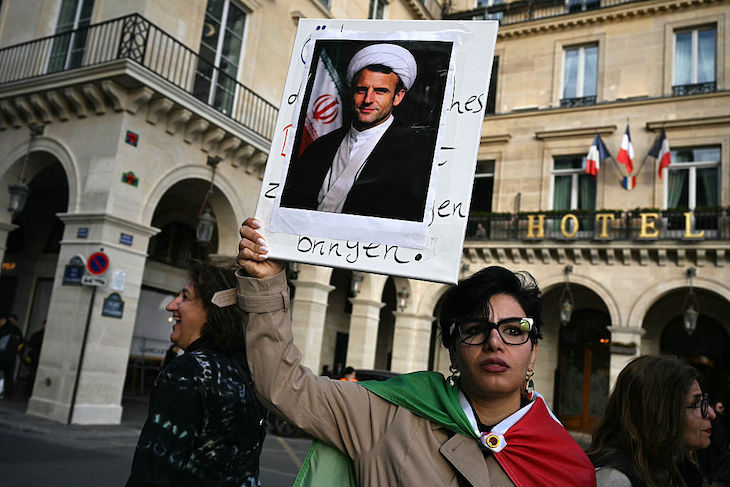
What is Emmanuel Macron playing at? In the space of just a few days, three apparently unconnected incidents have the French president’s fingerprints all over them. They indicate that, while Macron is a spent force at home, he is willing to deploy his powers to help France navigate the Iran war crisis and try to salvage his reputation – even if it means making his allies, including the United States, look utterly foolish.
While Macron is a spent force at home, he is willing to deploy his powers to help France navigate the Iran war crisis
On April 2, a French container ship, the Kribi, became the first western vessel to cross the Strait of Hormuz and exit into the Gulf of Oman since the war against Iran began. The boat’s safe passage during the Iranian blockade came on the same day that Macron said that only diplomatic efforts, rather than military efforts, would ensure the reopening of the Strait. Did the French government help broker the ship’s safe journey through a passage of water dubbed the “Tehran Toll Booth?” It seems highly likely, but at the very least the incident demonstrates France’s willingness to bear the reputational cost of being seen to coordinate with Tehran, not to mention reinforcing Iranian sovereignty claims over the Strait.
A day later, France joined fellow permanent members of the United Nations Security Council (UNSCR) China and Russia in vetoing a Chapter VII resolution, sponsored by Bahrain and backed by the United States and the Gulf Cooperation Council, authorizing military force under international law to reopen the Strait of Hormuz. In so doing, Paris sent a signal to Tehran just as it abandoned the Gulf states. It also demonstrated its willingness to veto a US-backed resolution.
On April 7, Macron announced that two French nationals detained in Iran for “spying” were returning to France after three years. Macron welcomed them to the Elysée with great fanfare. At what price did Macron secure their release?
No media outlets have connected all three episodes, but they clearly interlock. By bending to the Islamic Republic, Macron appears to have obtained the release of the hostages, thumbed his nose at the US and secured a commercial win. This was a high stakes game in keeping with the president’s risk mentality. Thus far it has paid off. His latest poll rating has risen from an utterly dismal 13 percent to 19 percent.
With only 12 months left of his presidency Emmanuel Macron is a lame duck domestically. With a stalemated parliament and a hamstrung government – all of his own making after the reckless 2024 dissolution of the National Assembly – he is without influence. But in foreign affairs French presidents have sweeping powers and Macron is leveraging them to save what he can of his presidential reputation. He knows better than most that plucking the French national chord on the world scene pays off. The episodes above are in that vein. And nowhere are French presidents more at home than playing on a certain Gaullist anti-Americanism.
From the beginning of the war against Iran, Macron has demonstrated the confidence and decisiveness so lacking in the British Prime Minister Keir Starmer. As a vocal critic of the war, Macron questioned from the outset its international legitimacy. At the same time, he was quick to seize the opportunity to display French military might. A French aircraft carrier group was dispatched from Sweden to the eastern Mediterranean to shield EU-member Cyprus (in Britain’s absence) and the Gulf States from Iranian missiles and drones. Other than adding to Britain’s international embarrassment, it was clearly a demonstration that France is the prime European military power. And Macron made the most of it. Filmed live on the deck of the French carrier, Charles de Gaulle, he proclaimed France to be there to protect its citizens, its allies and its friends. The French media loved it.
Macron’s fiercest criticism has been reserved for Donald Trump’s handling of the war. This descended into the most personal of attacks by both men with Trump sniggering at Macron’s relations with his wife and the French president mocking the American president’s inconsistency. This too has played well with the French media.
As his time in power comes to an end, Macron can be counted on to pursue this hyper-Gaullist rhetoric. But his opportunism, deviousness and grandiloquence show that it is little more than bombast. As the clock counts down his final months in the Elysée, the 5th Republic’s most unpopular president could resort to ever greater international impulsiveness in the hope of retrieving what he can of a tarnished reputation.



Comments