America

Iran, the Shah and the revival of kingship

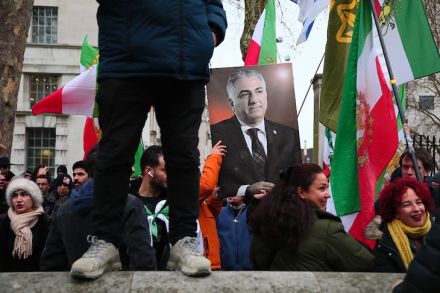
Earlier this week in Los Angeles – home to the largest Iranian community in the United States – thousands gathered in solidarity with protests unfolding in their homeland. Amid the sea of national flags and chants against the Islamic Republic, some demonstrators carried Lion and Sun banners and invoked a return to the pre-1979 monarchy, signalling a strand of sentiment that looks back to Iran’s last Shah. The rally took a darker turn when a truck drove into the crowd, underscoring the depth of division within the diaspora debate over Iran’s future. For some Iranians, particularly in the diaspora, the monarchy represents a lost period of national pride and state
There should be no ‘sanctuary’ from ICE

After three hours of parsing American case law, for once I share Donald Trump’s exasperation. See, many a naif, including yours truly three hours ago, would have thought the Democrats’ ‘sanctuary cities’ unconstitutional. A sanctuary city instructs its local police force to cease all co-operation with federal immigration agents. The constitution’s supremacy clause dictates that federal law overrules local law, just as rock crushes scissors in the hand game. For sub-jurisdictions to offer refuge from big meanie federal Immigration and Customs Enforcement (the aptly cold-hearted sounding ICE) should not, legally, be possible. It’s possible. The work-around is the 10th Amendment’s ‘anti-commandeering doctrine’, which prevents the feds from directly telling local

Trump is playing geopolitical Monopoly with Greenland

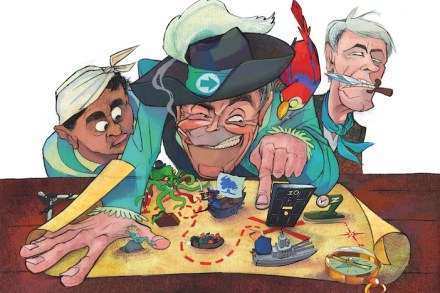
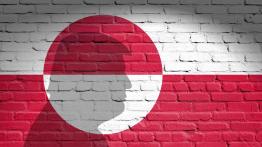
Donald Trump is playing hemispheric monopoly. Depending on what day of the week it is, the President’s focus alternates between Venezuela, Canada, the Panama canal – and for the last twelve months or so, Greenland. Given what Trump and his team have said over the past week, their acquisition plans for the island are well advanced. But why exactly does he want Greenland? The world’s largest island is an integral part of the Kingdom of Denmark and is about three times larger than Texas. While the term du jour is geopolitics, perhaps the most plausible reason for why Trump is gunning for Greenland is ego-politics. We have a president eager

Stormy seas, Trump’s revolution & Gen Z’s sex recession

43 min listen

Can Farage plot a route to Number 10, asks Tim Shipman in our cover article this week. He might be flanked by heavyweights – such as his head of policy Zia Yusuf and Conservative Party defector Danny Kruger MP – but he will need a lot more people to pull off his biggest upset for British politics yet. Where will they come from? And what’s the balance he needs to strike between being radical enough to win power but also without alienating significant chunks of the electorate? Plus, as former UK ambassador to the US Peter Mandelson breaks his silence – in this week’s Spectator – to argue that Europe

Is Trump going for Iran next?

23 min listen

Donald Trump’s stunning attack on Venezuela has the world wondering what his next move might be. What does it mean for Iran, Russia, and the future of the global order? Freddy Gray is joined by Owen Matthews and Paul Wood to discuss the rest of this podcast.

The trouble with Minnesota

In its haste to acquire Greenland, the White House neglects to consider whether the interests of the United States might be better served by contracting rather than expanding the nation’s territory. Minnesota governor Tim Walz has said the state’s National Guard stands ready to protect citizens if necessary, adding ominously: ‘We’ve never been at war with our federal government.’ Mayor Jacob Frey has told Immigration and Customs Enforcement (ICE), a federal law enforcement agency, to ‘get the fuck out of Minneapolis’. Their remarks come after the fatal shooting of a US citizen by an ICE agent during an immigration raid. The circumstances are contested, with some believing the woman was

Trump won’t back down after the Minnesota shooting

So much for ‘Minnesota nice’, the phrase that Midwesterners like to use to describe their calm dispositions. Three gunshots – fired point-blank in the gelid snows of Minneapolis by a federal immigration officer at Renee Nicole Good, a 37-year-old white woman and American citizen – have plunged the North Star State into renewed political turmoil. The fatal shooting took place only a few blocks from where George Floyd was killed in May 2020. In responding to the tragedy, President Trump proceeded on his favourite premise – the best defence is a good offence. On social media, he declared that the need for the imposition of law and order by immigration

Trump’s lessons for Europe

Donald Trump’s dramatic intervention in Venezuela has achieved much more than to bring a brutal, corrupt dictator and drug trafficker to justice in an American court of law, something which no amount of human rights declarations, international law or indictments in the international criminal court were able to achieve. It took President Trump deciding it was in America’s interests to helicopter Nicolas Maduro to face justice, and this is the awful truth that Europe’s political leaders are coming to terms with: Trump has the means and the will and they don’t. Europe’s growing geopolitical impotence in the world is becoming the issue now, and histrionics about Greenland is confirming this

mandelson

Does America need Venezuela’s oil?

43 min listen

Freddy Gray is joined by Robert Bryce, energy expert and author of Robert Bryce’s Substack, to discuss what America’s strike on Venezuela has to do with energy and oil. They examine the strategic importance of heavy crude, the role of China and Russia in the Western Hemisphere, and why electricity grids – not democracy – may be the real battlefield.

Donald Trump is confronting a reality that Europe has ignored

Donald Trump’s rendition of Nicolas Maduro was a brilliantly executed coup. It was also an exhibition of America’s hard power, power that has underpinned the rules-based international order that protected America’s allies for decades. Now those allies fear that the rules-based order is as much a smoking ruin as Maduro’s Caracas compound. European hysteria is, however, misplaced. President Trump has not inaugurated a new era of disorder, he has responded to realities about which European elites have been in denial. The post-war international order has been crumbling for more than a decade. And British governments have been enablers of that process. One of the most determined users of hard power

Trump’s Greenland grab would expose Europe’s ultimate weakness

As Donald Trump weighs up taking control of Greenland, Britain and the EU has fallen back on a familiar strategy: talk tough, and do nothing. The UK joined France, Germany, Italy, Poland, Spain and Denmark yesterday in making a joint statement affirming that ‘Greenland belongs to its people’. Arctic security, it said, must respect ‘sovereignty, territorial integrity and the inviolability of borders’. Greenland would be the moment when that pretence finally collapses If Donald Trump decides to take Greenland, much like today’s statement, Europe’s initial response would be loud, formal and legally impeccable. Europe and the UK would protest loudly, threaten, – and then do almost nothing at all. There

Why the US should annex Greenland

What do you think: is it manifest destiny that the United States acquire or at least exercise control over Greenland? That’s pretty much how America got Texas, California, New Mexico, Hawaii, the Philippines, Puerto Rico, Guam and American Samoa. Then there was the Louisiana purchase. In 1803, Thomas Jefferson doubled the size of the United States, paying France $15 million or a bit less than three cents per acre for a landmass that is about 26 per cent of the contiguous United States. And let’s not forget about Alaska. A few facts about Greenland. It is big: 836,000 square miles. It is home to about 50,000 people, mostly Inuits. Historically, it has

Which Latin American narco-state will Trump topple next?

24 min listen

Freddy Gray is joined by Joshua Trevino, Chief Transformation Officer at the Texas Public Policy Foundation and Senior Director of the Western Hemisphere Initiative at the America First Policy Institute. They discuss the complex history of so-called ‘narco-states’ and how they came to dominate vast parts of Latin America. Trump’s assault on Venezuela may prove to be the first of several military operations – which states could come next? And how significant has Marco Rubio been in shaping this policy priority?4pm

Venezuela has left Trump feeling cocky

There was no dancing, let alone prancing, in the Brooklyn courtroom as former Venezuelan dictator Nicolas Maduro was arraigned on four charges, including narco-terrorism and weapons trafficking, following his capture by American forces on a military base in Caracas on Saturday. Instead, Maduro, whose terpsichorean moves to a musical remix of his ‘No War, Yes Peace’ speech had apparently incurred Trump’s ire, seemed like a shrunken figure as he appeared in prison attire and ankle shackles. ‘I’m still president,’ Maduro stated. But the no-nonsense 92-year-old federal Judge Alvin Hellerstein quashed his attempt at delivering a personal liberation theology speech. The dictator’s wife, Cilia Flores, the former first lady of Venezuela

The hypocrisy of the Maduro fanclub

Finally, the left has found a ‘kidnap victim’ it cares about. Having spent more than two years making excuses for Hamas’s savage seizing of 251 Israelis, having violently torn down posters of those stolen Jews, now the activist class has suddenly decided that abduction is bad after all. Why? Because a dictator they admire, Nicolas Maduro, has been abducted by the United States. What do we even say about people who get more agitated by the seizing of a 63-year-old corrupt ruler than they do by the abduction of a nine-month-old Jew? That was Kfir Bibas, kidnapped along with his mother and his four-year-old brother during Hamas’s carnival of fascist

Was Maduro’s capture the greatest special forces raid in history?

On this occasion no one can accuse Donald Trump of hyperbole. The American president praised the Delta Force team that seized Venezuelan leader Nicolás Maduro as ‘incredible’. The operation to capture Maduro – codenamed ‘Absolute Resolve’ – was months in the planning, and Trump watched it unfold in real time. ‘They broke into places that were not really able to be broken into,’ he said. ‘I’ve never seen anything like it.’ According to the New York Times, the operation began last August when CIA officers infiltrated Venezuela and began gathering intelligence about the habits and movements of Maduro. They were assisted by stealth drones high in the sky overhead and

What are Trump’s post-Maduro plans for Venezuela?

Donald Trump likes to keep both his friends and enemies guessing. It’s no surprise then that his plans for Venezuela’s future after his typically bold and reckless abduction of dictator Nicolas Maduro are a mystery. Trump has awarded the plum of power in Caracas not to Machado but to Maduro’s vice-president and oil minister Delcy Rodriguez In his Mar-a-Largo news conference after the bombing and special forces raid on Caracas that caught the mustachioed Marxist napping, and delivered him to US custody, the US president begged as many questions as he answered. Looking and sounding understandably exhausted after watching the nighttime Operation Absolute Resolve unfold on a live feed in real

Maduro got off lightly

Nicolas Maduro is a very lucky man. The Venezuelan dictator – or ex-dictator now – might not feel that way as he enjoys the hospitality of the U.S. justice system after being snatched from the safety and comfort of his own capital on the orders of President Trump. But once he’s had a bit of time to relax, he should compare photos of his capture, Nike-clad and brandishing a water bottle, to the way Saddam Hussein looked when he was dragged out his “spider hole” in 2003 – or the way Muammar Gaddafi looked when a mob of his own people got done with him. Maduro didn’t lose a war

What is the Donroe Doctrine's plan for Venezuela?

The US launched a military operation in Venezuela, targeting the regime in Caracas and detaining President Nicolás Maduro, who has been transferred to New York where he faces charges of narcoterrorism. Donald Trump has described the move as a decisive defence of American interests, but critics point point to the double standards when it come to Trump’s ‘America First’ doctrine. Jacob Heilbrunn, editor of The National Interest, joins Freddy Gray to discuss the strategic importance of Venezuela’s oil reserves, the role of socialism in the country’s collapse, and how Trump may seek to manage the risk of regional backlash and a counter-insurgency.