Book Reviews

Our reviews of the latest in literature

Kevin Allocca glosses over YouTube’s terrifying power

On 25 April 2005, Jawed Karim sent an email to his friends announcing the launch of a new video site — intended for dating — called youtube.com. Within 18 months, the site was being used to view 100 million videos a day. Last year it had more than a billion users, watching five billion videos every day, with creators uploading 300 hours of video to YouTube every minute. Given this almost incomprehensible scale, it’s fitting that the word Videocracy — the title of YouTube Head of Trends Kevin Allocca’s history of the site — evokes the idea of an authoritarian dystopia. Like any approved account from such a regime, its

The lost art of Roman winemaking

Taste has a well-noted ability to evoke memory, so it is curious how infrequently most wine writers mine their pasts for inspiration. You wouldn’t think that some had ever fallen in love, read a novel or even got drunk. Instead they obsess over scores, sulphur and diurnal temperature variation. Thank heavens for Nina Caplan, who brings a bit of hinterland to this often dry subject in her weekly New Statesman column. Characteristically, The Wandering Vine, her first book, is about much more than wine. It’s a heady blend of travel, literature, memoir, history and what I can only describe as psychogeography, though don’t let that put you off. The publishers

In 1968, even Boston was ankle-deep in LSD

‘And this is good old Boston/, The home of the bean and the cod,’ John Collins Bossidy quipped in 1910, ‘Where the Lowells talk to the Cabots/, And the Cabots talk only to God.’ Also home, in 1968, to Mel Lyman, a folk musician turned LSD guru who believed he was God, and to Van Morrison. The music business abounds with stories about Morrison being grumpy. In my experience, he’s perfectly reasonable. You’d be grumpy if your job obliged you to consort with thieves, liars and drummers who can’t keep time. You’d be especially irritated by people asking how you wrote Astral Weeks. Sensibly, Morrison explains that Astral Weeks was

Only an idiot would choose to live at any other time than the present

Steven Pinker’s new book is a characteristically fluent, decisive and data-rich demonstration of why, given the chance to live at any point in human history, only a stone-cold idiot would choose any time other than the present. On average, humans are by orders of magnitude healthier, wealthier, nicer, happier, longer lived, more free and better educated than ever before. Moreover, as Bill and Ted’s Excellent Adventure noted: ‘Bowling averages are way up, minigolf scores are way down, and we have more excellent waterslides than any other planet we communicate with.’ Some of the many graphs in this book slant from the bottom left towards the top right, showing the rise

Thomas Paine: spendthrift, scrounger and polemicist of genius

‘We have it in our power to begin the world over again.’ Ronald Reagan made this most unconservative of lines a leitmotif of his 1980 presidential campaign, knowing its radicalism would highlight his energy, personal optimism and desire for change. As it duly did. The astonishing power over words of its author, Thomas Paine, persists to this day. In a letter of 1805, the former president John Adams said of Paine that there can be no severer satyr on the age. For such a mongrel between pig and puppy, begotten by a wild boar on a bitch wolf, never before in any age of the world was suffered by the

Napoleon’s dazzling victories invited a devastating backlash

On 20 July 1805, just three months before the battle of Trafalgar destroyed a combined French and Spanish fleet, the Emperor Napoleon ordered his chief-of-staff to ‘embark everything’ for the invasion of England that he had been dreaming of for two years. ‘My intention is to land at four different points,’ he explained to Berthier, ‘at a short distance from one another… Inform the four marshals there is not an instant to be lost.’ While there is possibly no saga in his whole astonishing career — Russia included — that so vividly exposes the curious and almost wilful blind spots in Bonaparte’s make-up, his enemies would have done well to

How a 14th-century Arab thinker influenced Ronald Reagan

  At a press conference in October 1981, Ronald Reagan quoted Ibn Khaldun (1332–1406) in support of what is known as supply-side economics. Although the 14th- century politician and thinker wrote extensively about economics and was almost unique among medieval Arab writers in so doing, it is quite ‘marvellous’ writes Robert Irwin, the author of a new intellectual biography of this famous North African, that he ‘should have anticipated American Republican party fiscal policy’. Irwin wears his immense erudition lightly and gives an often very funny account of how orientalists, historians and modern Arab nationalists have interpreted Ibn Khaldun’s most famous work, the Muqaddima (also known as the Prolegomena) more

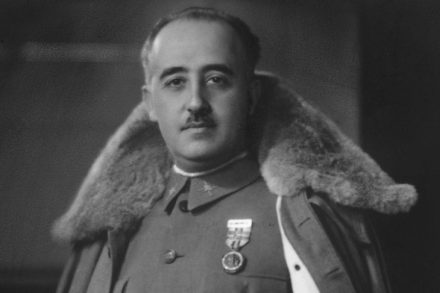
Franco’s deathly legacy

Spanish restaurants in Germany are relatively rare, but not nearly as rare as biographies of General Franco. So when the Spanish-born waiter in Bonn’s Casa Pepe approached my table, it struck me as an opportune moment to solicit his opinion about the former dictator. ‘No sé mucho,’ he shrugged. ‘I don’t know a whole lot.’ Just imagine it: an unexceptional army cadet becomes a general in his mid- thirties, leads the Nationalists to victory in a bloody civil war, wields absolute power for close to three decades, and then, barely a generation later, his memory is reduced to an indifferent shrug. The contrast with Germany’s treatment of its totalitarian past

The horror of Honduras

The Spanish journalist Alberto Arce worked for Associated Press in Honduras in 2012 and 2013. After a year, he says: ‘My wife and daughter left me. It was the right choice.’ Arce stayed on in the capital, Tegucigalpa, ‘fighting against addictions, sadness and depression’. He believes he ‘won’ that fight, ‘but only because each morning I counted down the days until I could leave’. So: Honduras, says Arce, is bad. How bad? He tells us that ‘Tegucigalpa is the most dangerous capital city in the world without a declared war.’ And that ‘in 2012 and 2013, more people were murdered in Honduras than in Iraq, even though the population in

How the CIA lost Afghanistan

Early every morning through the spring of 2002, US troops at Bagram airfield on the Shomali plains north of Kabul assembled on a makeshift parade ground. After the daily briefing, an officer announced the number of days since 9/11, read a short obituary of a victim of the attack and reminded the troops of their mission: to capture or kill those responsible for the worst terrorist strike ever in the US. Only a year previously, Bagram had been captured by the Taliban, who then exercised nominal control over 80 per cent of Afghanistan. Reduced to bombed-out buildings and a potholed, unusable airstrip, it was of limited strategic importance. Within weeks

Boxing not so clever

For Horace Hopper, the half-breed protagonist of Willy Vlautin’s bleak new novel, essential truths come slowly, and usually too late to do him any good. Abandoned by his Native American mother and Irish American father, he has exiled himself from the only people who love him, an elderly couple on a sheep ranch in deepest Nevada. His one idea for becoming ‘somebody’ is to transform himself into a world-champion lightweight boxer with a wholly fabricated Mexican identity. ‘Mexican boxers are the toughest… true warriors who never quit,’ he believes. Only well into the novel does it dawn on him that his self-inflicted loneliness is ‘a sort of disease’, not a

Culinary cold war at the White House

‘Tell me what you eat and I shall tell you what you are.’ The best known adage in food literature, penned by the French politician and gastronome Jean Anthelme Brillat-Savarin, divides all of us generally: the gourmands from the picky, the greedy from the careful, one nation from another, one culture from the next. Laura Shapiro’s book about six famous women and their ‘food stories’ made me want to re-read a few biographies for those food moments. Shapiro claims that food in life stories is undervalued as a subject, considering how much time people spend eating. Their tastes, loves, hates, phobias, habits and cravings can tell us as much about

What do Walt Whitman, Jackson Pollock and Jimi Hendrix have in common?

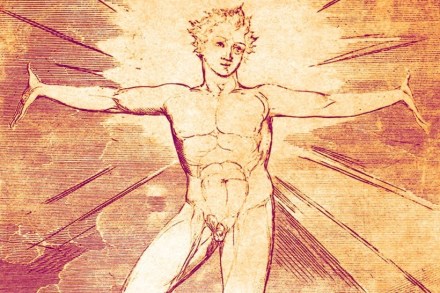
On 3 September 1968, Allen Ginsberg appeared on William F. Buckley’s Firing Line. Buckley exposed Ginsberg’s politics as fatuous — the blarney, stoned — but Ginsberg stole the aesthetic victory by reading ‘Wales Visitation’, a homage to William Blake. ‘White fog lifting and falling on mountain brow,’ Ginsberg intones, ‘…teeming ferns/ exquisitely swayed/ along a green crag/ glimpsed through mullioned glass in valley rain.’ ‘Nice,’ Buckley nods. He lets Ginsberg read the whole poem. Ginsberg opposes the artificial imagery of power and money (‘London’s symmetrical thorned tower / & network of TV pictures flashing bearded your Self’) to the vision of the unmediated, natural Self: ‘Each flower Buddha-eye.’ After six

Blake

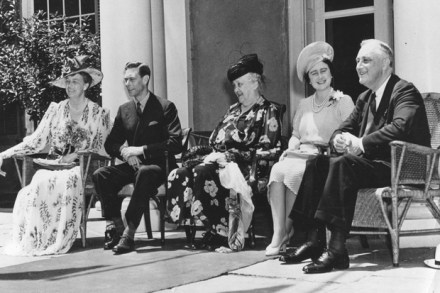
What America needs is another Franklin D. Roosevelt

Franklin D. Roosevelt isn’t as popular as he once was. When Barack Obama won the 2008 election, he let it be known that he was reading a book about FDR, and tumbleweed blew through the newsrooms. Which is odd because for many decades FDR was every bit the model liberal as Ronald Reagan was the model conservative. Roosevelt was credited with ending the Great Depression, laying the foundations of a welfare state and leading America through the second world war — achievements for which he was rewarded with not one, not two but four election victories. And he did all of this despite being an elitist East Coaster with a

It’s time to rehabilitate Ulysses S. Grant — scorned hero of the Civil War

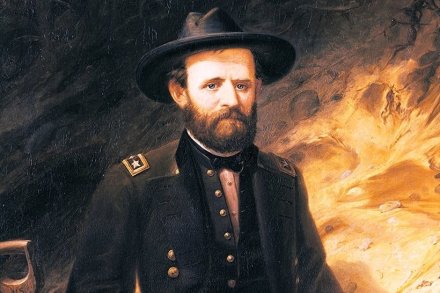
Last year, more than 6,000,000 people visited the Lincoln Memorial in Washington DC. By contrast, barely 80,000 went to General Ulysses S. Grant’s tomb in New York City. Some would argue that the neglect is no better than Grant deserves. But others, notably Ron Chernow, believe it’s time for a rehabilitation. Why do Americans pay so little attention to the man who beat the South in the Civil War and went on to become the 18th president of the United States? At least part of the answer can be found in the terrible alchemy of war. It spews out vast quantities of lead but, for some people, also spins gold.

Ulysses S Grant

On the run with Martin Luther King’s assassin

This newly translated novel by the Spanish writer Antonio Muñoz Molina is really two books, spliced together in alternating chapters. One is a deeply researched account of the squalid peregrinations of James Earl Ray, who spent two months on the run after murdering Martin Luther King, Jr., in 1968. The other is a memoir charting the gradual attainment of personal and professional happiness on the part of the author himself. The reader feels confident that both protagonists will eventually arrive at their historically appointed destinies: handcuffs at Heathrow airport for Ray; a career as a celebrated author for Muñoz Molina. But considerable suspense surrounds the question of what on earth

A cult of inspired amateurishness that seized the 60s

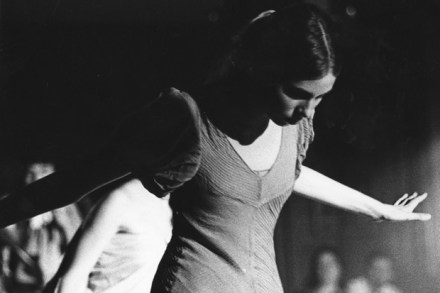
The Exploding Galaxy flashed brightly in the black-and-white world that was just coming to an end as I was growing up. When I first met them, my opinion of art was fixed firmly against what I thought of as amateur. I came from a theatrical family, dedicated to extreme professionalism and mockery of anything less. Whether it was holiday pantomimes, school plays or cabaret flamenco — anything short of Yehudi Menuhin and John Gielgud — we would be told how ludicrous they were, how comically inept. It seemed to be the only thing my parents agreed about, and so we went along with it. How we laughed! They would wrap