Arts Reviews

The good, bad and ugly in arts and exhbitions

Sistine sitcom

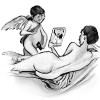
A rush of air. A mighty whooshing. That was the noise that filled my ears during the opening five minutes of On the Ceiling. It was the horrid turbulence of weighty ideas being picked up and flung earthwards to no good effect. Nigel Planer’s new comedy has such a brilliant and simple theme that you wish it’d been thought up by anyone other than him. We’re in Rome at the height of the Renaissance. Michelangelo is engaged in the greatest mission of his life, the painting of the Sistine ceiling. Two assistants, awaiting their absent employer, idle away the hours discussing the maestro’s abilities, his character and his place in

Far from barbarians

Some years ago, just before the Shah went into exile, I was touring the archaeological sites of Iran as a guest of the then Imperial Ministry of Culture. I wanted to see the extent to which archaeology was now acting as a means of establishing national identities. Near Hamadan there was a modern bridge over a ravine, whose sole purpose was to bring the visitor to two large cuneiform inscriptions in which Darius and his son Xerxes rather touchingly gave thanks to God for his gift to them of the land of Iran. With Iran’s chaotic history over the past two millennia in mind, I turned to my guide, a

Shades of Gray

Although marginalised or ignored for much of her long life, the designer and architect Eileen Gray (1878–1976) is now a hugely admired and influential figure, celebrated in the same breath as Le Corbusier, Marcel Breuer, Mies van der Rohe, Alvar Aalto and Charles Eames. I was first aware of her as the aunt of the distinguished painter Prunella Clough (who looked after Gray in her declining years), and acquainted with her work mostly through illustrations in books and catalogues. So this retrospective of her work was eagerly awaited, even though the Design Museum seems so often to be hamstrung by limited budgets. In the event, the exhibition is quietly exciting,

Character is destiny

I’ll be honest. I’ve watched less than bugger-all TV this week. The three bridge evenings (one of them, get this, tutored by the legendary Susanna Gross) didn’t help, nor yet did the parents’ barbecue evening at our kids’ new school, and Wednesday night is Pilates night so obviously that’s no good, and you wouldn’t seriously expect me to waste time watching preview tapes during my actual working day. But I did catch a bit of 49 Up (ITV1, Thursday) — will that do? Yes. We find this series especially intriguing in my family because one of the children whose fortunes the film has been following every seven years of his

A victory and a sell-out

News of England’s Ashes victory spread rapidly though Cortona’s ancient streets last Monday evening, as those with satellite TV rang the mobile phones of friends and families to pass on the momentous news. It was not, of course, Italians calling; Tuscans observed uncomprehendingly as the holidaying English roared at the result; and one resident Englishwoman let out a primal Home Counties scream of joy in a clothes shop, unnerving the proprietor. Only those with Channel 4 were in the know; the BBC World Service, I was told, boringly reported football results. Mysteriously, Test Match Special on Radio Four long wave doesn’t seem to be available abroad and, as we know,

Tale of the unexpected

The Royal Opera’s new season began with a nice big surprise: Donizetti’s last opera, Dom Sébastien, roi de Portugal, written for Paris in 1843, shortly before his fatal syphilitic illness set in. Far from there being any traces of failing powers, it strikes me as the strongest serious opera he wrote, even though it has a ramshackle libretto by Scribe which means that it is one of those works whose plots are best unravelled after you’ve listened to it — the Royal Opera, as has become its habit, did its first opera in concert form only which, all things considered, was probably a good idea. A magnificent cast had been

Chillier view

A publisher has just reprinted, in time for its centenary, H.E. Marshall’s Our Island Story (Galore Park, £19.99), which in its day was the immensely successful ‘History of Britain for Boys and Girls, from the Romans to Queen Victoria’. I’m old enough to remember this from first time round — it went through many editions —and it’s rather touching to see it again. It uses fables and legends, some possibly true, to illuminate the succession of monarchs, culminating in the glory of our Empire. Good people are rewarded and bad people, such as King John and Richard III, meet unhappy and well-deserved ends. This amiable view of our history is

French connection

Much trumpeted as the first exhibition to explore together the lives of Horatio Nelson and Napoleon Bonaparte, Nelson & Napoleon at once raises the double question of was it a good idea and does it work? This crowded display is a qualified success, with an audiovisual presentation which re-enacts the Battle of Trafalgar every five minutes or so in blips of light and moderate sound effects, and is curiously unconvincing as a centrepiece. Two upper floors of the National Maritime Museum, Greenwich, are given over to this large and ambitious exhibition, which is the highlight of SeaBritain 2005, a year-long festival of events around the UK (for more information consult

All in the mind

Interesting news from the world of conjuring. Magicians don’t believe in magic any more. Marc Salem, one of the new breed of sceptical illusionists, isn’t a clairvoyant or a mind-reader but a ‘professor of non-verbal communications’. And he boosts his university income by sitting in on CIA interviews to help the spooks decide when a suspect is lying. I certainly wouldn’t like to face him across the interrogation room. He’s as wide as he is tall, and he wears a black frock-coat which makes him look like a cross between a mad rabbi and a Victorian undertaker. His beard is unnervingly neat, he has shrewd little I-can-see-through-you eyes, and his

Discovering a master

The Canadian painter David Milne (1882–1953) is not known in this country. His name is shamefully overlooked by the Yale Dictionary of Art & Artists, and there has never before been a show of his work here. The fact that there is one now is largely due to the vision and enthusiasm of Frances Carey, who acquired three watercolours by Milne while she was deputy keeper of Prints and Drawings at the BM. However, even when there is a really superb exhibition of his work in London, the public is not beating a path to its door. (Would it be different, one wonders, if the show had been mounted elsewhere

The real thing

You were probably expecting me to watch Celebrity Shark Bait (ITV1, Sunday) but I didn’t because I was feeling a bit ‘been there, done that’ and, short of filming the celebrities actually being eaten, I couldn’t see how they could possibly have made it exciting. I expect there was lots and lots of build-up as the celebrities (Ruby Wax, Richard E. Grant, a couple of others you’ve never heard of) confessed how scared of sharks they were, followed by shots of them looking at fins in the water going, ‘Ooh, er. No way am I going into the water with them,’ followed by scenes of them in the cage going,

Life transformer

The revival of interest in what was called ‘early music’ in the 1970s and 1980s was a cultural event which went beyond a new way of making sounds. There was, for example, the dress code and the eating habits which were said to go with it. There was even a political resonance: Thatcher and Reagan were widely held never to have listened to a Josquin Mass. (Not that they were alone in that. We used to invoke that shade whenever an unattractive person, like a footballer or a captain of industry, was found to be behaving in a brutish fashion.) Having just attended the 24th edition of the Utrecht Early

Royal scandal

The Document series on Radio Four is often an absorbing pursuit of information triggered by the discovery of one document which leads to another. The sleuthing involved can be revealing about an historic event and occasionally is of some importance. But not always, it seems to me. This week’s programme, A Right Royal Affair (Monday) — the second in the current series of four — began without a document, namely the will of the Queen Mother, who died three years ago. The Queen succeeded in having her mother’s will sealed, its contents remaining a secret. This puzzled the presenter of Document, Mike Thomson, who told us that he’d always understood

The scent of sex

Towards the end of his life, John Betjeman was asked during a television interview if he had any regrets. Ravaged by Parkinson’s disease he tremblingly replied, ‘Not enough sex.’ The effect was at once comic, touching and desperately sad — like his best poems, in fact — and his words have haunted me ever since. From what you read in the public prints, you might think that anyone who writes for The Spectator is endlessly at it, that condoms are supplied gratis with each miserly pay cheque, and that once this column is completed I will be taking my pick from any number of admiring lovelies. Not a bit of

At full throttle

Andrew Lambirth on an artist’s relationship with the Llanthony Valley in south Wales On a warm but dampish day a month ago, I set off for the wilds of south Wales to explore the Llanthony Valley in the Black Mountains. The train takes the visitor as far as Abergavenny, after which you’re somewhat reliant on a car, unless you favour pony-trekking or have the leisure for hill walking. The darker green on the hillsides in July was bracken, the distinctive red earth slipping here and there into red mud after the cloudbursts of the day before. The narrow, twisty lanes climbed hills and traversed vales embowered with dank herbage, but

Seamless flow

I am always thrilled by a good performance of Giselle, especially when it is informed by choreographic consistency, dramatic fluidity and historical accuracy. That is why, last Friday, I left Sadler’s Wells in a jolly good mood. Indeed, Ballet Nacional de Cuba’s Giselle benefits greatly from the insight of its artistic director Alicia Alonso, a living legend and one of the 20th century’s greatest interpreters of the title role. Alonso’s acute sensitivity to the subtle nuances that underpin the classic does not stem solely from her dancing experience, but also draws clearly on historical research into the choreographic and performing formulae of the Romantic era. Attention to historical detail was

Look back with pleasure

The Bloomberg Space on the edge of Finsbury Square is a fine ground-floor gallery with rocketing ceilings that exudes wealth and sophistication. It’s a rare and pleasantly civilised experience to walk in off the street and not only be welcomed but also handed a complimentary catalogue of the exhibition. The catalogue is a modest illustrated pamphlet containing ample information about both artists and exhibits — sufficient even for the knowledgeable spectator. Here are none of the door-stopper tomes beloved of academic curators, just a neat, stapled brochure, and a handlist of the exhibits if you require more specific information. The surroundings are spacious and elegant. Museums should be like this.

Road to nowhere

It was an odd oversight, or possibly it was ignorance, which led Auden not to include Mussorgsky’s Khovanshchina in his list of ‘anti-operas’, for it lacks to an extraordinary degree many of the chief constituents which people associate, and rightly, with opera, while even more conspicuously including, often seeming largely to consist of, elements which virtually defy operatic treatment. It may be unfair to describe it, as one eminent conductor did, as ‘Sarastro meets Gurnemanz when both of them are having an off day’, but one sees what he meant. A disproportionate number of the characters are sung by basses, and when they meet — and they do tend to