Arts Reviews

The good, bad and ugly in arts and exhbitions

Separation anxiety

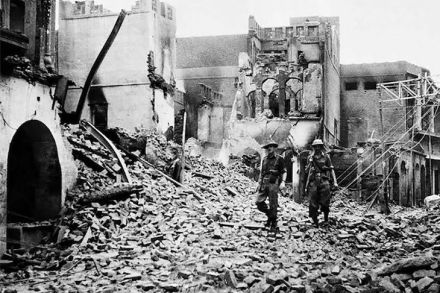
As Europe remembers Passchendaele, India and Pakistan recall Partition, just 70 years ago, when Britain so hastily abandoned its Indian empire, exhausted by the costs of war in the world and troubled by the upsurge in violence between Muslims, Hindus and Sikhs as the campaign for Britain to Quit India took root. In Partition Voices on Radio 4 (produced by Mike Gallagher, Tim Smith and Ant Adeane), we heard from those who witnessed the bloody terror that broke out across the subcontinent as it was divided on religious, not political, ethnic or communal grounds, many of whom fled to Britain to make new lives for themselves. Harun, who was a
An inconvenient truth | 3 August 2017

Maudie is a biopic of the folk artist Maud Lewis (1903–70) who is, apparently, beloved in Canada, and while Sally Hawkins is superb in the title role, and she will win you over (eventually), you do have to buy it as ‘a beautiful love story’. I bought it, hook, line and sinker — such a beautiful love story! — but then I read up on Maud (damn the internet) and had to significantly unbuy it. Does it matter that it may not be ‘the truth’? Or that a woman who was, in fact, severely disabled is presented mostly as someone with a slight hobble? I don’t know, frankly. But I

In praise of Netflix

All this week I have been trying, with considerable success, to avoid being bludgeoned by TV programmes telling me in various sensitive and imaginative ways just how brilliant, heroic and historically maligned homosexual men are. I achieved this by sticking to Netflix. One of the great things about Netflix (whose annual subscription costs just half the BBC licence fee, by the way) is that though it’s probably run by lefties it doesn’t try to ram its politics down your throat. Maybe this is one reason why its 100 million-plus subscribers are so much less resentful than BBC viewers: they’re being offered choice, variety, entertainment — not worthiness, race, gender quotas

Starting block

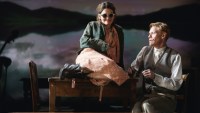
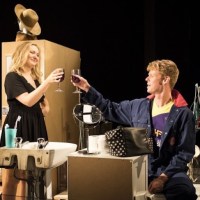
Conor McPherson’s new play is set in dust-bowl Minnesota in 1934. We’re in a fly-blown boarding house owned by skint, kindly Nick who has designs on a sexy widow with a big inheritance coming. Good opening. Roll the story. But there’s more. Nick’s useless son is a depressed novelist entangled with a beautiful governess betrothed to a rich man she doesn’t love. An even better opening. Roll the story. But wait. Nick has a black maid called Marianne whom he rescued as a baby and raised as one of the family. An interesting complication. Roll the story. No wait. Marianne claims to be pregnant but declines to reveal whether the

Show up and show off

The Edinburgh Festival was founded as a response to war. The inaugural event, held in 1947, was the brainchild of Rudolf Bing, the manager of Glyndebourne Opera, and Henry Harvey Wood, a British Council grandee. Both were convinced that a festival of music and theatre was needed to restore the artistic heritage of Europe after six years of devastation. Edinburgh recommended itself as the host city because of its cultural prestige, its picturesque location (to rival Salzburg), and its ample store of theatres and hotels that could accommodate hundreds of performers and thousands of visitors. That the Luftwaffe hadn’t flattened the city was a significant mark in its favour. The

Balkan brass

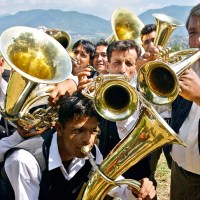
When brass instruments with button-operated valves were introduced in the first half of the 19th century, music-making changed. Once requiring a semi-professional approach, it could now be quickly mastered by large groups of working people. A noisy result were Britain’s colliery bands: but a more spirited upshot was Serbia’s trumpet tradition. Like the colliery bands, Serbian brass music had a political imperative — re-weaving national identity after 500 years of Turkish occupation. The leader who first hit on trumpets as a vehicle for this joie-de-liberté was Prince Milos Obrenovic, who created the first Serbian brass ensembles in 1831. They took swift hold, providing an outlet for everyday south Slav exuberance. The

1967 and all that

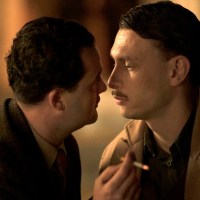
As you may have spotted, the BBC is marking the 50th anniversary of the decriminalisation of male homosexuality with an extended gay season. (And if you haven’t, I can only assume you’ve seen and heard no BBC trailers for months.) The centrepiece this week was Against the Law (BBC2, Wednesday), which dramatised the story of Peter Wildeblood, a Daily Mail journalist imprisoned for 18 months in 1954 for the possibly overlapping crimes of buggery and gross indecency. But — double entendre alert — Wildeblood didn’t take this lying down. After his release, he published a book making the case for legalisation. In the central role, Daniel Mays captured Wildeblood’s reluctant

Heavy-handed

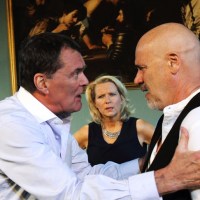
Oliver Cotton is an RSC stalwart who looks like a man born to greatness. Google him. He has the fearless jawline of Napoleon, the diabolical stare of Heathcliff, the tumultuous eyebrows of Michelangelo and the streamlined quiff of Liberace. And there’s something richly corny about his appearance too, as if he were Bill Nighy done up as a 1970s porn baron. When he isn’t treading the boards, Cotton writes contemporary thrillers and his latest effort, Dessert, is directed by Trevor Nunn. We’re in a London mansion where smug billionaire Hugh Fennell and his gem-encrusted wife are showing off their latest toy, a Renaissance oil painting, to a pair of rich

What stopped Stoppard?

Two programmes this week presented two radically different world views, or rather ways of life. Aditya Chakrabortty’s series for Radio 4, Decoding the News, looked at five words or phrases which have come to characterise how politics, finance and business operate in the UK. We entered a world of policy wonks and pundits, of words used not to enlighten or explain but to calculate and confuse. A world in which those who tell stories get all the attention, while those who insist on sticking to the facts are ignored or on occasion ridiculed. It made for chilling listening as, for instance, Chakrabortty deconstructed the meaning of that slippery term, ‘shareholder

Strong stuff

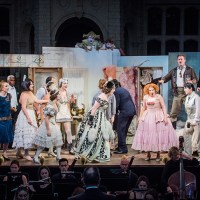
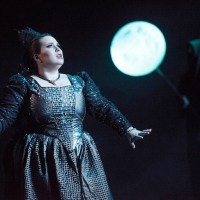
The strings sweep upwards, the horns surge, and Leoncavallo’s Zaza throws itself into your arms. We don’t know it yet, but we’ve just heard the drama’s focal point: what David Lynch would call its ‘eye of the duck moment’. The same music recurs near the end of Act One, as the fumbling attempts at seduction of the small-time showgirl Zaza finally come good, and she locks lips with Milio Dufresne, the Parisian dandy who she imagines will take her away from the seedy, bustling demi-monde that we see laid out around her. For now though, in Marie Lambert’s production, the entire cast — playboys, pierrots, divas and stagehands — files

Game of Thrones gets back to brutal business

A good measure of whether Game of Thrones is feeding you a placeholder episode is to imagine trying to spoil it for a close friend who has yet to watch. After the series opener, ‘Dragonstone’, I was left scrambling for ways in which I could ruin the viewing experience for virgin eyes. Daenerys arrives at Dragonstone? Not exactly news. Cersei schemes against everyone? Change the record. Jon Snow makes a brooding, portentous speech about the White Walkers? Got the t-shirt. And it took a fair time for season seven’s sophomore effort, ‘Stormborn’, to tread new ground, but, when it finally did, it was in a heady blaze of sex and

Ivory towers

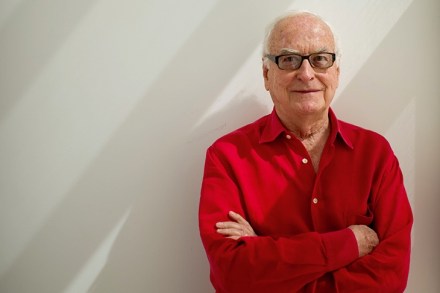
Great novels rarely make great movies, but for half a century one director has been showing all the others how it’s done. James Ivory has worked his magic on all sorts of authors, from Kazuo Ishiguro to Henry James, and this week the finest of all his adaptations returns to the big screen. ‘A film that’s almost two and a half hours long, non-stop talking, set in the Edwardian era — who would have thought that would be such a huge success?’ says Ivory, on the phone from his home in upstate New York. Yet somehow, this taciturn director turned a wordy novel by E.M. Forster into a gripping drama.

Kids Company faces the music

It was surreal to sit in the Donmar Warehouse and watch Committee, a musical based on the investigation into the charity Kids Company. The first oddity was that anyone ever thought to write a musical based on the transcript of a Public Administration and Constitutional Affairs Committee. The second, that this production wouldn’t have existed if The Spectator hadn’t published an article (by me) raising questions about Kids Company’s appallingly managed finances and the behaviour of its chief executive, Camila Batmanghelidjh. It’s strange that Camila has come to this. In February 2015, it was considered sacrilege to utter a word against her. She was the untouchable friend of the BBC, banks,

The joy of the Proms

Summer nights, hot and humid, mean just one thing — it’s Proms season again. Sore feet, sweaty armpits, queuing outside the ladies loos, home on the Underground with a head and heart buzzing with Bruckner or Bacharach, Handel or Honegger. Just as special is the nightly feast on Radio 3 — a live concert, guaranteed every evening, and on top of that specially commissioned talks and literary events to get us thinking. On Sunday afternoon, in between the Mozart and Schumann performed by Bernard Haitink and the Chamber Orchestra of Europe (COE) at the Royal Albert Hall, Sarah Walker took us inside the working life of an orchestra. What does

Out of sorts at the RSC

The RSC’s summer blockbuster is about Queen Anne. It’s called Queen Anne. It opens at the Inns of Court where drunken wags are satirising the royals with a naughty sketch about boobs and beer guts. Everyone on stage pretended this was hilarious. A few audience members did too, out of politeness. The principal characters arrive with their dramatic goals on display. Queen Anne wants to rule wisely. Her general, Marlborough, wants to conquer widely. His wife, Sarah, wants to help her monarch to rule wisely and her husband to conquer widely. And Sarah’s scheming cousin, Abigail, wants to befriend the Queen so that she can marry a steady salary. These

New kid on the block

The new Grange Park Opera at Horsley is amazing, as everyone who visits it must agree. In less than a year a pretty large, comfortable theatre, with excellent acoustics and a large stage, has been erected from nothing, and among the first productions is one of Die Walküre, a demanding work in all respects, and one which, when it is largely successful, as the performance I went to was, provides an exalting and moving experience such as few works can. You probably need to be as difficult and abrasive a personality as Wasfi Kani to bring it off, but there is no doubting that she has. The ‘creative team’ has