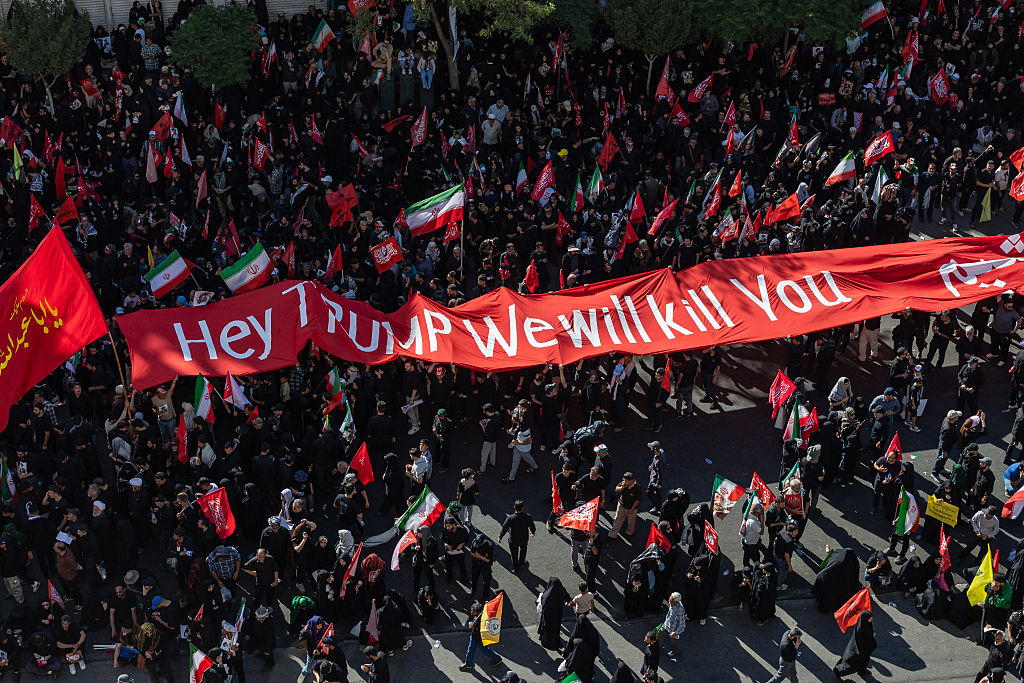
With the reimposition of the American naval blockade against Iran, the Memorandum of Understanding (MOU) between Washington and Tehran seems dead. Its demise reveals the Islamic Republic for what it has always been: an aggressive, terroristic power that has no interest in rejoining the community of nations.
The Trump administration demonstrated with the MOU that it was willing to go big on sanctions relief for Iran. As part of its terms was a General License X that permitted Iran to sell oil using dollars for the first time in decades. The US military blockade was lifted. Discussions were beginning on the unfreezing of billions of dollars in frozen or restricted Iranian assets. The document also dangled a $300 billion investment fund for economic development and reconstruction of the country as part of a final settlement.
But this outstretched American hand was met once again with an Iranian clenched fist. And not for the first time. Since 1979, the US government under multiple administrations have engaged the Islamic Republic in the hopes of improving relations. But to no avail. During the Carter administration, White House chief of staff Hamilton Jordan spearheaded secret diplomacy with Iran’s foreign minister Sadegh Ghotbzadeh over releasing American diplomats held hostage. Ghotbzadeh was later executed, and while the hostages were eventually released, Tehran continued to hunt Americans. During the Reagan administration, the White House’s entreaties to Iran over arms for hostages unraveled in scandal. In 1989, after then-president George H.W. Bush pledged ‘goodwill begets goodwill’ and appeared cautiously optimistic about Ali Akbar Hashemi Rafsanjani’s ascension to the presidency given his pragmatist tendencies, Iran responded with more support for terrorism that killed US citizens.
During the Clinton administration, Tehran spurned American efforts at dialogue, rejecting meetings with Iran’s foreign minister and president during their visits to the United Nations in New York. Despite President George W. Bush authorising bilateral talks in 2007 – for the first time in decades – over Iran-backed killings of US servicemembers in Iraq, Iran continued to attack Americans throughout the region. President Obama’s inking of a nuclear deal with Iran only temporarily constrained its atomic capabilities while bankrolling its Quds Force via sanctions relief and feeding its appetite and budget for militias and missiles. Tehran rejected multiple Biden administration offers to revive the Obama nuclear deal that President Trump withdrew from in his first term.
While President Trump too has attempted diplomacy with Tehran, he is different from his predecessors. None ever married significant military with economic pressure. They were focused on the latter while punting on the former.
Iran has tried to reset the rules of the region by asserting unilateral sovereignty over the Strait of Hormuz, responding aggressively to US enforcement of freedom of navigation, and striking Israel over its attempts to neutralise Hezbollah.
Now, Iranian strategists, like the supreme leader’s military advisor Mohsen Rezaei, view the Strait of Hormuz as one of the regime’s most important strategic assets ‘more important than dozens of nuclear bombs.’ But this hasn’t fully deterred the United States from strikes on Iranian soil. And as the late secretary of the Supreme National Security Council (SNSC) Ali Larijani reportedly warned, the closure of the Strait of Hormuz is a card that could be played only once effectively. In the long run, it is a diminishing asset as Iran’s neighbours begin developing alternatives that bypass the Strait of Hormuz.
Conventional wisdom has framed the collapse of the Memorandum of Understanding as down to drafting mistakes, bad negotiating, and mistrust between parties. But that is a misreading. The agreement collapsed because of the nature of the Iranian regime as an international pariah, a regional bully, and a domestic dragnet that is not seeking peace. As President Trump recently told a radio show, the MOU was a test for Iran, and it failed.
The regime in Iran does not view diplomacy as a means of solving problems with the United States as Washington does. It views diplomacy as an extension of its conflict with America.
The Iranian regime’s violations of the MOU were manifold. It continued to attack ships crossing the Strait of Hormuz, its media ecosystem and military created uncertainty as to the Strait of Hormuz’s status, it threatened to kill American citizens, the IRGC instigated Hezbollah to fire at Israel, and it continued construction at nuclear facilities like Pickaxe Mountain – despite provisions in the MOU which mandated the status quo of Iran’s nuclear programme be preserved. The US government rightfully responded to these breaches, and the MOU’s fate was sealed.
The Iranian officials the US was working with should be held personally accountable as well. The US government has given them temporary immunity while diplomacy was underway. But they have not delivered. Reports indicate the US government will be ramping up sanctions against corrupt IRGC commanders. For a start, American sanctions should be levied against Speaker of Parliament Mohammad Bagher Ghalibaf and Iranian Foreign Minister Abbas Araghchi. Ghalibaf has escaped American sanctions to date. He would be a prime candidate for sanctions under multiple authorities, including for human rights abuses dating from his service on the SNSC when it issued a live fire order against Iranians protesting in January.
Araghchi too should be sanctioned as he is a member of a foreign terrorist organisation, the IRGC. Just as when Javad Zarif was sanctioned in 2019 when he was foreign minister, Araghchi should similarly be designated under this authority.
Supreme Leader Mojtaba Khamenei, who has already been sanctioned by the US government, should be indicted amid an existing Justice Department probe into alleged money laundering.
Critics of President Trump suggest he has no strategy. But he has had a consistent strategy all along: one of coercive diplomacy. The President lays out his demands, gives Iran an off-ramp, sometimes sets a deadline, tests their willingness to engage, and if they don’t in good faith, he strikes. The defunct MOU is just another chapter of that same coercive diplomatic dance. It will continue until US objectives are met.


Comments