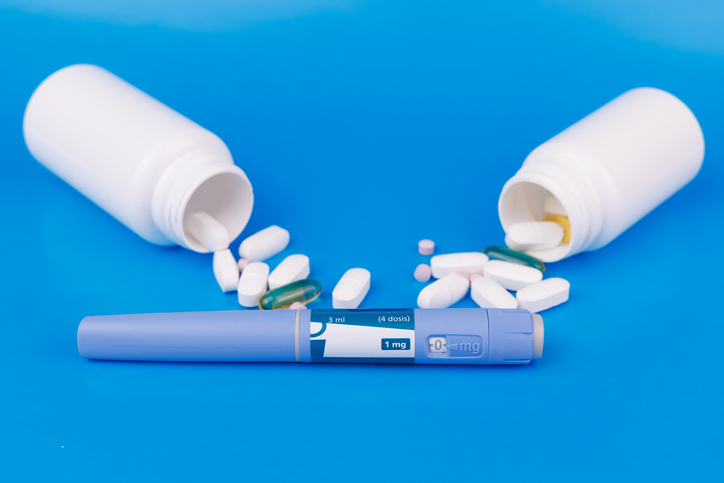
‘The weight is over,’ read an advert on the side of a bus outside my hospital this morning. The first really effective pill for weight loss has now been on sale in Britain for just over a month.
Wegovy – it has the same brand name as its injectable equivalent – is a semaglutide. Ozempic is the same drug at a lower dose, sold to treat diabetes. Mounjaro is more effective than Wegovy but is injection-only. Lilly hopes its rival pill – Foundayo, orforglipron – will soon be licensed here; already it’s on sale in America. Drugs have a brand name, which is capitalised, and a generic name, which is not. (An odd exception is aspirin, which was Bayer’s trade name, but which they largely lost as the result of the first world war. Since, as part of the conglomerate I. G. Farben, they started bankrolling the Nazis from 1933, we need not feel sorry for them.)
You can’t get oral Wegovy on the NHS, at least not yet, but demand in the private sector has been huge. Boots reported thousands of completed online consultations even in advance of the 6 July launch. Chemist4U said its waiting list ran into the tens of thousands. Private Britain has embraced a medical revolution – the NHS, in contrast, is rationing it almost into oblivion.
If you want weight loss drugs and can afford to pay for them yourself, then you should
Estimates suggest well over 2 million people in the UK are already using these new weight loss drugs, almost all privately. These drugs differ from those which came before chiefly in the fact that they actually work and work brilliantly. With the most effective of them, people can lose 20 per cent or more of their weight. And it stays off – as long as they stay on the drugs. Some people think of the need to keep taking them as a flaw, but we don’t apply the same logic to drugs for blood pressure, or to replace missing thyroid hormones. These drugs do what seemed unthinkable a few years ago, but they’re largely for life.

By next year, the number of people taking weight loss drugs is projected to hit 7 million. New and more powerful ones are already in development, more data is being gathered about the health benefits, and those numbers may turn out conservative. Like many of the other drugs we take in increasing quantities, to control our blood pressure and blood sugar, to reduce our cholesterol, one way of conceiving of them is that they postpone some of the hazards of age.
A cliche already in circulation is that these drugs free you from the ‘noise’ of always thinking about food, of always being tempted. I find it a welcome sort of music, and often a symphony, and will avoid these drugs for as long as I possibly can. I adore eating. An addiction to sport as a young man has left me with a lingering taste for the gym, but exercise has always been something I have relished partly because it meant I could eat more, and with greater satisfaction – the best sauce for food being hunger, as the great philosophers (Socrates, Cicero, Sancho Panza) have noted.
Not getting at least a little plump as you get older sometimes seems to me to represent a deficit of happiness. Chiselled men of my age look gaunt – dangerously lean and hungry. Thin, sort of stretched, like butter scraped over too much bread, to quote that other great philosopher, Bilbo Baggins.
Blessed with good genes and a helpful gym habit, I am delighted these drugs exist and equally delighted to avoid them myself. How shameful that the NHS has thus far opted out almost altogether.
My wife, the professoressa who works with these drugs, tells me that the current average BMI for NHS patients getting tirzepatide – Mounjaro – is 46. For a man of average height, hitting a BMI of 46 requires him to reach 22 stone. I hold fast to my fond belief that a little pudge around the middle is often a sign of happiness. To be 22 stone and average height is not. It’s a sign something has gone badly wrong.
If you want weight loss drugs and can afford to pay for them yourself, then you should. If you can’t, and you need them, there should be help. Not an infinite amount, but significantly more than requiring people to reach a weight at which they will be massively unhealthy. The NHS’s official eligibility criteria for 2026/27 allow patients whose BMI is over 35 so long as they have four or more ‘qualifying’ co-morbidities. NICE estimates that 3.4 million people qualify for tirzepatide. NHS England plans to reach only 220,000 during the first three years and allows itself up to twelve years to treat the rest.
The state should not fund cosmetic slimming. Preventing diabetes, heart attacks and strokes is a different matter. These new drugs can prevent the worst consequences of obesity, and we’ve designed a response that withholds them until several have already arrived. For those who need these drugs most, the weight is not over.






Comments