
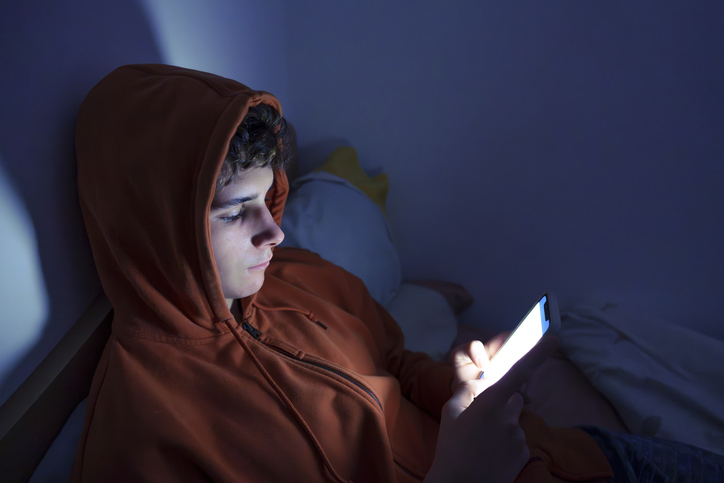
Today, with much fanfare, the British government is rolling out its new policy to protect young people from online harms. Here is a political/legal move for which I am the target audience. I have three teenagers, and for those not so afflicted, let me tell you that keeping them from spending all day, every day goggling at one piece of tech or another is an infernal game of whack-a-mole.
Item: Child One, Instagram. Very, very occasionally, she forgets to delete her browser history and Ctrl-H yields page after page after page, hour after hour, of Instagram hits. If you restrict or remove the phone app, it will be re-downloaded or the site opened instead in a browser window. My ISP used to allow an admin to block specific sites at the router, but (as I discovered after around an hour with their tech support), our useless service provider has removed this feature. After much wrangling, I installed a third-party DNS blocker. Daughter circumvents the router by tethering a device to her mobile data.
Item: Child Two, Snapchat. We currently have two overlapping screen time restrictions: the native iPhone settings and an app called Qustudio which vexes my son and pleases me by blocking his phone apparently at random. Only this morning, I was exchanging messages with his mother about how much time he’s spending on his phone while on an exchange visit to France. In ping the requests – just 15 minutes more, pleeeease – and back and forth go the arguments. Do the different restrictions interfere with each other? Is he circumventing this while we loosen that? Does he really need downtime off so he can listen to music? It’s exhausting.
Saying under-16s should be banned from certain tech is easy to do
Item: Child Three, YouTube, Minecraft, Rocket League, etc. Finally, and only by standing over his shoulder for ten minutes to make sure that he finishes his game, do you persuade a very resentful 12-year-old to turn off the PlayStation. You go to put the kettle on and return to find he has installed himself on your desktop computer and is watching YouTube shorts. You kick him off the computer and send him upstairs. On following him, you discover he’s found a laptop and is watching YouTube shorts. “I was waiting for you!” You kick him off the laptop and send him to brush his teeth. You find him brushing his teeth with a phone in his hand, watching YouTube shorts. You snatch the phone. He laughs like Daffy Duck and produces an iPad from a pocket you didn’t know existed. You snatch the iPad. Another even bigger iPad appears from an even smaller pocket. Snatch! Now *your* phone appears in his hand. You go to snatch it and he produces a cartoon hammer marked ACME and biffs you on the bonce. Little blue birds fly tweeting round your head, looking – it strikes you dizzily – a lot like the old logo for Twitter.
This multi-front battle, or versions of this multi-front battle, is taking place in homes up and down the country – as parents spend significant portions of their only lives on earth trying, and mostly failing, to keep their children’s screen time down to a reasonable level. And this is to say nothing of what they are *actually* watching. Are they being groomed, bullied or abused in addition to having their brains rotted by AI slop, vacuous influencers and videos of people cutting cheese toasties in half? Who knows?

And, look, I get it. I find my phone addictive (and I know a bit about addiction). You find your phone addictive. Children, with their still-forming prefrontal cortexes, with their poor impulse control and their extreme susceptibility to peer pressure, don’t stand a damn chance. The children’s laureate Frank Cottrell-Boyce has said something that sticks with me: that when kids are scrolling social media or bingeing YouTube shorts or Instagram reels, they aren’t being entertained, they’re being sedated. They are. Sedation – numbing, distraction, not having to think too much – is exactly what substance abuse can offer and what digital media offers too: the drip-drip-drip of a trivial dopamine hit being chased again and again.
We, as parents, find it very hard and very tiring to invigilate even the amount of time that is spent on these screens – digital natives will tend to run rings around us, and addicts are notoriously ingenious when it comes to protecting their supply. That is even before you get to how you go about screening the content, and it’s not as if Big Tech shows much interest in helping. Yesterday’s report that X refused to remove multiple posts calling Kemi Badenoch the n-word, despite having them repeatedly flagged through their harassment reporting system, was so routine as to barely register.
So, of course, a crackdown will sound to No. 10 like an easy win. My 12-year-old’s Looney Tunes routine is annoying, but it’s trivial by comparison with the plight of those parents whose children are suckling at the poisoned teat of Andrew Tate, are asking ChatGPT for advice on how to kill themselves, are accessing self-harm or pro-anorexia content, or are circulating revenge porn among their classmates. No wonder many parents cry out for the state to take at least some of this problem off their hands. Nine in 10 are said to back a ban on under-16s using social media. And we feel, absolutely, Culture Secretary Lisa Nandy’s rage at the tech companies that profit from all this harm while doing nothing about it. As she told Laura Kuenssberg yesterday:
Tech companies have had more than enough time to get their own house in order and to be able to create products that keep children safe online. If they are not prepared to do it, they lose the right, frankly, to market their products toward children.
So at the time of writing, it looks like we’re heading for a full ban on all social media for under-16s and some sort of mandatory tech-induced curfew where even under-18s won’t be able to scroll anything after a certain time at night. So, what’s not to like?
There is, on one level, a principled position to do with *not* making parenting the business of the state; with saying that, however insoluble and costly the failures, it isn’t a problem for government. I don’t buy that, personally: it’s the sort of idea you’d come up with at a think tank rather than in light of any contact with actually-existing teenagers. The ultra-libertarian position abandons parents to an unequal fight with vast multinationals who make money from selling something that’s at best addictive and at worst deadly. The state stops newsagents selling cigarettes to ten-year-olds, and most people agree that’s a good thing rather than a dramatic infringement of age-old yeoman liberties.
The more creditable objection is that banning under-16s from social media will be as effective as Owen Glendower’s grandiose boast in Henry IV: Part 1 that he can “call spirits from the vasty deep” (retort: “Why so can I, and so can any man; but will they come when you do call for them?”). Or, as the old syllogism has it: something must be done! This is something! So it must be done!
Saying under-16s should be banned from certain tech is easy to do. Actually keeping them off it – as the Australian precedent shows, not to mention, hem hem, the situation in my own house – is a bit tougher to enforce. Online harms come in many forms, not all of them through social media, which is in any case hard exactly to define. Is WhatsApp social media? And though we can imagine some sort of passport scan or facial recognition mechanism to verify identities for the big individual sites (with all the privacy/data-harvesting issues that will raise), the mechanism for this curfew is difficult even to imagine. And what, meanwhile, of start-ups, unregulated Android apps, browser-based services and so on that will offer an even less secure environment than the horrors of Meta and TikTok and X?
Pause should certainly be given, I think, by the fact that Ian Russell, the father of a teenage girl who died by suicide after viewing self-harm content online – and who has campaigned for years to hold Big Tech to account for online harm – doesn’t think it’s a good idea. He says it makes more sense to implement existing laws than to use “sledgehammer techniques like bans.”
At present, then, we have a headline, not a policy. Until we learn exactly how it is to be implemented, how enforced and how insulated from the law of unintended consequences, it will remain no more than a headline. But I won’t be alone in thinking: what a pretty headline.






Comments