
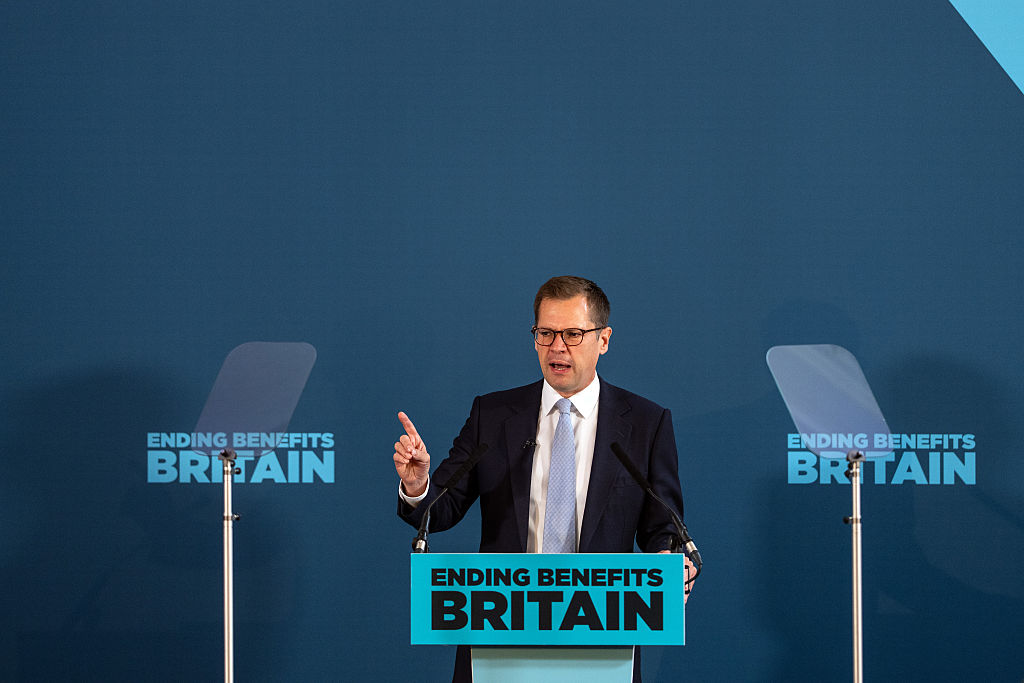
Well done to Reform UK for proposing to make chunky, £50 billion cuts to the welfare budget, more than twice the £23 billion cuts the Conservative have pledged to make. The left will scream about kicking away the crutches of the poor and sick, but the benefits system has become a voracious beast that is rapidly consuming the country. The bill has risen by 27 per cent in real terms since 2014/15.
Try to reform welfare without touching the state pension and you are tying one arm behind your back
We have opportunists claiming Personal Independence Payments for anxiety and food intolerances, and people hoodwinking officials who carry out online Work Capability Assessments into allowing them a public-funded life of leisure. Robert Jenrick is quite right to force long-term benefit claimants to turn up and do some work in return for their benefits. When John Major tried the same in a pilot scheme in the 1990s nearly half the claimants evaporated. Either they decided they could get a job, after all, or they probably were working and claiming benefits fraudulently on the side. Jenrick is also right to say there is nothing kind about trapping people on welfare; doing so is setting them up for a life of failure.
But hang on, isn’t there a rather giant hole in Reform’s plans? There is one benefit which didn’t even get a mention, other than in reassurances that it wouldn’t be cut: the state pension. And yes, it does deserve to be called a ‘benefit’. There is no accumulated state pension fund set up to fund the payments; they are paid out of the pockets of today’s taxpayers. But no matter, insists Jenrick: no pensioner will suffer as a result of the welfare reforms. Indeed, the party has committed itself to maintaining the triple lock.
Why? Try to reform welfare without touching the state pension and you are tying one arm behind your back. In 2024/25 the state pension accounted for £143.5 billion of the overall £304 billion welfare bill. The triple lock has already added over £12 billion a year to the annual state pension bill, relative to what it would have been had pensions simply risen in line with average earnings.
The triple lock is a ratchet which, if carried on for long enough, will inevitably bring ruin to the public finances. Given that the state pension can never rise less than average earnings, but may sometimes rise more than it, we will eventually reach the situation where the state pension is worth more than the average wage. Given that the state pension is funded out of taxes on wages, it isn’t hard to spot the slight issue here.
Supporting the triple lock is also a poke the eye to people who complain about intergenerational unfairness. Given the dire situation of the public finances, everyone is going to have to bear the burden of rebalancing public expenditure with revenue. To protect retired people while hammering those of working age is, not unreasonably, going to generate a little ill-feeling. Are Reform UK’s strategists sure of the demographics of its voters? It might make a reasonable core vote strategy for the Conservatives to go out of their way to offer goodies to the over 65s, but if Reform UK wants to form a government it is going to have to appeal to working-age voters in Red Wall seats.
One of the most underrated political slogans of modern times was ‘we’re all in this together’ – which appeared throughout the Conservative party’s 2010 manifesto. It successfully made the case for spending cuts by reassuring voters that it wouldn’t just be them who felt the pinch: it would be everyone. Reform UK’s slogan should be ‘don’t you worry, we’re going to pick on everyone else’.
Reform UK’s £50 billion of benefit cuts might sound a lot, but it won’t quite bring the welfare bill down to what it was in 2014/15, as government is spending £65 billion extra in real terms than it was a decade earlier. I have a modest proposal as to where the other £15 billion could come from: reverse the triple lock and bring the state pension back to where it was, in real terms, 12 years ago.






Comments