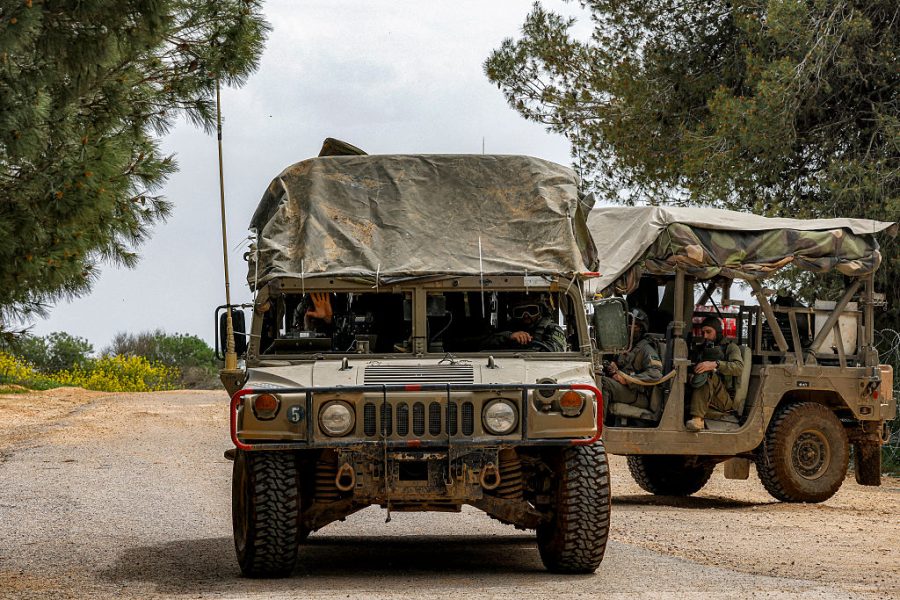
Israel launched a limited ground operation in southern Lebanon this week, intended to expand the de facto buffer zone which it has maintained along the border since the ceasefire of November 2024. At that time, Israel held control of five positions on the Lebanese side of the border. In response to Hezbollah’s decision to re-engage with Israel in the context of the current conflict between Jerusalem and Tehran, the IDF is pushing further into Lebanon.
Israel is now bombing Hezbollah targets throughout the country. Ground forces, meanwhile, are cautiously pushing forward. According to Israeli media reports, the IDF’s goal is to establish 13 additional positions north of the border. Eight-hundred and eighty-six Lebanese have been killed and 2,141 wounded, according to Lebanese government figures. Twelve Israelis have been killed and 247 wounded. Hezbollah fire on Israel’s northern communities is continuing. Unlike in the previous round of fighting, the government of Israel has not evacuated border communities.
If this all sounds like something you’ve heard before, that’s because it is. For those of us who spent part of our younger years defending Israel’s northern border, the familiarity is wearisome. I can only speak with certain knowledge for the Israeli side on this matter, but I suspect sentiments may not be too different among many on the other side too.
Israel trusts only measurable and physical realities
The town of al-Khiam, for example, is hitting world headlines at the moment as a site of clashes between troops of the IDF’s 36th Division and Hezbollah fighters in the last couple of days. Khiam, located on high ground just a few kilometers from the border, is a Shia town and a center for the terror group’s support. In the summer of 2006, I spent a not very pleasant hour or so in an improvised defensive position in an irrigation ditch below Khiam with a group of comrades and beside the body of a good friend, after our tank was hit by two Kornet missiles fired from the town. This happened during the Israel-Hezbollah war of that year. These sorts of associations are not unusual for Israelis of my generation and the preceding one.
The issue of the contraction or collapse of Lebanese sovereignty and the subsequent use of the country’s territory by non-state Arab and Islamist military organizations for war against Israel has been around since the late 1960s. Back then, it was Palestinian and Arab nationalist groups who sought to use the border area as a launching ground for attacks on the Jewish state. That ended with the Palestine Liberation Organization’s departure for Tunisia in the wake of Israel’s invasion in 1982.
But Lebanese sovereignty and the Lebanese state didn’t replace the Palestinian gunmen on the border. Rather, Israel sought to maintain a “security zone” to its north. Tehran’s Islamic Revolutionary Guards Corps (IRGC) established one of Iran’s first proxy military groups, Hezbollah, to fight Israel in this area. This long insurgency (1985 to 2000) brought about Israel’s withdrawal to the international border. The state didn’t return at that time, either.
Hezbollah, rather, with its hundreds of millions of dollars in yearly support from Iran, grew to become the most powerful political and military force in the country, with capacities beyond those of the state’s own army. It initiated and fought another inconclusive war against Israel in 2006. It brushed aside a feeble attempt by the state to challenge its power in 2008. It then chose to launch yet another war against Israel in October 2023.
What has made all this possible – and continues to make it possible – is the combined lack of will and capacity of the Lebanese state to end the presence of non-state military organizations on Lebanese soil. Israel seeks nothing but quiet from Lebanon. Observable reality in Jordan and Egypt shows that when neighboring governments with full authority sign peace agreements with Jerusalem, the result is quiet borders.
In the Lebanese case, both political elites and publics have a visceral fear of a return to civil war. Hezbollah and its supporters are the only exception to this prevailing sentiment. The terror group is stronger than the state armed forces. The Lebanese army contains a high percentage of Shia soldiers who would probably refuse to engage against their fellow Shia, causing the state forces to split and become unusable. As a result, things in Lebanon don’t change, and Hezbollah, when its masters in Tehran decide, periodically launches war across the border.
Is there any sign of this pattern being broken? The current Lebanese government talks a stronger language than its predecessors. Prime Minister Nawaf Salam has declared Hezbollah’s weapons to be illegal. President and former Lebanese Armed Forces General Joseph Aoun has accused the Shia Islamist movement of seeking to bring about “the fall of the Lebanese state… at the price of destroying dozens of our villages and the fall of tens of thousands of our people for the sake of the Iranian regime’s calculations.” Aoun has said he will “confiscate all weapons” from Hezbollah following a negotiated ceasefire.
Few in Israel are convinced by these statements, however. They see them as representing an effort to avoid a major Israeli incursion by making promises, after which the status quo ante can resume.
Something has shifted, nevertheless, on the Israeli side. Some analysts have suggested in recent weeks that the Jewish state following October 7 has adopted a new strategy in which, rather than containing or deterring enemies, it now seeks to conclusively defeat them.
In reality, the complete destruction of the regime in Iran or of Hezbollah in Lebanon may be hoped-for outcomes but are not goals that can feasibly be achieved by force of Israeli arms alone. What has changed is that Jerusalem no longer seeks to deter or to impact the consciousness of the other side. Rather, it trusts only measurable and physical realities.
In the case of Iran, that means a campaign to reduce the regime’s capacities to do harm to the greatest extent possible. In the cases of Gaza, Lebanon and Syria, what it means is physical buffer zones intended to place a barrier between organizations or regimes hostile to Israel and Israeli civilian communities, plus the use of air power as and when deemed necessary. This is an adjustment to an existing reality, rather than a plan to fundamentally change it.
The expansion of the Israeli buffer zone north of the border in Lebanon forms a component of this wider approach. As things currently appear, it is a limited and carefully calibrated operation. It is predicated on the unfortunate and probably accurate assumption that this round of fighting for Israel in Lebanon is probably not the last. Déjà vu all over again.

Comments