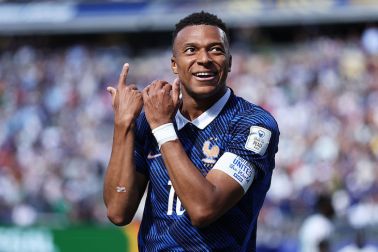
Poor old Kylian Mbappe (well, not so poor, he’s worth some £200 million). Having just been pipped at the post for the Ballon d’Or by our own Harry Kane, he discovered he had been heavily criticised by the Chinese government over comments he had made about Chairman Mao. The world’s number two footballer is officially public enemy number one in the People’s Republic.
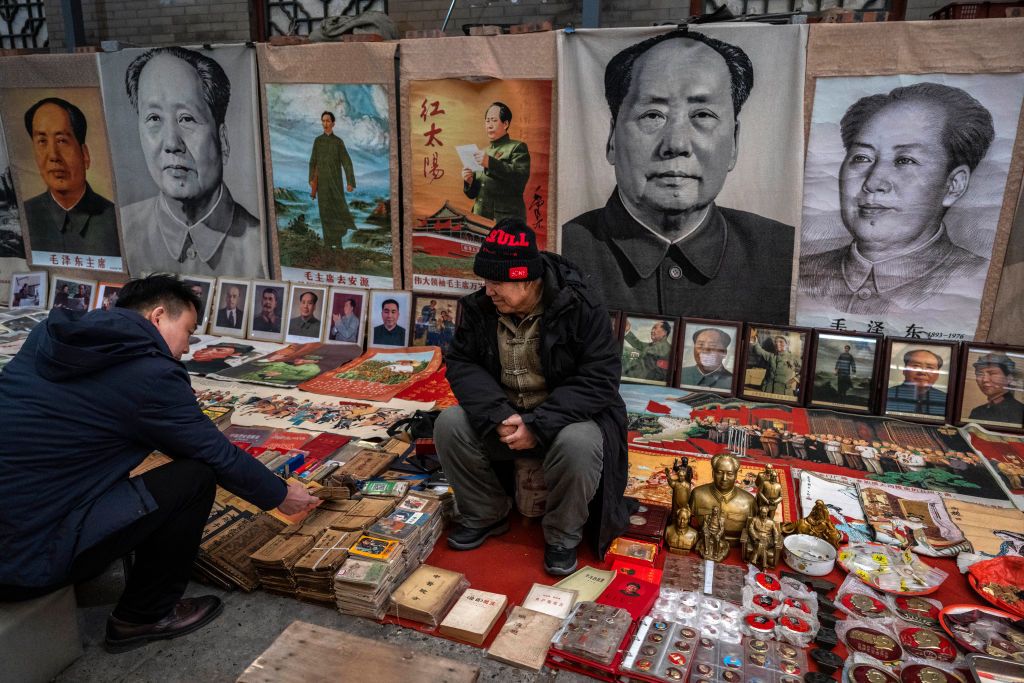
Mao merchandise still sells well in China, his embalmed corpse attracts 8 to 10 million visitors a year and his portrait still adorns houses and public areas. And unlike Churchill, he hasn’t been removed from the banknotes
The much-memed global superstar remarked on a talk show that he found some of the AI creations of himself amusing. His favourite he said is a mock-up of himself as Chairman Mao, complete with zhongshan suit and combover. Mbappe didn’t appear to know much about Mao’s career and referred to him as ‘some Chinese dictator’ (one of Mbappe’s nicknames is ‘the dictator’ due to his outsize influence on the teams he represents).
Innocuous, one would have thought. But the Chinese saw red. Literally. Three drink manufacturers in China that have sponsorship dealings with Mbappe immediately severed their connections, and a foreign ministry spokesperson, when asked about the incident, condemned ‘any words or actions that hurt the feelings of the Chinese people’. The state broadcaster CCTV pulled all games and commercials featuring Mbappe.
An absurd overreaction? It hardly needs saying that Mbappe meant no offence, and as to the word dictator – well, if the Mao cap fits… If the man who once ordered that all the sparrows in his country be killed as part of ‘war on pests’ is not a dictator, then I’m not sure what the word means. Some might use harsher epithets. Never mind the sparrows, Mao’s other personal initiatives, the Great Leap Forward and the Cultural Revolution, are estimated to have resulted in anything between 15 and 55 million deaths.
But after 30 years in Asia, I am not particularly surprised by the reaction. The whole concept of criticising politicians is still a very serious taboo for the Chinese. I have yet to hear a bat squeak of criticism from my Chinese acquaintances and have had to endure presentations on the greatness of Mao on more than one occasion. Mao merchandise still sells well in China, his embalmed corpse attracts 8 to 10 million visitors a year (many bring flowers), and his portrait still adorns houses and public areas. And unlike Churchill, he hasn’t been removed from the banknotes.
The official line on Mao is still that he was 70 per cent right, 30 per cent wrong. The good is anyone’s guess; the bad presumably refers to those millions of unfortunate deaths. He is still revered, if not quite worshipped, and any criticism must be very carefully worded. In Mbappe’s case, the problem is exacerbated by the harshness of the word dictator when translated into Chinese: ‘ducaizhe’ is especially strong.
Mao’s legacy lives on then and any attack on the Chairman has uncomfortable implications for current leader Xi Jinping. Xi has, to some extent, modelled himself on the man who once purged his father. He has centralised power, fostered a cult of personality, and had his own political philosophy, ‘Xi Jinping thought’, written directly into the Chinese constitution (as did Mao).
At the 130th anniversary of Mao’s birth in 2023, Xi referred to the former leader as ‘a great proletarian revolutionary, strategist and theorist… a great patriot and hero of the people’. It was an unequivocal endorsement that will have sent a clear message that criticism was off-limits – or even tolerance of criticism. The hasty cancellation of Mbappe by three drink companies looks merely prudent in such an atmosphere.
There may also be a footballing dimension to this. A little-known fact about Mao is that he was something of a footie fan, having reportedly played as a goalkeeper at university. He saw physical fitness as key to the successful revolutionary transformation of China. He was keen to promote himself as an image of good health and vigorousness, as witnessed by his legendary swim across the Yangtse at the age of 72, breaking world speed records in the process…
Xi is an even bigger enthusiast for the beautiful game and is supposedly a Manchester United fan. He has declared three goals for Chinese football: to qualify for, win, and host a World Cup by 2050. Having failed, unlike Curaçao, to make it to the recent 48-team tournament, it would be an understatement to say China has some way to go. Chinese football is better known for corruption than excellence (can you name a single Chinese player? I’m struggling). Thus, the mockery of a top international star must be especially hard to take.
Perhaps the most disturbing aspect of this seemingly trivial affair, though, is the speed of the response. Rather than telling those ‘offended’ to get over themselves, both Mbappe and La Liga expressed immediate remorse. Chinese investment in the elite end of football is considerable (for La Liga especially) and financial considerations must have been a factor. But the almost reflexive nature of the apologies to an accusation of offense giving is a sign surely of how effective our own cultural revolution has been. The Chairman would be proud.



Comments