
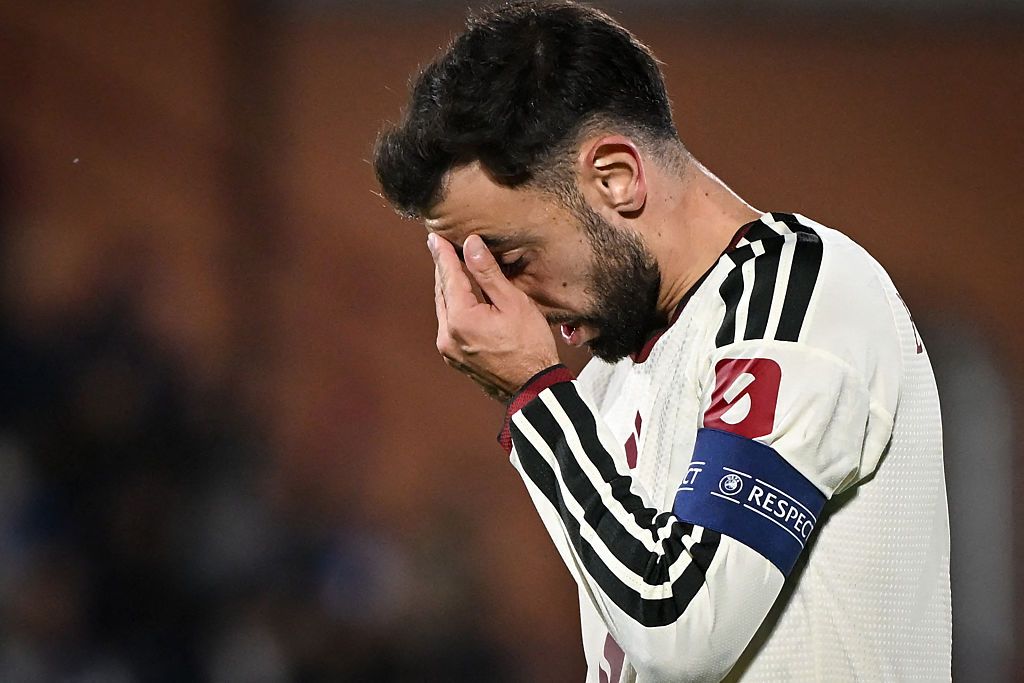
Manchester United lost 4-1 to Como, Italy last night, one of their worst results in 70 years of European football. ‘Perry Como could have beaten us tonight,’ was one wag’s response to the insipid and shambolic showing against a team that was in Serie D just seven years ago and had never played in the competition before.
It would be tempting to declare Manchester United’s loss a fresh nadir in their tortuous and interminable quest for renewed glory. But that would be to forget such debacles as the FA Cup defeat to Grimsby, or the 7-0 and 5-0 hammerings by Liverpool, or the 4-0 loss to Brentford… the list goes on. In truth, this was just another in a long line of calamities. The club is starting to look cursed.
This humbling will prompt questions not just about their beleaguered manager Michael Carrick (who could be gone by the weekend) but about the long-term direction of one of England’s greatest clubs. It’s not the result so much, which will be quickly filed with all the others, but the manner of the performance and the mood at the club it revealed. Manchester United is not a happy ship. Nor is it watertight: both Lisandro Martinez and Bruno Fernandes have publicly criticised the club and the team’s tactics in recent days.
A vivid illustration of this malaise was when Michael Carrick went to the block of 700 Manchester United fans in the stands after the game, making repeated gestures of contrition (you wonder, if he had been Japanese, whether he would have performed the dogeza, or ‘bow of shame’), totally ignoring his players in the process. What was striking was that he received some applause in return. The crowd clearly understands that Carrick alone is not accountable for the club’s problems.

So who is? If Manchester United were an airline, they would be British Airways – a once-respected flag carrier fallen on difficult times, a top-heavy behemoth desperate to recapture past glories but riven by internal discontent and a cumbersome management/ownership structure, now routinely outperformed by smaller, nimbler, and more focused rivals, and with no obvious route back in a fiercely competitive environment.
Confusion at the top – who actually controls Man Utd? – is reflected by confusion on the pitch, as the hugely expensive assembled squad has struggled to cohere around a consistent pattern of play, just as management has struggled to formulate a consistent strategy for the future. Each game seems like a reinvention, a fresh start; and sometimes it works, but more often, as with yesterday, it is a hot mess.
The club seems to be in an endless transition off the pitch too, and the direction of travel is not entirely clear. Take the plans for the new stadium: once confidently unveiled as a 100,000-seater modernist masterwork with a huge canopy with spindles thrusting like a trident into the Manchester sky, the design seems to have been significantly scaled back, with the grand opening postponed from 2031 to 2035. We don’t know the location, the cost, or for that matter, what will happen to Old Trafford.
All this will bring delight to many. Football is a cruel game, and Manchester United’s long years of success and reputation for arrogance preclude sympathy. But other, less partisan, might be less enthused. Manchester united is a great club and, in terms of the English game, a unique example of a Premier League club with an English manager and owner (sort of). The club has a world-renowned academy (carrying on a tradition dating back to the 1930s) and a decent figure of eight home-grown players in their squad. Overall, they are probably a force for good in the game, even if, as a Spurs fan, I say that through gritted teeth.
And though Manchester United may have serious problems, on and off the pitch, we should keep things in proportion and not overindulge in schadenfreude. Manchester United’s difficulties are as nothing compared to their rivals across town. A 4-1 defeat to one of the Champions League’s rank outsiders might be mortifying in the short term, but it’s recoverable. Manchester City on the other hand may have won their midweek tie with ease, but they face the very real prospect of being sent down to the levels Como were used to until quite recent years.
Overall, who would you rather support right now?






Comments