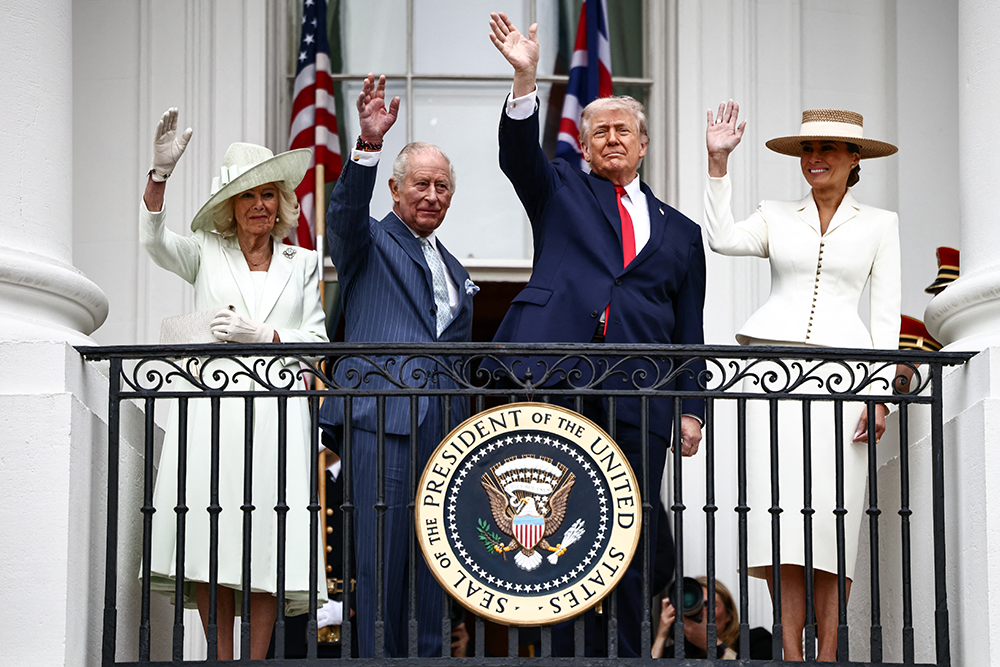


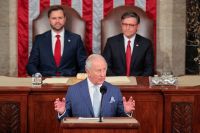
It was to King Charles’s great credit that he refused to fall for the Trump power handshake thing and instead retracted his own hand so that the orange psychotic was left, for a nanosecond, flailing and unsure of what to do with his right arm. It is always good to call the bluff of a bully, because they usually are bluffing. I would have preferred it if Chaz had executed a swift jujitsu move and thrown the President over his shoulder and onto the ground. But one cannot have everything – and of course the King was there to be emollient and to remind Trump of the things he quite likes about the UK: golf and class distinction, basically. He doesn’t seem to like us for any other reason – which is, in fairness, the mindset of almost every previous US president.
The US was instrumental in ensuring a British humiliation in Suez
One day it will percolate through to us that the ‘special relationship’ does not exist and has never existed – not now and not when Winston Churchill coined the phrase, speaking in the US immediately after a war which had installed that country as the world’s no. 1 power and had shoved us, penniless and exhausted, down the list to about no. 8. The special relationship was always a fantasy – and now is the right time to recognise that fact and, in a sense, be proud of it. Then we can continue our lives without the needy kowtowing to a country that has, in truth, abused our supplicant faith and good will perhaps more than any other.
President Trump recently adopted the old football chant England fans used to sing to the Belgians: ‘If it wasn’t for us, you’d all be speaking German.’ No, Donald, it would – in this order – be the RAF and the Red Army that kept us from that. The notion has established itself in the mind of the Americans that their country sailed to our assistance in the second world war out of an altruistic desire to support democracy against tyranny. Of course this is not remotely what happened. The American public and government were determined to keep out of the war until they themselves were attacked by an Axis power at Pearl Harbor.
Even in 1941 the odious Joe Kennedy, ambassador to the UK between 1938 and 1940, was demanding the US keep itself out of the fighting. And then after Pearl Harbor this special relationship was still subjected to American deceit and chicanery. In 1943 the US and UK signed the Quebec Agreement which guaranteed shared information on the development of both nuclear weapons and nuclear power between the US and the UK (and Canada). As soon as the war ended the US decided the Quebec Agreement didn’t amount to a hill of beans and resolved that no information would be shared with the UK, despite the fact that some 60 British scientists, led by the Nobel laureate James Chadwick, had worked on the Manhattan Project. The response from the US was: get stuffed.
So it has been for pretty much the entirety of the following 80 years, a pattern that has remained constant: America demanding support and obedience from the UK, usually getting it, and giving absolutely nothing back in return. We went along with the Truman Doctrine and supported military action in Korea. A few years later the US was instrumental in ensuring a British humiliation in Suez. The American revulsion at what they considered an act of desperate old-world imperialism was of course confected, given the US’s own burgeoning colonialism and illegal involvement in the politics of third- world countries, beginning with the Philippines at the turn of the 20th century. Vietnam followed and the British prime minister Harold Wilson still offered moral support for this ludicrous imperialist adventure, even if he had the good sense to resist Lyndon B. Johnson’s bullying and refused to commit British troops to the adventure.
There were echoes of this in Trump’s incandescence at the UK’s failure to send troops to sort out his latest folly, the war against Iran. Nobody else signed up, Donald. Everybody thought it was stupid. But there was no criticism of the adventure by the UK, even if Sir Keir Starmer did have the sense to refuse British military involvement.
In the 1980s the Reagan administration was split on whether or not to support the British efforts to reclaim the Falklands Islands, with a hefty proportion of the administration, led by Jeane Kirkpatrick, siding with the congenial Argentinian fascists. Then the US – at the high point of our special relationship – invaded the British Commonwealth country of Grenada, without letting us know. Further, in the first half of that decade, as the UK suffered one terrorist attack after another from the IRA – an organisation which got most of its funding from the Americans – not a single terrorist was extradited to the UK from the US, despite repeated demands. Later, of course, we diligently signed up to two wars against Iraq, one of them illegal and catastrophic.
Those are the facts of the special relationship. There isn’t one, so far as the Americans are concerned, nor so far as our respective people are concerned. The Americans can’t stand us. An Ipsos poll from 2020 asked people from across the world how ‘attractive’ they viewed other countries. Kenya, Ukraine and South Africa were our biggest fans: the US came near the bottom, below…Argentina. And the feeling is reciprocated: a recent YouGov poll suggested that the countries most respected by British people were Norway, Italy and Sweden, while the US did not even make the list.
The special relationship was always a delusion, as I suspect Churchill knew when he uttered the phrase. At the very least we should be grateful to Trump for making that fact very clear. We are, to the US, useful idiots who can be commandeered to spill our blood in the pursuit of lost causes but are to be despised for our antiquity and pretensions to being a major power.

Comments