
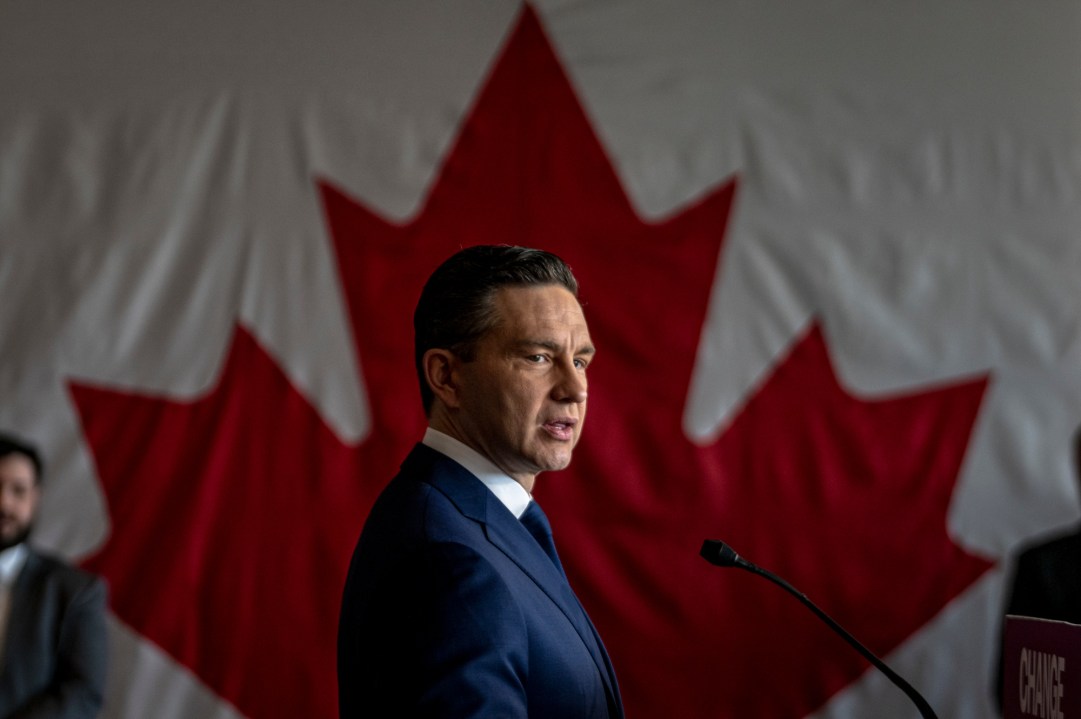

Over the last week, I have been stalking Pierre Poilievre. The leader of the Canadian Conservative Party has been in Westminster to renew the bonds of Anglospheric amity; consequently, I had the pleasure of watching him speak on two successive evenings.
The arc of history is long, but it bends towards Robert Jenrick
Until a year or so ago, Poilievre was the Prince Across the Atlantic – a punchy and pugnacious Conservative would who had united his party around a popular and populist message of more housebuilding, tackling inflation and championing those working-class voters that Canada’s Liberals had taken for granted for too long. He built a hefty lead over Justin Trudeau and topped the polls among young voters. Especially in the flaming wreckage of the aftermath of the 2024 election, he seemed the perfect model for our Tories to learn from.
And then Donald Trump returned to the White House. Suddenly, the central question of Canadian politics was not whether you could afford a family home, but whether you wanted to be annexed by the US. Since most Canadians did not want to be the 51st state, Poilievre was left somewhat high and dry as a rally-around-the-flag effect benefited the incumbents – especially when Trudeau sodded off to spend more time at Katy Perry concerts and was replaced by the effortlessly smooth and well-CVed Mark Carney. At last April’s election, Poilievre managed to win a healthy 41 per cent of the vote – but Carney won 44 per cent, the highest share for the Liberals since 1984. Poilievre found himself losing his own seat.
But now he is back in Canada’s Parliament, and with Carney still riding high, looking for something to do. Fortunately for Britain, that has manifested itself as a trip to the mother country to meet with politicians, commune with the root of our shared liberties at Runnymede and promote the cause of CANZUK – a proposed alliance of Canada, Australia, New Zealand and the United Kingdom. A shared head of state, historic ties, similar economies, shared language, overlapping trade and foreign policy interests – surely unity is a no-brainer?

This is a point I watched Poilievre make first at the Carlton Club, and then the annual Margaret Thatcher lecture of the Centre for Policy Studies (CPS). He was eloquent, historically literate and engaging. His habit of slipping into French mid-speech was something I was more prepared for after my sojourn to the Plaid Cymru party conference.
What should CANZUK mean in practice? Automatic professional recognition and regulatory presumption of equivalence, for a start. As Poilievre put it for the CPS, if ‘someone can perform heart surgery in Sydney, Australia, they should be able to do so in Syndey, Nova Scotia’; if ‘a drug or auto part is safe in London, England, it should be safe in London, Ontario’. It should be made easier for high-skilled workers to move between the four countries – just in case we weren’t losing enough NHS doctors to Oz – while defence procurement should be integrated and a critical minerals and energy compact signed to enable the ‘building blocks of modern defence’ to serve ‘to power [Canada’s] allies’.
All splendid stuff, even if his insistence that we should buy Canadian liquid natural gas seemed a little odd after his opening encomium to Adam Smith and the merits of free trade. Being a Daniel Hannan fan, I’ve always been quite taken with the CANZUK concept, but I fear it might be a century or so out of date. If Joseph Chamberlain couldn’t make it work, I’m not sure Poilievre can. There might have been too much change within and between our four nations – demographically, and with our post-imperial reorientation towards Europe and the US – to mean that those deep bonds of English-speaking amity he eulogised no longer exist.
Most importantly, it’s also an unfortunate fact of life that in three out of four of the countries – excepting stout and beautiful little New Zealand – there are currently centre-left governments in power. Both Carney in Canada and Anthony Albanese have received more accolades over the situation in the Middle East than Keir Starmer is managing – another suggestion that the UK might not be best placed to lead a push for CANZUK.
But it was about domestic politics that I hoped Poilievre might say a little more. Two decades ago, the Canadian Right was split between a party called Reform and a party called the Conservatives. My knowledge of their eventual merger isn’t what it could be, since all the best books of the subject have been snapped up and now go for extortionate amounts on AbeBooks. I was hoping Poilievre would fill me in; no dice. This was a missed opportunity.
Perhaps Poilievre didn’t want to lecture his hosts. Each unhappy set of Right-wing parties are unhappy in their own way. For most of the time when Canada’s Reform (later renamed the Canadian Alliance) and so-called Progressive Conservatives were battling it out and letting the Liberals win by default, Poilievre was still at school or university. But as important as it is to re-state the fundamental truths that Smith outlined, and as grand as the celebrations for the 250th anniversary of the publication of The Wealth of Nations deserves to be, one can’t implement his lessons if we’re not in power. We have an agenda, but the Right needs a vessel.
As a recent Spectator editorial outlined, the Right currently confronts a war without an enemy – a civil war, where the best talents are spread across both sides, and where a high-level clash of personalities, histories and shades of blue obscures an underlying unity of analysis and direction. It is a tragedy that Kemi Badenoch and Nigel Farage are at cross purposes, especially if it repeats the Canadian mistake of enabling the Left to keep winning.
Happily, the contours of a potential deal are starting to emerge. Reform have stalled in the polls; the Conservatives are down, but not out. After May’s elections it will become clear that the Tories are no longer a national party but might still function as a regional interest group for the wealthier bits of the South. If various seats can be won back from the Lib Dems in 2029 with a ‘Vote Davey, Get Starmer/Polanski/Rayner’ message, a hung parliament may be forced. The 2019 Tory coalition will be put back together, with Reform winning the Red Wall and the Conservatives the Blue. A hung parliament will provide an incentive to work together; a deal will be done, the Right reunited, the war without an enemy declared over.
Of course, such a union will not be facilitated under the current leadership of either party. Badenoch is too proud to admit the Conservatives are not a national party; Farage has dedicated himself to wiping the Tories out. But the pair are united by a shared disinterest in actually becoming Prime Minister, since both realise it would be too much like hard work.
Any union will require someone reassuring to both tribes – bringing Reform’s outsider elan without frightening Tunbridge Wells. Someone who can look like David Cameron but talk like Matthew Goodwin – our own Poilievre. Someone hungry for power, and supportive of the neo-Powellite agenda around which the Right will unite. Fortunately for Britain, that candidate exists. The arc of history is long, but it bends towards Robert Jenrick.





Comments