‘Theory was cool. Theory was French. Theory was also, strange though it might sound, sexy.’ When Emily Eakin first encountered ‘theory’ as a Harvard undergraduate in the 1980s, it marked the start of an obsession, intense as a love affair. She wasn’t the only one. For the Anglophone world, France has long represented a style of thinking that is just that: stylish. It’s not for nothing that an estimated three million American tourists flock to the boulevards of Paris each year. The place is synonymous with glamour in its most alluringly intelligent form. For Eakin and hordes of other turtleneck-wearing students, literary theory – a style of reading that emerged from the work of successive waves of French intellectuals in the late 20th century – was a shortcut to that Gallic sophistication. The fact that the writing of these thinkers happened to be ‘barely accessible to the lay reader’ only heightened the appeal. Theory was like a secret code: mastery of it promised access to a ‘counterculture’, even ‘an intellectual elite’.
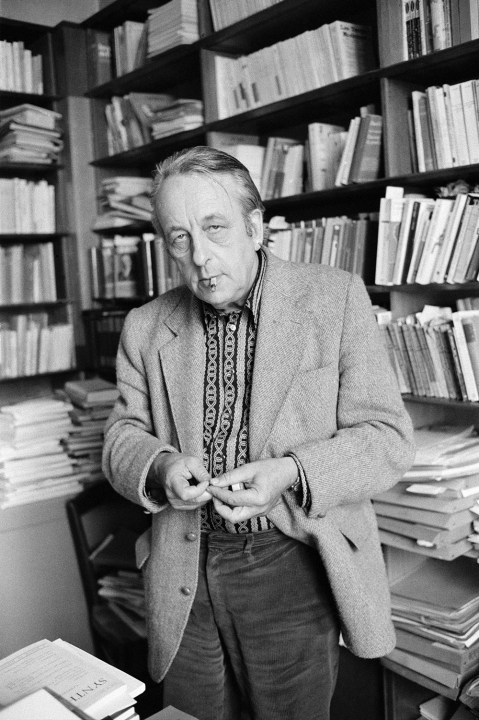
But what if ‘the Frenchmen’ – a term Eakin designates for a group spanning multiple disciplines and decades, from Louis Althusser to Roland Barthes, Jacques Derrida to Michel Foucault – weren’t themselves as cool as their clever ideas and Frenchness made them seem? In her book, by turns a memoir, biography and work of intellectual history, Eakin sets out to ‘re-embody’ these men. In so doing, she uncovers the complicated and at times unpleasant personalities beyond the sexy stereotype. It’s a genuinely useful project. By the time I came to ‘literary theory’ as an undergraduate much more recently, the likes of Barthes and Jacques Lacan had been reduced to soundbites – the ‘Death of the Author’; the ‘mirror stage’. It didn’t occur to us, or to me at least, to consider them as individuals shaped by personal experience, or that their environments would have influenced their thinking. We were more likely to take their ideas at face value because a previous generation, Eakin’s, had digested them for us in advance.

In chapters that follow the ascent of theory to the zenith of its popularity during her student years, Eakin reveals a set of deeply troubled individuals, arguing that their life stories are vital to understanding such strands of theory as psychoanalysis, structuralism and deconstruction. Take Althusser, the Marxist theorist. Eakin describes his takedown of Jean-Paul Sartre after a lecture at Paris’s École Normale Supérieure in 1961 as the moment that existentialism was ‘publicly dethroned and… structuralism took its place’. Both Sartre and Althusser were prisoners during the second world war, an experience that informed their respective philosophies. Upon release from captivity, with its regimented rhythms, Sartre was overwhelmed by his newly restored free will; he went on to write that ‘man is condemned to be free’. Imprisonment was also an oddly happy time for Althusser, who relished this period of separation from his ‘oppressive’ parents. He arrived at a view of family as one of many ‘ideological state apparatuses’ in which we are inescapably enmeshed, a conviction that rendered Sartre’s notion of absolute freedom ridiculous to him. Yet later events in Althusser’s life present this disagreement in a different light. One morning in 1980, in a fit of rage, madness or hatred – Althusser himself claimed not to know – this esteemed philosopher strangled his wife in their bed.
When we encounter Althusser’s work armed with the knowledge that he murdered his wife, his opposition to Sartre’s ideas about freedom begins to look like an abdication of responsibility for personal agency. Through this and numerous other examples, such as Foucault’s dalliances with underage boys in Tunisia and Paul de Man’s wartime Nazi sympathies, Eakin reminds us that theory didn’t evolve in a vacuum. She covers a lot of ground and is persuasive in demonstrating that philosophy when ‘sanitised of biographical details’ risks seeming ‘self-evidently true’. What she calls ‘human context’ is, however dark or unpleasant, essential to understanding the history of ideas. Meanwhile, the elements of autobiography in the book (which chronicle Eakin’s pivot from a planned academic career – a life in theory – to journalism) illustrate how the use of theory by readers is at the heart of the Frenchmen’s legacies.
Of course, the question of what to include in a biographical reading is open-ended. What seems essential in one account is peripheral in another. There’s a perhaps inevitable contrast with Eakin’s book, therefore, in School of the South by Onur Erdur, an academic at Berlin’s Humboldt University. This more straightforwardly scholarly account of the lives of certain theorists is, by design, narrower in scope, focusing on their connections to French colonialism in North Africa. Erdur, who is unimpressed by the glamorous clichés, seeks to emphasise an intellectual context beyond the Parisian cafés where these thinkers would sit ‘drinking apricot cocktails’ (this is a nod to Sarah Bakewell’s 2016 book At the Existentialist Café: Freedom, Being and Apricot Cocktails, which Eakin identifies as her direct model).
According to Erdur, we can’t grasp Barthes’s Mythologies without an awareness of his trips to Morocco; Pierre Bourdieu’s concept of habitus is ‘hardly conceivable’ without the empirical studies he conducted in Algeria; and Derrida’s interest in ‘what makes an identity impossible’ stemmed directly from his upbringing as a member of the Jewish-French-Magreb minority in Algeria. Each of these episodes are illuminating and engagingly told, and Erdur is bold in his assertions about the ‘criminally neglected colonial roots of French Theory’. I couldn’t help but think, though, that he has over-egged things. Has the colonial context really been neglected to a ‘criminal’ extent? The Norton Anthology of Theory and Criticism is, for instance, clear and informative in its commentary on Derrida’s ‘culturally complex’ childhood. Meanwhile, Eakin establishes the Algerian War of Independence as one of the key events that informed the development of French theory.
What if ‘the Frenchmen’ weren’t themselves as cool as their clever ideas and Frenchness made them seem?
But I shouldn’t fault Erdur for his focus. Like Eakin, he makes a case for the richness and scholarly value of biography, while asserting the importance of continuing to engage with theory, given its status as a ‘force in institutions’ (to borrow a phrase from Jonathan Culler). Theory has been, as both authors are eager to point out, variously celebrated and demonised amid the fraught debates about identity politics and woke culture; and both emphasise that the Frenchmen’s ideas have been taken up by the left and the right for political ends.
At the same time, as Eakin admits, we shouldn’t underestimate how useful theory has been for literature departments facing declining enrolments. In its promise of a methodology that is quasi-scientific in its precision, theory equips literary scholars and students with something appealingly technical. Learning to perform a structuralist reading of Dickens isn’t so far off from learning to analyse cells under a microscope. But theory isn’t really a microscope; it’s a malleable thing, developed and practised by people with biases and blind spots. It’s best to approach theory the way that theory teaches us to think: that is, with deep suspicion.





Comments