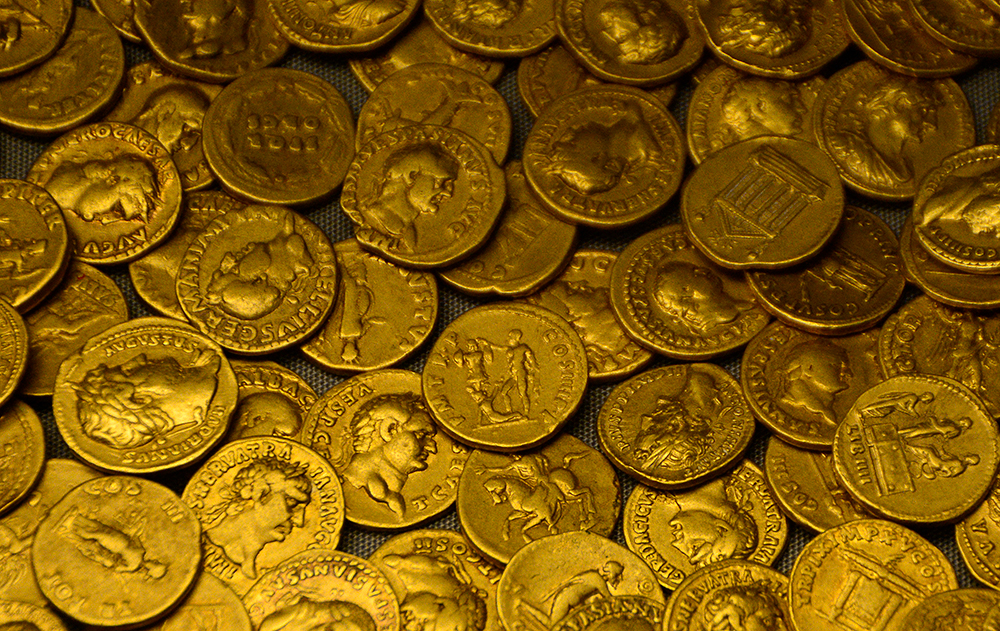
Money is a pagan god because it has value only as long as people believe it does. Refuse to believe, and the value disappears.
In the 3rd century ad, the Roman empire was under intense pressure, and emperors resorted to increasing taxes and debasing coinage to fund its protection. The result was terrifying inflation. Cash became worthless. Soldiers refused to be paid in it and the state to accept tax in it. So ‘requisitioning of supplies’ – goods, materials, labour – became, in effect, taxation ‘in kind’ to pay for the military; and the army plundered at random to ‘collect’ it.

The emperor Diocletian rationalised the system by organising this requisitioning of supplies into a coherent tax scheme. He defined two universal units of resource – (i) the man and (ii) the land-measure (the area required by one man to support his household) – and categorised the economy of the whole empire in terms of these units by regular five-year, later 15-year, surveys (a massive task). Then, for the first time ever, he drew up an annual budget of the state’s needs, which he matched against the ‘value’ of the empire’s newly defined resources. From this the ‘tax’ demand was worked out – to be paid, not in cash but in kind.
It worked. Convinced the problem was cracked, Diocletian proceeded to mint vast quantities of new, sound coinage to fund the army and his ambitious public projects. To his bewilderment, inflation roared merrily ahead. Convinced this was due to businessmen’s greed, he published his famous edict ‘On prices’ (ad 301, found only in fragments), enforcing maximum prices and wages on some 1,400 different items of goods, wages and services in ‘units of account’ (‘3-pronged fork 8; 2-pronged fork 4; barber, for each client 2; guardian of clothes in public baths 2; halter for a mule 80; woollen cover from Britannia: first-quality 5,000; second-quality 4,000; coarse linen for common people or slaves: first-quality 1,000; second-quality 800; third-quality 600; lion, first-quality 150,000’; etc. etc.). But goods at once disappeared from the market, because sellers could make no profit. In a few years, the edict quietly lapsed.
Will our politicians never learn? Question expecting the answer ‘No’.






Comments