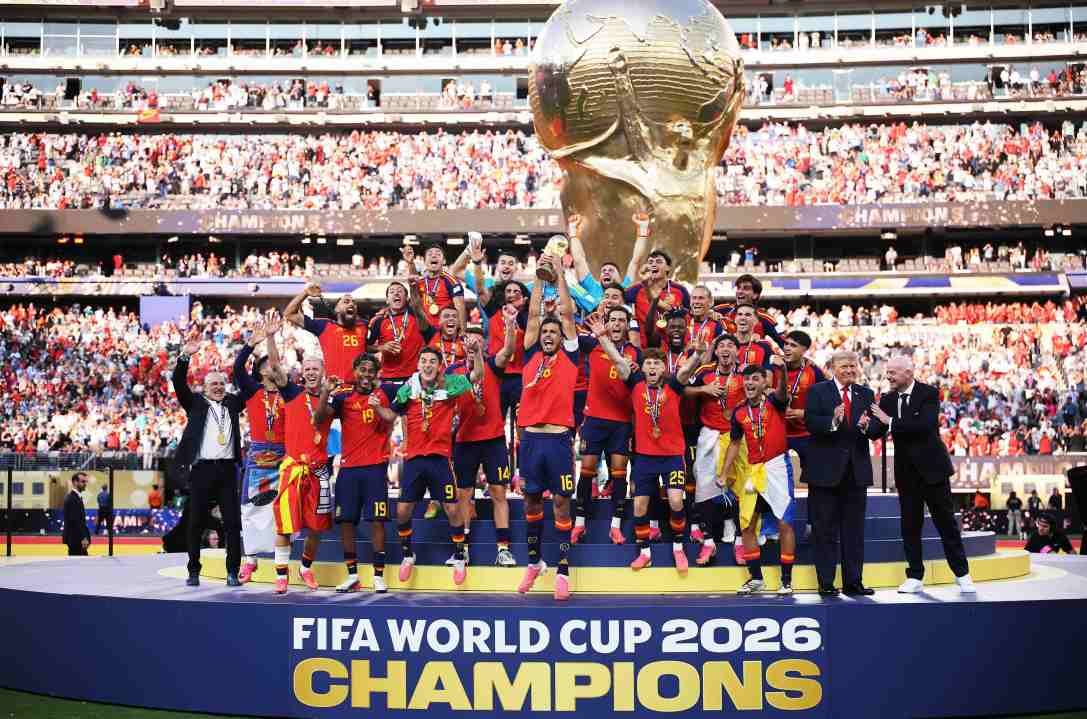
There is something intimidating about sporting royalty in the stands. At many great clubs, retired legends seem almost gargoyle-like, perched high above the pitch, judging those sent to inherit their legacy. Manchester United have long played beneath the watchful gaze of Sir Alex Ferguson; other clubs have their own ghosts.

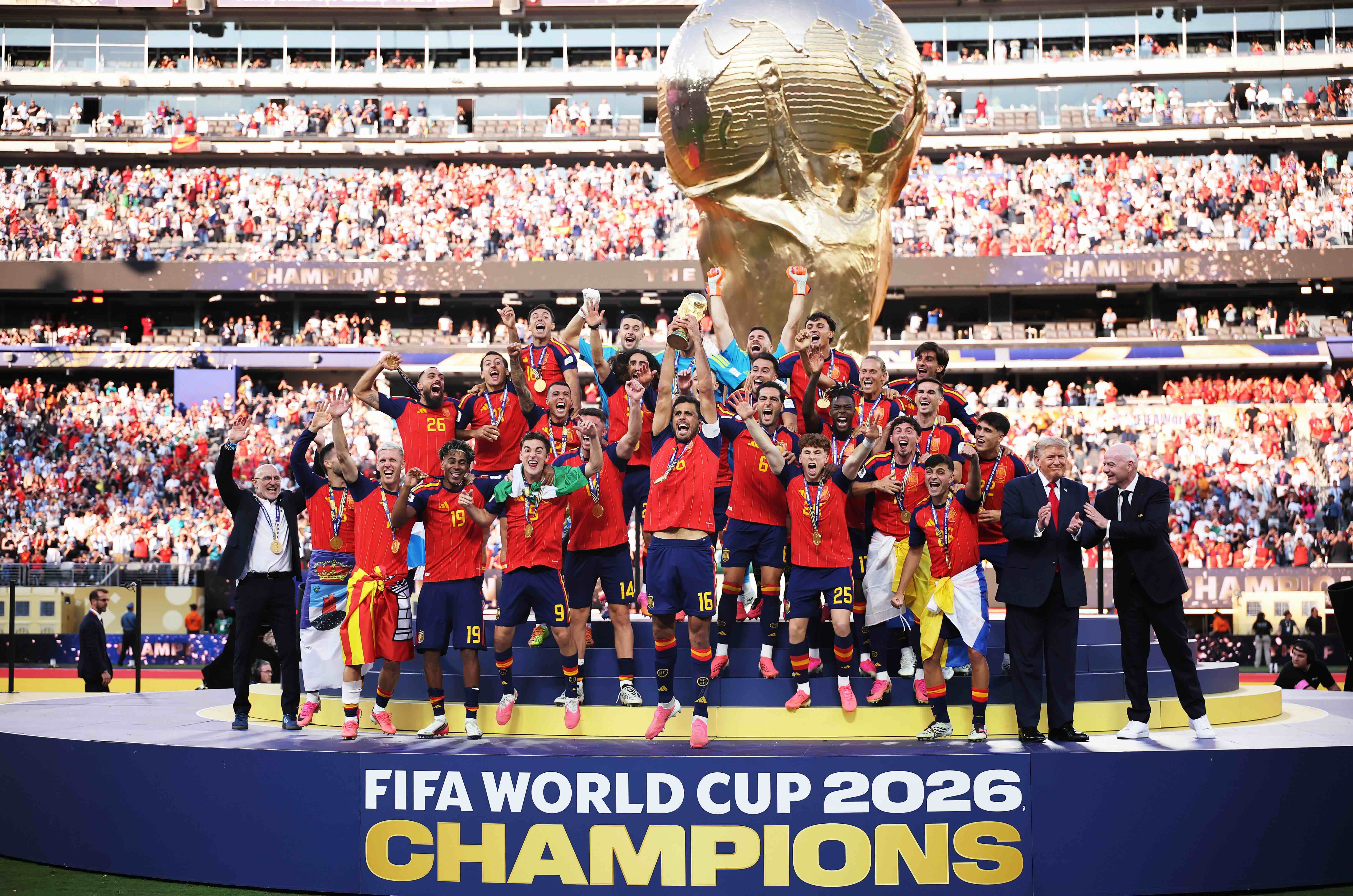
Spain’s World Cup triumph offered a different spectacle. As the Spanish greats of the past – from David Villa to Iker Casillas – watched Lamine Yamal, Rodri and co defeat reigning champions Argentina, they resembled something more saintly; a reassuring reminder of Spanish supremacy. It was a far cry from the shaking head of Ronaldo watching yet another Brazilian disappointment or protestations of England’s World Cup alumni. The ease with which one generation gives way to the next is no coincidence. It is one of the defining features of modern Spanish soccer.
Spain’s footballing journey did not begin at the start of this tournament when they won their second World Cup, nor in 2008 when they won their first of three European championships this century. To understand it, we have to travel back to Barcelona in 1988, when an uncompromising Dutchman arrived with a radically different idea of how soccer should be played.
When Johan Cruyff became Barcelona manager, Spanish football was not regarded as the game’s intellectual center. The national side possessed flashes of brilliance but an enduring reputation for underachievement. Barcelona itself had won only a single European Cup. For 30 years, if you wanted to understand soccer, you went to Italy to AC Milan, Juventus or Inter. The Italian league Serie A was where tactics evolved and where the world’s greatest players congregated.
But, as Italian football became burdened by debt during the 1990s, Spain invested in something less glamorous but ultimately more durable: youth development. While Serie A looked increasingly backwards, signing older, high-profile players, Spain’s La Liga began educating the next generation of coaches and footballers. Cruyff built something more ambitious than assembling a successful team. He created a philosophy that would outlive him with coaches like Pep Guardiola carrying the torch.
Influenced by the Dutch ideals of “Total Football,” which emphasizes fluid tactics and positions, Cruyff insisted that technical ability and intelligence mattered more than physical stature. Young players were encouraged to solve problems with the ball rather than without it, to understand space before strength and angles before athleticism. Barcelona’s academy La Masia ceased to be a production line for footballers and became a school of ideas.
The principles spread far beyond Catalonia. Top-tier teams such as Villarreal, Athletic Bilbao, Real Sociedad and Valencia CF invested in technically demanding academies. Meanwhile, Spain’s thriving futsal culture – a scaled-down version of soccer – taught young players to think quickly in confined spaces, making close control and spatial awareness second nature. By the early 2000s, Spain was dominating the game at club and national level and the rest of the world was trying to follow in their footsteps.
Spain’s greatest footballing achievement may not be its silverware but getting the rest of the world to play the game on its terms
But there were bumps in the road, bumps that risked derailing this football revolution altogether. In September 2006, Spain traveled to Belfast for their Euro qualifying match and suffered a chastening 3-2 defeat to Northern Ireland. Familiar accusations resurfaced that the national team, while talented, were poorly managed. Critics, both inside and outside the country, doubted Spain’s methods and called for a new coach.
Instead, then Spain manager Luis Aragonés doubled down. Rather than reverting to a more direct, physical style, he placed greater faith in the technically gifted players who would soon define an era. The rewards transformed international soccer. Their victory at Euro 2008 was followed by the World Cup in South Africa and two other European Championships in 2012 and 2024. On the surface it looked like a “golden generation.” Perhaps it was never a golden generation at all, but the first generation of a new footballing order.
The country’s success now far extends that of the national team. Last season, Premier League champions Arsenal were coached by Mikel Arteta, a product of San Sebastián and Barcelona. The Champions League was won by Luis Enrique, the Spanish manager of Paris Saint-Germain. Unai Emery lifted the Europa League trophy with his team Aston Villa. Both Liverpool and Chelsea have recruited Spanish managers this summer in the forms of Andoni Iraola and Xabi Alonso. After dominating the Premier League, Manchester City now have a stand named after Cruyff’s heir, Pep Guardiola.
For all its success, then, the Premier League – La Liga’s closest rival at a national level – is very much a Spanish affair. Indeed, Spain’s greatest footballing achievement may not be its silverware but getting the rest of the world to play the game on its terms. The Premier League possesses the TV money and global audience, but increasingly it imports its footballing ideas from Spain. England owns the richest competition on earth; Spain supplies much of the expertise that makes it worth watching.
That perhaps is Spain’s greatest triumph. Trophies can be won by golden generations, but changing the way the rest of the world thinks about football is something altogether rarer. The legends celebrating in the stands in New Jersey on Sunday were not just watching another success but also the philosophy they popularized triumph.




Comments