
There is a particularly memorable moment in Michel Houellebecq’s 2015 novel Submission, in which France succumbs to Islamist rule. As his Jewish lover, Myriam, prepares to leave for Israel, the novel’s protagonist, François, reflects on his own predicament: ‘There is no Israel for me.’
Eleven years later, Houellebecq has been placed under formal investigation in France over remarks about Muslims made in a 2022 interview. Meanwhile, the latest statistics released this week jointly by the Israeli Ministry of Aliyah and Integration and the Jewish Agency show that an increasing number of British Jews are following in Myriam’s fictional footsteps. It is François’s predicament, though, that might concern the wider British public. Houellebecq identified something that has become increasingly pertinent to British life.
What happens when the pressures familiar to British Jews begin to intrude into other people’s lives?
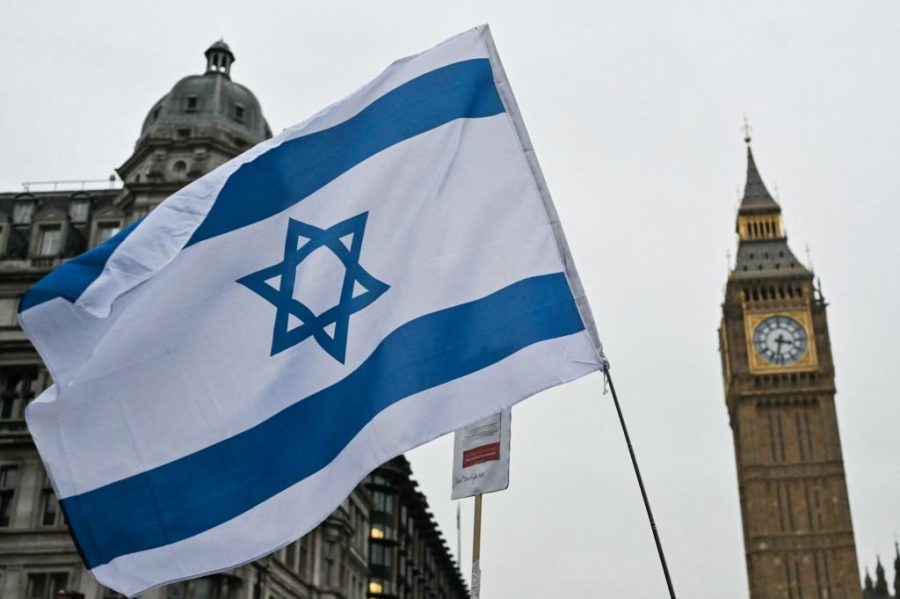
The latest Israeli immigration figures suggest that a growing number of British Jews are reconsidering where they want to spend their lives. By 22 November, 1,013 had moved to Israel this year, up by a third on the equivalent period last year. More than 2,500 have gone since 7 October 2023, and over 5,000 have opened immigration files with the Jewish Agency. These are significant numbers for a relatively small Jewish community with deep roots in Britain – there are only around 300,000 of us in the UK. Previous increases in 2015 and 2021 coincided with periods of heightened anti-Semitism and conflict in the Middle East. The present increase has been gathering momentum for three successive years.
The character of the enquiries is apparently changing, too. Speaking in London in October, Israel’s director-general of the Ministry of Aliyah and Integration, Deganit Sanker-Lange, described an unfamiliar sense of urgency among prospective immigrants. People wanted to know how quickly they could find work and establish themselves in Israel. The immigration fair attracted more than 1,200 visitors.
There is something extraordinary about the growing appeal of emigration to a country that has spent much of the past three years at war. For some, the attraction is ideological or religious. Others see better professional prospects or want their children to grow up immersed in Jewish life. Such considerations have motivated aliyah for generations. Increasingly, they sit alongside a much less agreeable calculation about the future of Britain.
Aliyah fairs are becoming a more regular feature of British Jewish communal life. They are also becoming targets for anti-Israel activists, extending the reach of their campaigns into the personal decisions of British Jews about where to live when this place has become increasingly hostile and hopeless. Even the Charity Commission has now become involved, investigating a much-loved London Jewish community centre in connection with one such event and questions surrounding a single flyer showing medical facilities where migrating doctors might find employment in Israel. Two were located in Judea and Samaria. The government’s approach to settlements risks making ordinary Jewish communal activities a subject of regulatory scrutiny. The absurdity of this development will hardly escape those already wondering whether Britain remains a comfortable place in which to be Jewish.
Imagine attending an event to investigate the possibility of emigrating and finding demonstrators outside aggressively objecting to your intended destination. For some attendees, the experience only provides a further argument in favour of going. Yet perhaps the most consequential aspect of this phenomenon concerns the people who will remain in Britain.
Jurors at the Old Bailey were told this week that a boy, aged just 13 at the time, shouted ‘Allahu Akbar’ during an alleged attack in which two schoolchildren were stabbed at Kingsbury High School, an ordinary, non-denominational secondary school in north-west London. The jury was shown footage allegedly recorded by the defendant himself. Prosecutors allege that the incident constituted an act of terrorism. The boy denies two counts of attempted murder and the case continues.
For years, I have argued that the dangers British Jews encounter with increasing frequency are symptoms of a much wider malaise. Our particular sensitivity to them comes partly from historical experience and partly from the frequency with which we encounter their early manifestations. The rest of Britain has grown remarkably accustomed to the security infrastructure surrounding Jewish life. Armed police outside synagogues, security guards at nursery schools and precautions surrounding communal gatherings barely register as political scandals any more. Our schools are already high-security compounds.
That accommodation has come at a cost. Once these conditions are accepted as an unfortunate feature of Jewish existence, the ideological forces that helped produce them can continue to develop with insufficient scrutiny. British Muslims, too, have a considerable stake in the defeat of Islamist extremism and the preservation of individual liberty. The freedom to reject religious prescriptions, question religious authority and live according to one’s own convictions belongs to them equally, if they wish to defend it.
What happens when the pressures familiar to British Jews begin to intrude more regularly into other people’s lives? When teachers, schoolchildren, artists and ordinary citizens find themselves making comparable calculations about their freedom and safety? Some British Jews have reached the point at which they are prepared to exchange the country of their birth for a country regularly subjected to missile attacks. Britain ought to have the intellectual curiosity to examine why.
Abandoning this country’s Jews will solve none of the problems that are encouraging them to leave. And the British public may yet discover the terrible significance of François’s lament.





Comments