The first mention of Westminster came in a charter of 785, attributed to King Offa, granting land in ‘that terrible place’. The document was a forgery though, drawn up by 12th-century monks to make Westminster Abbey seem a site of holy terror. Even so, ‘that terrible place’ would strike most people today as a good description of SW1.
Parliament has failed to cover itself in glory in recent years: the financial crisis, the expenses scandal, the Brexit wars, the prime ministerial merry-go-round, the unfair if unshakeable perception that our politicians are fiddling – with their finances, and possibly their staffers – while Britain suffers. No wonder, then, that politicians of all stripes have tried to boost their popularity by railing against Westminster.
For Scottish and Welsh nationalists, the Palace of Westminster explains the underperformance of their beloved homelands, never mind how generous the funding they receive through the Barnett formula. Across eight attempts to be elected to the Commons, Nigel Farage denounced ‘the Westminster bubble’ again and again. Hannah Spencer, the recently elected Green party MP, has condemned Parliament’s alleged drinking culture. And now another left-winger hoping for by-election success claims that Westminster’s myopia drove him away to Manchester yet now compels him to return to save it.
Excusing politicians on the basis of their upbringing will only increase contempt for politics
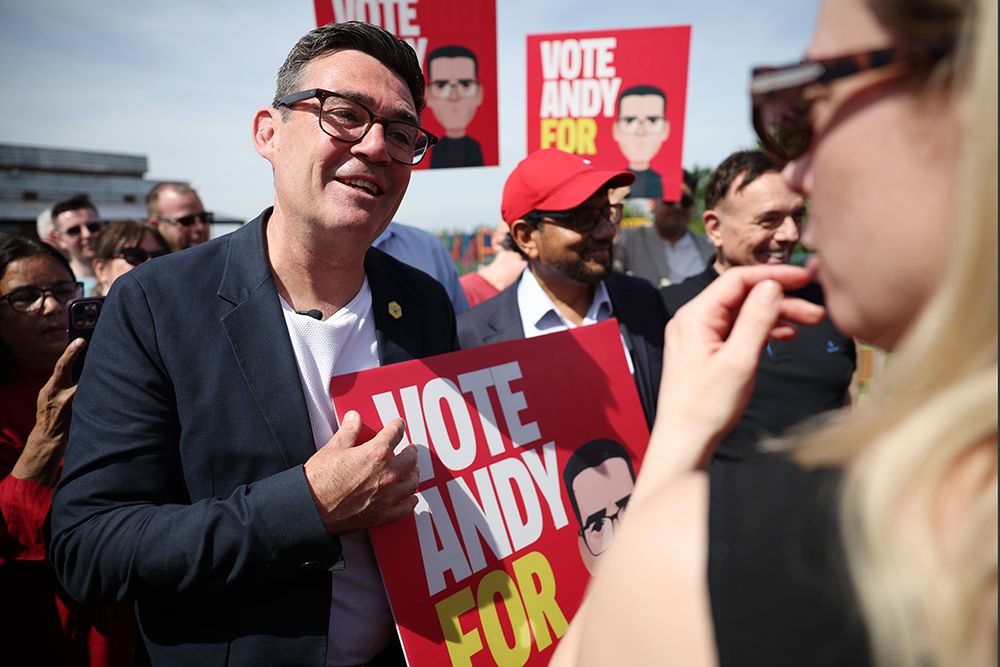
Jokes about Andy Burnham identifying with equal facility as a Blairite, a Brownite and a Corbynite are well-worn. But the Greater Manchester mayor’s pose as a political outsider, a tribune of the North speaking hard truths to London, is remarkable for a man who left Cambridge to work as a special adviser before being parachuted into a safe Labour seat, serving in the Cabinet, and then losing two leadership elections. Paint a few buses yellow, play a little Oasis, and all is forgotten.
Perhaps Burnham underwent a genuine conversion on his way up the M6. Perhaps his ‘Manchesterism’ – a ‘business-friendly socialism’ – is a coherent philosophy of government that – through a smorgasbord of devolution, building social housing and ‘stronger public control’ of utilities – will mark ‘the end of neo-liberalism’, a break from the ‘high-ineuality, low-growth trap that came from the 1980s’ and revitalise Labour’s fortunes. Definitely, maybe.
But the grass is not greener on the other side of the Irwell. The growth that Manchester has enjoyed is largely the consequence of long-standing council initiatives, George Osborne’s ‘Northern Powerhouse’ policy and Boris Johnson’s transport reforms. Burnham has benefited from his distance from the capital. He has crafted an image of himself as a man of the people away from the scrutiny of the national press or the challenges of national government.
In this, he bears some comparison to Nicola Sturgeon. Scotland’s former first minister often received rave reviews south of the border, and these were accompanied by a lack of curiosity matched only by Sturgeon’s own apparent disinterest in her now estranged husband’s spending habits. Just as she failed to question where her spouse, Peter Murrell, had found the money for a £124,550 motorhome and £2,618 set of salt and pepper grinders, so Sturgeon’s cheerleaders failed to notice Scotland’s growing failures in education, record drug deaths and toxic political culture.
Similarly, a set of different standards have developed for politicians branded as working-class. When Robert Kenyon – Reform’s candidate against Andy Burnham in Makerfield – was found to have endorsed a sexually explicit tweet about Carol Vorderman, the party’s response was to say that he wasn’t a ‘polished, professional politician’ but an ‘effective voice for normal working people’. Likewise, when Angela Rayner was found to have underpaid stamp duty, her supporters said she was being targeted because she was a working-class woman.

Yet to hold working-class politicians to a lower standard is to embrace the soft bigotry of low expectations. Ernest Bevin was orphaned at eight and left school at 11 to become a farm labourer; Nye Bevan left school at 13 to work in a coal mine. The pair went on to create Nato and the NHS. Today’s working-class politicians should aspire to similar heights, rather than deploying their background as a smokescreen for their failures. Excusing politicians on the basis of their upbringing will only increase contempt for politics. It is to imply that only the privileged ought to be morally upstanding, which is insulting to people of all backgrounds.
Andy Burnham wants to return to Westminster because that it is where power ultimately lies. The qualities needed to succeed within SW1 are different to those required for chirping for applause from the sidelines as a self-styled King of the North. Going from a budget of £2.6 billion to running some of the world’s largest bureaucracies, chairing Cobra, and navigating the competing demands of public opinion, restless backbenches, bond-market vagaries and national security, is a huge leap. Few manage it. But those ministers who have succeeded in recent years have possessed the sort of guile and immersion in Whitehall that SW1’s critics despise. Westminster is an arena to be navigated, not a barricade to be stormed. However often it is besmirched, the ‘terrible place’ endures.
Undoubtedly, much about Westminster could change. A crumbling Victorian palace, for which the costs and timeline for repairs are spiralling, is a depressing national metaphor. But demanding better of SW1, and fixing our often dysfunctional political system, ought not to mean believing every hollow chancer who claims to be an outsider.





Comments