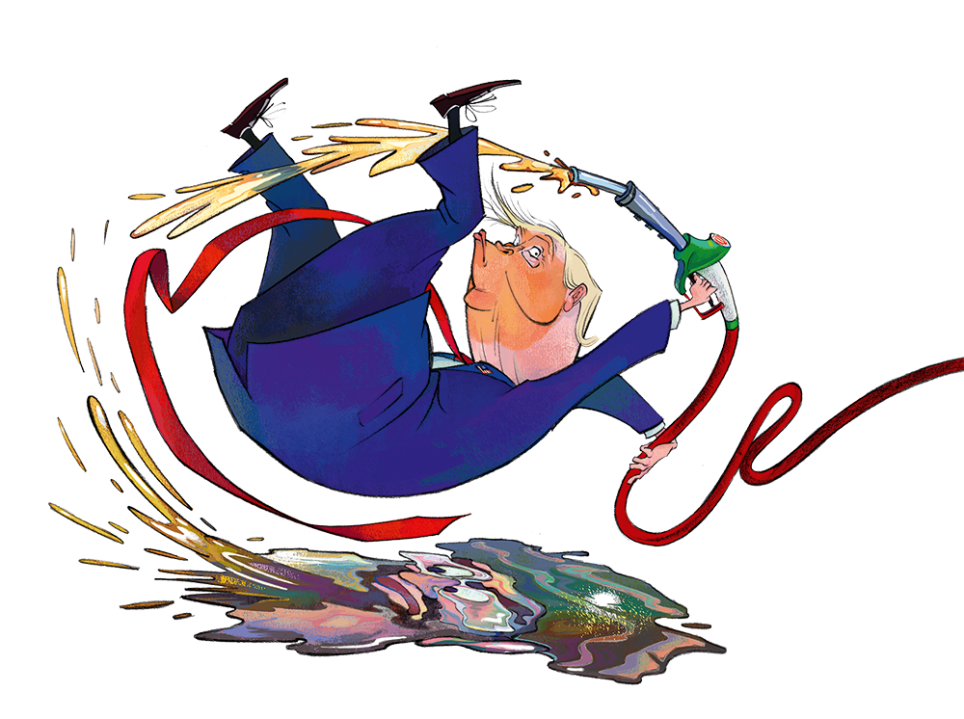


“Donald Trump is a complicated person with simple ideas,” said Kellyanne Conway, the former White House senior counselor. “Way too many politicians are the exact opposite.” It’s a good way of understanding the 45th and 47th President and his extraordinary success. His turbulent personality causes mayhem, yet his political aims have remained constant, straightforward and popular.
Decades ago, as a New York tycoon with a keen eye on international affairs, he identified three priorities for America: tackle the nation’s trade imbalances, force NATO allies to spend more on defense, and destroy terrorists.
When it comes to realizing those simple ideas, however, his more complex attributes emerge. Trump believes in mixing intimidation with diplomacy, war with peace and common sense with confusion. “We have to be unpredictable, starting now,” he said, back in 2016, and his second administration has turned that madman theory into an operational tour de force. To advance his trade agenda, he freaked out the financial system through a bonkers array of punitive tariffs. To show Latin America’s narco-states he meant business, he kidnapped Nicolas Maduro. To bring NATO members to heel, he threatened to annex Greenland. Most brain-melting of all, he inaugurated a “Board of Peace” for the Middle East as he set about waging war.
Most brain-melting of all, he inaugurated a ‘Board of Peace’ as he set about waging war
But Operation Epic Fury, his assault on Iran, has exposed once again the limits of American power, as well as the shortcomings of the madman approach. A bold president armed with the most awesome military the world has ever seen can achieve a lot. But he cannot control the global price of energy or the internal power dynamics of very different, very hostile countries.
“I knew oil prices would go up if I did this,” said Trump on Monday. “And they’ve gone probably less than I thought they would go up.” His bravado was unconvincing. One of Trump’s pet obsessions is bringing down the price of gas, and war with Iran is having the opposite effect. At Mar-a-Lago last weekend, advisers and donors sought to impress upon the President the inflationary consequences of an oil spike, which is why, having ended last week demanding “unconditional surrender,” he began this week insisting his Iranian “excursion” would “very soon” be over. “I think the war is very complete, pretty much,” he said.
“Short-term” pain will lead to long-term benefit, insist Trump and his advisers. But campaigning for November’s midterm elections has already begun and Republican party strategists are all too aware that is not a winning message.
Last week, Trump tried to gin up markets by promising to underwrite insurance premiums for ships going through that choke-point of the world economy, the Strait of Hormuz. This week, a more desperate-sounding Commander-in-Chief took to social media again, promising to hit Iran “TWENTY TIMES HARDER” if it “does anything that stops the flow” of tankers from the Persian Gulf. “This is a gift from the United States of America to China,” he said, though Chinese ships appear to be the vessels currently best able to navigate the strait. Trump’s energy secretary, Chris Wright, posted a video of American warships escorting a US tanker through Hormuz waters, which sent the oil price tumbling. But he then promptly deleted it, amid denials from the White House, and the oil price soared again. The next day “unknown projectiles” struck three ships off the coast of Oman and the UAE.
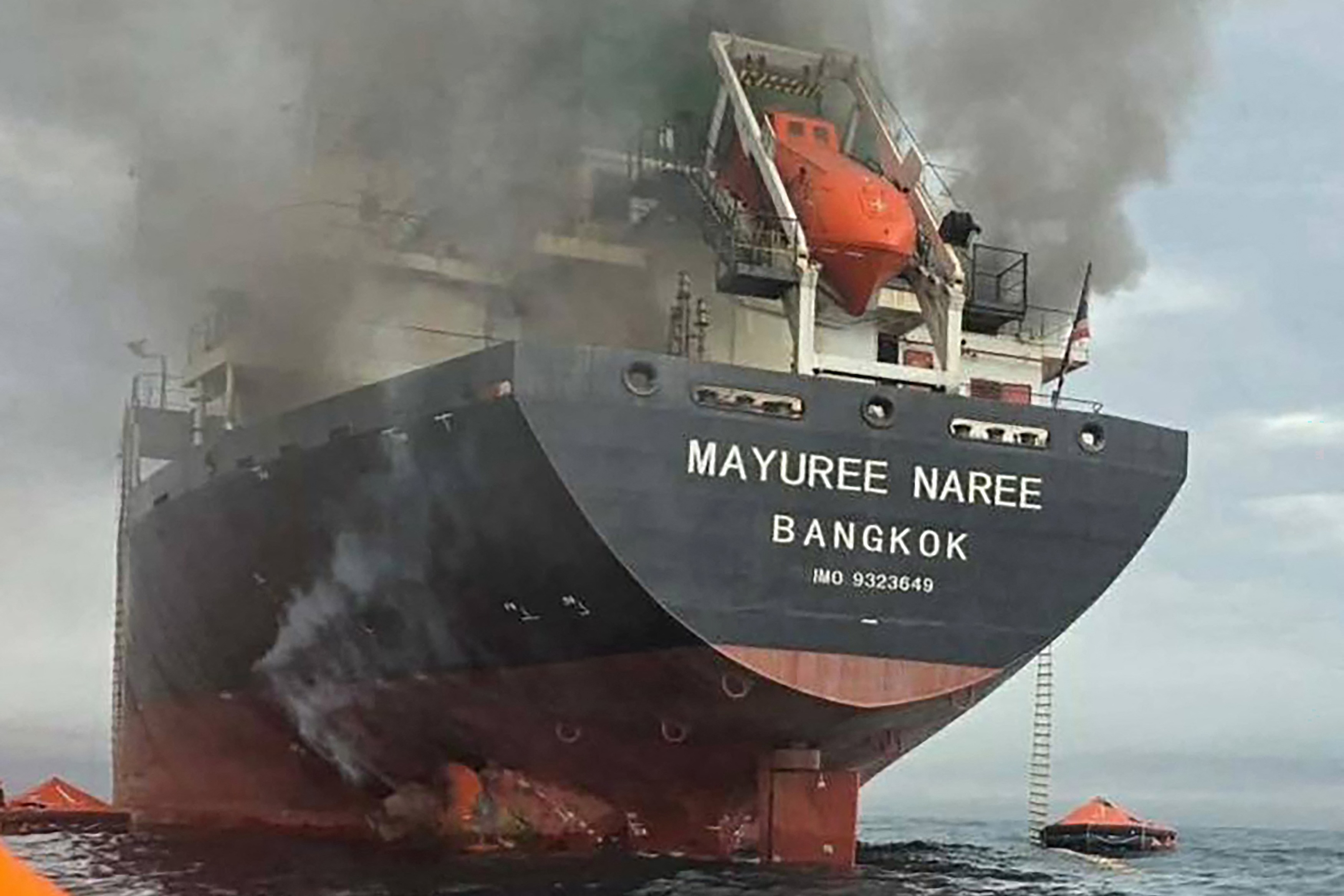
The black gold issue has also exposed divisions between America and its lead partner in the Iran endeavor, Israel. Over the weekend, Israel Defense Forces jets bombed 30 Iranian oil sites, eliciting an angry response from the Pentagon. “WTF,” US officials reportedly told Israeli sources, as dark black clouds billowed over the Islamic Republic. “That wasn’t necessarily our objective,” observed Pete Hegseth, the Secretary of War, not usually a master of understatement.
The President’s team, from Vice-President J.D. Vance to Secretary of State Marco Rubio to White House Press Secretary Karoline Leavitt, insist that the administration is laser-focused on destroying Iran’s offensive capabilities and ensuring Tehran is unable ever to build a nuclear weapon. But Trump and the Israeli PM Bibi Netanyahu have both gambled on the Islamic Republic collapsing, or at least bending to their will, and so far that has shown no sign of happening.
On Tuesday, Hegseth repeated the administration’s line that, in responding to US and Israeli strikes by firing off thousands of missiles and drones at the region’s Gulf states, Iran had made a “big mistake.” Far from caving under fire, Team Trump insists, the Gulf Cooperation Council has sided more firmly with America and Israel. But that isn’t necessarily a correct reading of the situation.
As Jennifer Kavanagh, director of military analysis at the Washington-based thinktank Defense Priorities, points out: “This is a pretty low-cost strategy for Iran with very high costs globally. All the Iranians have to do is keep firing drones to keep regional airports closed, to attack oil infrastructure across the region, to attack US bases and stop traffic through the Strait of Hormuz. The challenge is that Iran gets to decide when it ends and it will be difficult for Trump to walk away if Iran is still firing.” The Iranians have called their response to Epic Fury “Operation Madman” for good reason. The only way to fight crazy is to go crazier.
The upshot is that, as Kavanagh says, Trump has “backed himself into a corner.” His administration can keep ratcheting up the military pressure, conducting ever more strikes against Iran’s fast-dwindling weapons supply. But if America and Israel cannot cause regime change, this merely amounts to “mowing the grass,” as the Israelis say. And the trouble with fanatical Islamists in hot countries is that, similar to lawns, the harder you mow, the stronger they grow back.
In Venezuela, regime decapitation appeared to work. Maduro was replaced by his seemingly more biddable deputy, Delcy Rodriguez. So far in Iran, however, the killing of Ayatollah Khamenei and at least 40 others has proved less decisive.
Tehran has appointed Khamenei’s son, the by all accounts even less compromising Mojtaba, as Supreme Leader. The new concern for America’s regional allies is that Iran’s leadership structure has now been all-too-thoroughly decentralized, to the extent that the political figures have lost control of the Islamic Revolutionary Guard Corps. Last weekend, Iran’s President, Masoud Pezeshkian, apologized to neighbors for having attacked them, but the missile and drone strikes against the UAE, Saudi Arabia and Qatar continued.
In other words, the so-called “diplomatic off-ramps” may have been blown up – along with so much else. And if that’s true, the second Trump administration’s much-hyped “flexible realism” strategy could turn out to have been catastrophically inflexible and unrealistic.
At some point soon, Trump will declare victory and send his ships and planes back home to help further establish “hemispheric dominance” over those naughty narco-states south of the border. He never admits defeat. But even his powers of persuasion might not be sufficient to stop Epic Fury going down in history as an epic fail.
Trump has resorted to what has become the official excuse: he had to move against Iran because, if he hadn’t, the mad mullahs would have built their nuclear bomb. Any blame will fall on his trusted advisers – his son-in-law Jared Kushner, his peace envoy Steve Witkoff, the himbo Hegseth and Rubio. “The situation was very quickly approaching the point of no return,” Trump said on Monday. “And the United States found it intolerable, in my opinion, based on what Steve and Jared and Pete and others were telling me, Marco also involved, and I thought they were going to attack.” With great power comes no responsibility.
Trump whisperers, meanwhile, have been left wondering why their beloved Commander-in-Chief ignored the more cautious voices inside his administration, as well as the widespread anti-war sentiment of his supporters, and listened instead to the most hawkish and treacherous figures of the old Republican establishment. Aboard Air Force One, on 27 February, the day before he ordered the strikes, the President asked a group of party bigwigs, including two former harsh Trump critics, Senators Ted Cruz and John Cornyn: “Should we strike Iran?” The answer was a resounding yes.
The so-called ‘diplomatic off-ramps’ may have been blown up – along with so much else
Meanwhile, 70-year-old Senator Lindsey Graham, who once called Trump a “race-baiting, xenophobic, religious bigot,” has been bragging on the airwaves about his role in starting the war.
“Here’s the problem,” says one MAGA insider. “Nobody will say so, because everyone’s afraid of getting on the wrong side of this administration, but you talk to White House staff, State Department Staff, almost everyone, and they’ll quietly go: ‘Yeah we don’t know what the fuck is going on or why we’re doing this…’ At some point the feedback loop to the base got broken, and we got the Lindsey Graham feedback loop instead.”
The war has upset the delicate MAGA ecosystem. Rumors have started up again that the White House chief-of-staff, Susie Wiles, whom Trump calls the “most powerful woman in the world,” is going to resign after the midterms to go back to the more lucrative world of political consulting and, perhaps, running Rubio’s 2028 presidential campaign.
Meanwhile, Vance, a known critic of military interventionism, continues to lie low on social media, even as he has been tasked with reassuring Trump voters that the war isn’t all bad news. “We get along very well on this,” said Trump, when asked about his Vice-President this week. “He was, I would say, philosophically a little bit different than me. I think he was maybe less enthusiastic.”
Trump has reportedly been polling guests at Mar-a-Lago as to who they think would make a better president: Vance or Rubio? The Floridian respondents tend to reply forcefully in favor of the latter.
Insiders worry, however, that Trump’s talk of a successor suggests he’s losing enthusiasm for the job. He wanted 2026 to be a year of triumphant celebrations amid the Trump-induced golden age: America’s 250th birthday, UFC cage fights and car races around the White House and the Fifa World Cup on home soil.
Instead, he’s distracted by a monstrously expensive war, saluting coffins at Dover air force base in Delaware and answering difficult questions as to whether or not America’s marvelous, AI-guided war machine dropped a missile on a girls’ school, killing 150.
“No other president could do some of the shit I’m doing,” he boasted on Monday night. But the next president might be better advised not to try.




Comments