The sight of tens of thousands of would-be immigrants storming into Spain’s north African enclave of Ceuta last week was an arresting image. A huge flow of migrants, juxtaposed with the apparent impotence of the authorities tasked with defending their borders, strikingly represented the challenge that mass immigration poses to Europe.
At least, that is how it looked on the surface; but some observers thought they detected the hidden hand of Zionism behind those shocking scenes. Hollywood actor Javier Bardem took to social media to suggest that, one way or another, ‘Israel and the far right’ was ‘punishing’ Spain for calling the conflict in Gaza a genocide. ‘Ceuta: Did Israel and US engineer the crisis?,’ asked Owen Jones breathlessly, before admitting he had no proof that they did – but it ‘surely demands explanation’.
It’s the kind of reasoning that some people have always reached for to provide order and purpose, and to assign blame for unwelcome, chaotic events. When something bad happens, there must be a bunch of Jews – in one form or another – pulling the strings. Israel is just the latest label to be slapped onto this particular conspiracy theory. But whereas in the past, this kind of nonsense was limited to fascist agitators, Islamist demagogues and conspiracy cranks, now it is embraced by a much wider and more influential audience.
Tackling this rise requires honesty about who is behind it. Islamist extremism poses the greatest violent threat to Jews right now
This latest episode comes at a time when the number of anti-Semitic incidents recorded in the UK keeps rising: a 21 per cent increase in the first six months of 2026, according to the Community Security Trust, the charity that provides security for the UK Jewish community. The worst of these was the stabbing of two Jewish men in Golders Green, alongside the arson attacks on synagogues and Jewish community ambulances, almost certainly orchestrated by Iran. But most anti-Semitism is not so violent. Instead, it is made up of language and ideas: shouts in the street, threats online, graffiti on walls, much of which expresses the basic idea that Jews today are genocidal baby-killers, guilty of the worst of crimes.
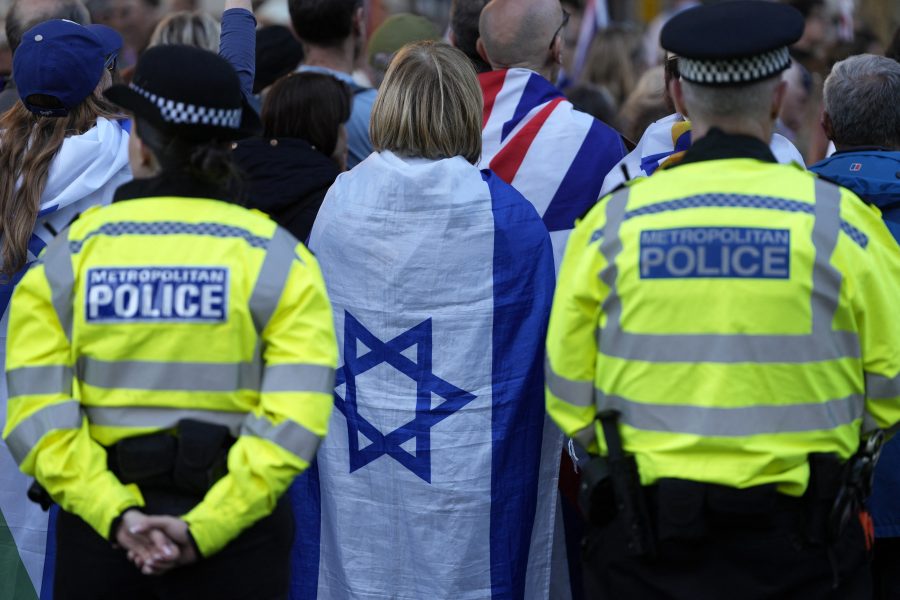
The accusation of genocide and child-murder is also the message that has animated and energised the anti-Israel movement ever since Hamas stormed into Israel on 7 October 2023. That event has proven to be a dramatically radicalising moment for this country. The combination of international conflict, terrorism, street protest, hate crimes, hostile state meddling and fraying community cohesion is unmatched. That it revolves around the Holy Land provides a unique cultural anchor. Of course, anti-Semitism has risen in this atmosphere – it always does.
It is impossible to avoid the evidence that it is anti-Israel sentiment keeping the numbers of anti-Jewish incidents so high. More than 40 per cent of all incidents reported to CST involved some mention of events in the Middle East, alongside the anti-Semitism. If a Jewish person is harassed in the street nowadays, it is much more likely to be with a shout of ‘Free Palestine’ than ‘Heil Hitler’. The already-elevated number of incidents climbed even further when the war against Iran began at the end of February. It spiked again, with every high-profile attack on the Jewish community in the UK a reminder that the sight of Jews being harmed excites anti-Semites to do more.
Tackling this rise requires honesty about who is behind it. Islamist extremism poses the greatest violent threat to Jews right now. More broadly, while most incident perpetrators in the report were described to CST as white (where a description was obtained), in almost a quarter of all incidents the perpetrators were described as Arab or north African – a starkly disproportionate figure to the general population. Measures to reduce anti-Semitism are essential, but will only work if they are targeted where they are most needed.
This all means that the neat distinction that politicians and commentators like to draw between anti-Semitism and criticism of Israel is of limited value, because the two categories do not reside in separate universes. It is a truism that it is not anti-Semitic to criticise the Israeli government, just as it is not racist to criticise the actions of any government. Indeed, many such criticisms may be well-founded. But it is also true that anti-Jewish hatred rises in parallel with anti-Israel protests; that no other overseas conflict brings such a security threat onto a section of British citizens; and that – as with the bizarre Ceuta theory – there is an obsessive, cranky nature to much anti-Israel sentiment. Perhaps this is all a coincidence, but it’s unlikely.
Rather, the cumulative effect of all this intense anti-Israel activity and commentary contributes, subtly and indirectly, to an atmosphere in which contempt for Jews becomes, for some, acceptable and even encouraged. This is inconvenient for all concerned, but given the alarming state of anti-Semitism in Britain today, it cannot be ignored.






Comments