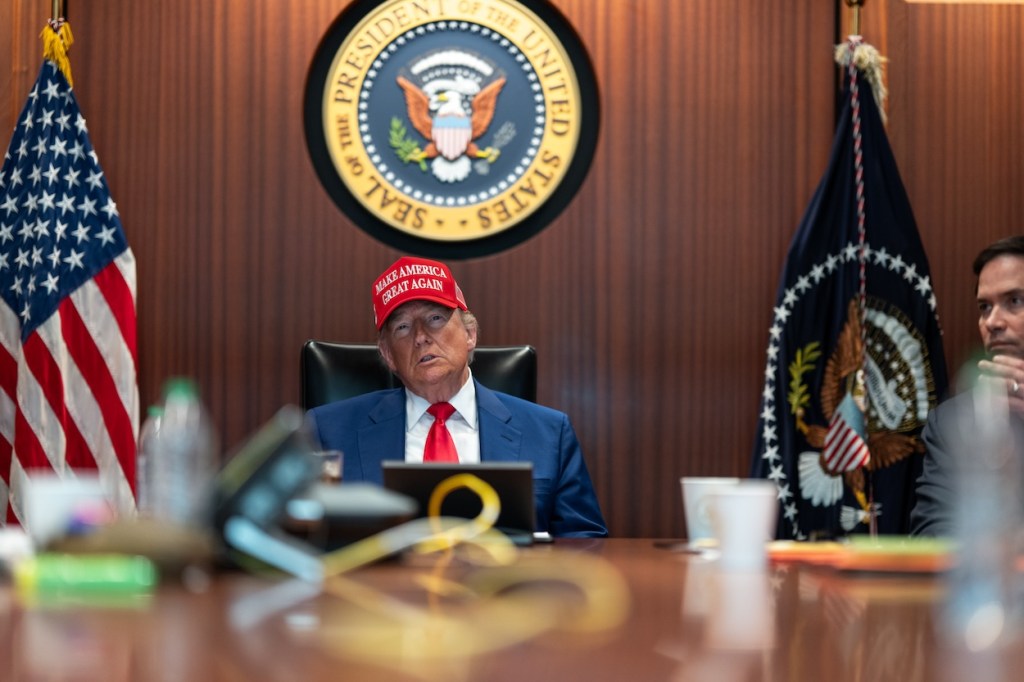
In December 2018, to the shock of pretty much everybody in the US national security establishment at the time, President Donald Trump publicly ordered the withdrawal of all US troops from Syria. The announcement caused a panic within the Defense Department, State Department and National Security Council, whose officials teamed up to dissuade Trump from going through with it. A similar story unfolded ten months later, in October 2019. Again, the bureaucracy pushed back; in October 2019, the House went so far as to pass a resolution opposing a US withdrawal, with senior Republican lawmakers signing onto the measure.
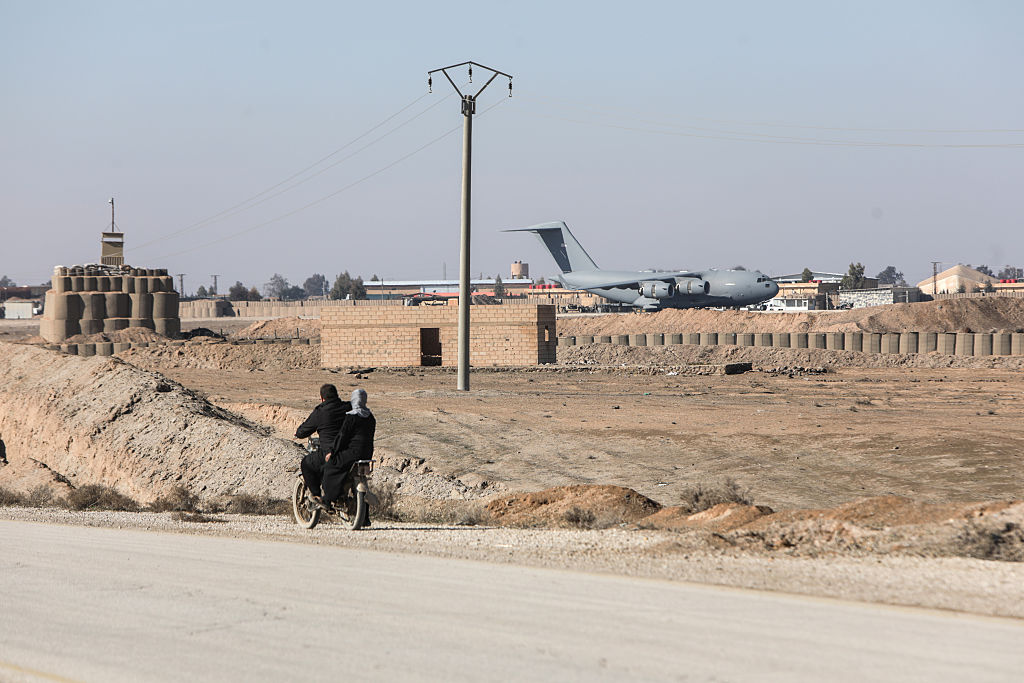
Fast-forward more than six years later, and the US troop withdrawal Trump floated about during his first term is finally coming to fruition in his second. On Thursday, February 12, US Central Command issued a statement that the US military “completed the orderly departure of US forces from al-Tanf Garrison in Syria… as part of a deliberate and conditions-based transition” of the counter-ISIS mission. The news came days after US troops and equipment reportedly left the al-Shaddadi base in northeastern Syria, likely for next-door Iraq.
Today’s departure from the al-Tanf garrison in eastern Syria is especially noteworthy. Al-Tanf, located at the cross-section between Iraq, Syria and Jordan, was used by the US-led coalition as a key staging ground for the training of anti-ISIS fighters. It quickly grew to become a de-facto US partition of Syrian territory, complete with a 55-kilometer no-fly and no-drive zone around the base. Any hostile force encroaching into the zone was at high risk of getting neutralized by US air power. During several instances in 2017, militias supporting former Syrian dictator Bashar al-Assad tested the zone by flying drones and sending military vehicles into US-enforced deconfliction bubble. The drones were shot down, the vehicles were destroyed and the personnel manning them were killed.
Yet as ISIS-held territory shrank and the caliphate fell apart in 2019, the US presence in al-Tanf, not to mention the constellation of smaller U.S. bases east of the Euphrates, took on a somewhat zombie-like existence. US officials couldn’t give a plausible explanation for why the US military needed to stay in Syria after the mission, destroying the ISIS caliphate, was accomplished. Washington’s entire Syria policy post-2019 could best be described as a mix of lethargy and a mishmash of different objectives, depending on which US official was being asked to explain it. For Trump, it was about keeping Syria’s oil. For John Bolton, it was about screwing with Iran’s military supply lines to Hezbollah in Lebanon. And for Joe Biden, the mission was partly about protecting the Syrian Kurds from Turkish attack. The constituency for keeping US troops bogged down in Syria was strong because it unified everybody from counterterrorism obsessives and Iran hawks to humanitarians.
Yet that constituency is breaking down, mainly because the rationale for continuing the status-quo is withering away along with it.
Containing Iranian power in Syria and the wider Middle East is less of a concern for the United States now than it was in the past, in large part due to Israel’s ferocious bombing campaign against Tehran’s proxy network in the region. Hezbollah and Hamas still exist, but their military capacity has been significantly diminished since the October 7, 2023 attacks in Israel. As a consequence of Israel’s more than two-year strike campaign against Hezbollah, the Lebanese militia is no longer the big, bad wolf dominating Lebanese politics. Pressed by Washington, Israel and the Gulf Arab states, the Lebanese government is in the process of demilitarizing this non-state armed force, an idea that would have been unthinkable a few short years ago. And with Bashar al-Assad sulking in a luxury tower somewhere in Moscow, the Iranians effectively lost the Syria’s civil war and with it, Syria’s status as an Iranian proxy.
Keeping the boot on ISIS’s neck isn’t a sufficient-enough reason to maintain a US troop presence in Syria either. Although ISIS militants continue to engage in low-level hit-and-run attacks against soft targets, this kind of activity is nothing new for the group and was impossible to stop even when a few thousand US soldiers were stationed on Syrian soil. The phrase “preventing the resurgence of ISIS,” which successive US administrations used to justify a continued deployment, might as well have been coined “we need to stay in Syria forever” since it was the very definition of an unlimited, unending military mission.
To be brutally honest, the United States never signed up to defend a Kurdish-led statelet
Some might argue that Trump pulling the plug on Syria will eventually result in more space for ISIS to regenerate and grow. Yet this isn’t exactly persuasive either. Unlike the Assad regime, Ahmed al-Sharaa, the new sheriff in Damascus, wants to consolidate his authority over the entire country and won’t tolerate any armed challengers to his rule. Just ask the Syrian Kurds, whose resistance to Sharaa’s political project prompted a Syrian military offensive in January that quickly pushed the US-backed Syrian Democratic Forces (SDF) into ever-shrinking territory and forced it to sign an agreement largely on Sharaa’s terms. Unlike the Assad regime, the Sharaa regime has worked with the U.S. military to pinpoint and neutralize ISIS targets – cooperation the Syrian government needs to keep up if it wants to stay on Trump’s good-side.
What about protecting the Syrian Kurds? Doesn’t the United States owe some gratitude for all the sacrifices Kurdish fighters have made over the last decade? Sure. But to be brutally honest, the United States never signed up to defend a Kurdish-led statelet in Syria’s northeast for eternity, particularly when doing so would keep the country divided and undermine the very reset in US-Syria relations that Trump supports.
Whether the US downsizing at al-Shaddadi and al-Tanf will lead to a full-scale withdrawal from Syria is still open for debate. Some of the same lawmakers, pundits and policy analysts who vocally opposed this scenario back in 2018 will do so again in 2026. But their case has become exceedingly thin as the years go by.

Comments