Vladimir putin

Who really triumphed at the ‘tri-lat?’

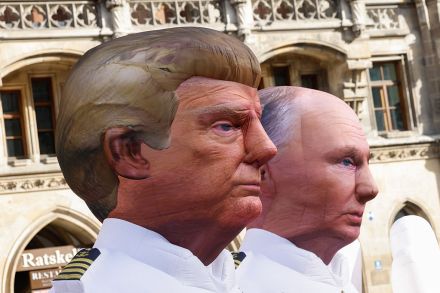
Big international summits tend to be flat affairs in terms of newslines – even when you throw in the dangerously powerful combination of Donald Trump, Xi Jinping and Vladimir Putin. And this week’s "tri-lat" between the leaders of the US, China and Russia in Shenzhen didn’t exactly throw up endless surprises. As expected, the presidents talked about nuclear proliferation and arms control – which was admittedly something new for the Chinese Communist party. Beijing has a mere 600 nuclear warheads, compared with roughly 5,000 each for Russia and the United States, and China has never been part of the New START treaty framework.
Shenzhen was kabuki theater

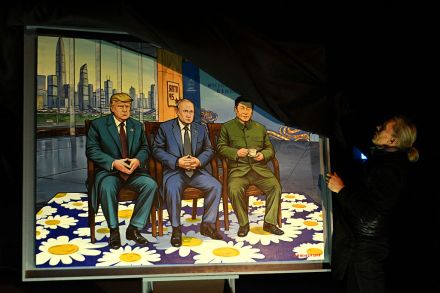
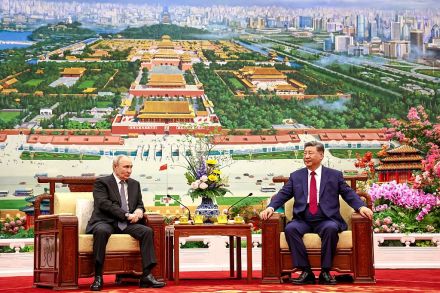
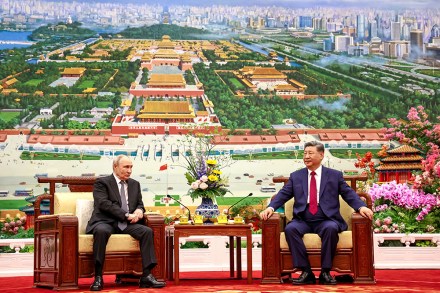
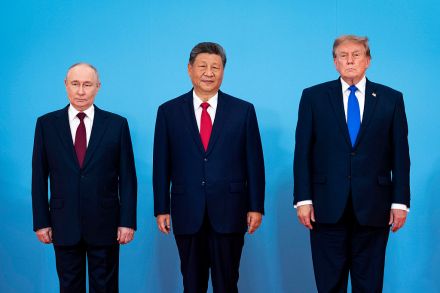
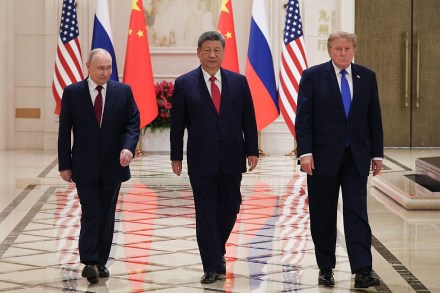
Vladimir Putin did not get to carve up the world at today’s historic summit in Shenzhen with Donald Trump and Xi Jinping. But he got the next best thing, which was a photo opportunity. Plus, warm words of friendship from Donald Trump. And from the Chinese side, the validation that Xi still values the two inheritances of Cold War superpower status that Russia has hung on to – a large nuclear arsenal and a permanent seat at the UN’s Security Council.  Best of all for Putin – and most shocking to Trump’s critics – was the moment when Trump called Putin “my friend” and promised that they would do “a lot of wonderful things” together.

shenzhen

Putin will not get his Yalta moment

This week was to be the crowning moment of Vladimir Putin’s career. After decades of cosplaying a superpower leader, Putin would at last sit down at history’s first-ever three-way summit between Russia, China and the US, to be held in Shenzhen on Thursday. The Russian press has been excitedly talking of the summit as a new Yalta – echoing the 1945 summit where Stalin, Roosevelt and Churchill sat down to carve out a new map of Europe out of the ruins of the Nazi empire.  The smoldering ruins of the Kerch Bridge confirm that Putin’s outsize self-image rests on a rotten foundation Alas for Putin, Kyiv chose this very week to finally blow up the great vanity project that had stood as the symbol of Russia’s new imperial might.

Trump is cynical and shocking about Ukraine – but is he also right?

What does “victory” in Ukraine mean – or “defeat?” Can there be lasting peace without justice? Direct talks between Russia, the US and Ukraine will finally commence in Abu Dhabi early next month, marking the beginning of the end of this bloody war. As Kyiv and Moscow, plus their respective allies, prepare to thrash out the details of a grand bargain, it’s vitally important to clarify what we mean by “victory” or “capitulation,” as those terms get thrown around by politicians observing the war’s closing act. A hot mess of false starts, betrayals, Russian dissembling and European denunciation lies ahead.

ukraine

Putin can smell Washington’s desperation

Donald Trump has staked a big chunk of his political credibility on finding peace in Ukraine – and by doing so in partnership with Vladimir Putin, and on the Kremlin’s terms. But is Putin ready to play ball and help save Trump’s backside, politically and economically? The answer is yes: Putin will probably play along with small gestures like partial ceasefires and prisoner releases. But when it comes to the big stuff like actually stopping what Putin calls his "special military operation," the Kremlin is likely to stick to its guns and ignore Trump’s special pleading while it continues pulverizing Ukraine’s cities.

donald trump russia

Has the plague broken out in Russia?

On the evening of Friday October 2, Daria Shipilova, an employee of the Irkutsk Anti-Plague Institute, died in a district hospital in the Russian city of Shelekhov. Her place of work, and the rumored circumstances of her death, have triggered a public health emergency in the region and a slew of questions: did the plague bacterium, Yersinia pestis, kill Shipilova? Could this metastasize into a plague epidemic in Russia? Should we – abroad – be worried? The Russian authorities have done their best to play down the link between the plague and Shipilova’s death. According to Russia’s public health watchdog, Rospotrebnadzor, Shipilova had been diagnosed with pneumonia of “unknown etiology” – i.e. of unknown origin.

plague

Why Putin is unlikely to attend the Miami G20

Secretary of State Marco Rubio has today announced that the US has invited Vladimir Putin to an upcoming G20 summit in Miami, giving the Russian leader “an opportunity to engage not just with Trump, but with other world leaders.” In one sense, the invitation is an olive branch to Moscow from Washington, so far the only Western nation willing to engage in peace talks with Putin. On the other, it’s a poisoned chalice that the Kremlin has already signaled that Putin will probably not accept.  For one, the summit will be held on Trump’s home turf – quite literally, as the venue is the Trump-owned Doral golf resort near Miami. When they met on a US Air Force base in Anchorage, Alaska, last year the two leaders were on more-or-less neutral ground.

putin

Putin’s miserable election rigging

After the counting of the ballots comes the number crunching to identify the level of fraud in this weekend’s Russian elections. The Kremlin has claimed a crashing victory for Vladimir Putin’s United Russia party, but preliminary analysis paints a picture of voter disillusion and frantic electoral manipulation. The more blatant the rigging, the less plausible the fiction Putin had framed these elections to the State Duma, the lower chamber of the Russian legislature, as a referendum on his rule and the war. In a TV address on Wednesday, he told his people that “your choice and your will shall once again demonstrate that millions of people stand behind our soldiers, that we are a united people bound together by shared values, historical memory, and love for our motherland.

election

Ukraine is losing the war

Vladimir Putin has not changed his war aims a jot since 2022 and remains determined on fighting on. Donald Trump has no new plan for peace other than bringing the Ukraine war to an end on Putin’s terms. And Kyiv is running out of money and men to defend itself, just as surely as it has already run out of Patriot interceptors to defend its skies against the Kremlin’s barrages. Those are the three depressing takeaways from the latest round of shuttle diplomacy in Moscow and Kyiv by Trump’s son-in-law Jared Kushner and special envoy Steve Witkoff. On the eve of their departure, Trump said his boys would be presenting “a new plan” for Ukraine. It quickly became clear that no such initiative existed.

Is Europe brave enough to keep pointing the finger at Putin?

Just under a month after three drones were discovered in quick succession at Leipzig airport, the German government took the unexpected step of publicly naming the country behind the incidents. Standing alongside foreign minister Johann Wadephul on Tuesday afternoon, the German minister of the interior, Alexander Dobrindt, announced: “The German government has concluded that Russia is responsible for the hybrid attack in Leipzig on 4 August.” According to Dobrindt, the German government was able to conclusively determine Russia’s involvement thanks both to a police investigation and findings made by the intelligence services.

putin russia

The great whataboutery delusion

If you live near the frontiers of acceptable opinion, as any thinking person must surely do, you quickly find that these badlands are policed mainly with insults and innuendos. And so you learn one morning, to your surprise, that you are an apologist for some repulsive regime which you strongly dislike. If you have been especially daring, you may be a ‘war crimes denier’ as well. Or you are charged with ‘whataboutery’, a word its users think will magically erase your case. Or, in many ways best of all, you are a conspiracy theorist. There is a myth that this phrase was invented by the CIA to try to discredit protestors against the Vietnam war, but the expression is far older than that.

Who gets to decide when assassination is justified?

When is extrajudicial killing just war by other means, and when does it become a state-sponsored act of terror? ‘We were not terrorists but fighters for freedom who fought with our eyes open,’ Menachem Begin wrote of Irgun, the irregular group of fighters he led during the 1947-48 civil war in Mandatory Palestine, the tactics of whom included bombings and assassinations. But where does the 1 August bombing of the Balzi Rossi restaurant in central Moscow – which killed at least five people and injured more than 20– stand on the scale? Some would describe the attack as a legitimate military operation. The bomb targeted the lavish birthday celebrations of Colonel-General Aleksandr Chayko, Commander-in-Chief of Russia’s Aerospace Forces (whose son-in-law died in the blast).

Burnham’s solutions must not lie in the 1970s

Andy Burnham is right. The cost of living is foremost in people’s minds just now. Naturally his electricity bill VAT holiday and freeze of bus fares find agreement in television news vox pops and focus groups. But he offers no explanation for the causes and concentrates only on the symptoms. Obviously, the removal of the 5 percent VAT will be nice for consumers. But underlying inflation today relates to government debauchery of money and disruptions of supply caused by Donald Trump’s tariffs and his short war, by Vladimir Putin’s long war and Ed Miliband’s net-zero trap, which makes us pay expensive green levies and bans new domestic fossil-fuel production. The remedy does not lie in the 1970s-style pretense that things can be made cheaper by fiat.

China has Russia over a barrel

Vladimir Putin just can’t keep away. Having visited Beijing in May on the heels of Donald Trump, it has been announced that the Russian leader – who has been to China more than two dozen times during his tenure as president – will lead his country’s delegation to the 33rd Asia-Pacific Economic Cooperation (APEC) summit in November. This apparent sign of amity, though, is actually an expression of Russia’s growing dependence on China – and Putin’s growing frustration with its refusal to green-light a new gas pipeline project.

Xi Putin

Putin has lost touch with reality

From our UK edition

As dark clouds of burning oil billow like thunderheads on the skyline of Moscow and black rain falls across the capital, why does Vladimir Putin fail to see that something fundamental is changing in the dynamic of his war? Why, when Donald Trump effectively agreed to hand over every inch of the Ukrainian territory Russia has captured and offered the Kremlin an easy off-ramp studded with juicy business deals, did Putin refuse? And why, for that matter, did the Russian President choose to launch his full-scale invasion of Ukraine in the first place? One answer is that Tsar Vladimir is mad, so blinded by his imperialist ambitions that he deliberately chooses to ignore the reality of a crashing economy, half a million dead fellow countrymen and a war that is obviously unwinnable.

Chinese puzzle or matryoshka doll – the complexity of Sino-Russia relations

China and Russia are twins. Both are great Asian land empires; both are continental, multi-ethnic powers that expanded by pushing forward their borders rather than by crossing oceans; both have a deep tradition of autocracy that survives to this day; and both (more plausibly in China’s case) believe that their social contract, ideology and system of government is a universal one superior to all others. In Entangled Empires, the German historians Sören Urbansky and Martin Wagner explore the convoluted story of Russo-Chinese relations from the moment in the mid-17th century that roving Cossack bands bumped up against Siberian tribes who owed fealty to Beijing up to the latest performative amity between Vladimir Putin and Xi Jinping.

The ‘great man’ era is passing away

Not long ago, I participated in one of the many off-the-record discussions in Washington about ending the war in Ukraine. This conversation was quite detailed, with American academics and policy wonks asking a European who was especially well-informed on Russian matters just what a land-for-peace deal or security guarantees acceptable to all parties might look like. When my turn to speak came around, however, I had to wonder whether all this wasn’t moot. There just isn’t much time to reach an agreement – let alone implement one –before the end of Donald Trump’s second term. And when America elects its next president in November 2028, Vladimir Putin will be 75 years old.

The President is winning the geopolitical battle with China

Almost all media commentators seem convinced that Donald Trump’s foreign policy in his second term is a disaster. He is bogged down in Iran, snookered in Ukraine, his tariff agenda has failed and he has alienated his NATO allies. But this consensus has been too hastily formed. Looking at the bigger global picture, Trump’s foreign policy has been a spectacular success. Take the western hemisphere. We have the so-called “Donroe Doctrine,” the updated version of the 19th-century Monroe Doctrine.

war

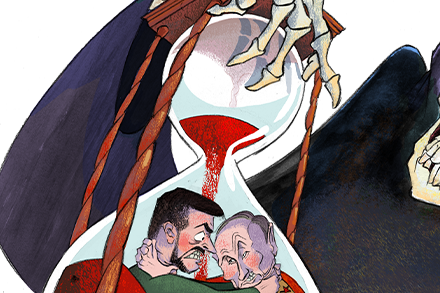
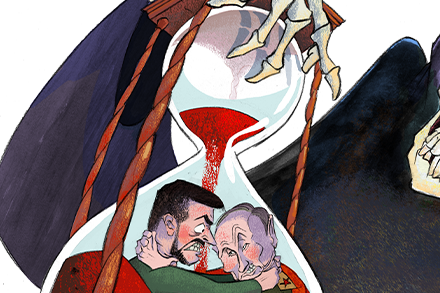
Forever war: will Zelensky and Putin be brought to an exhausted peace?

Volodymyr Zelensky stood proudly on the steps of 10 Downing Street earlier this month, flanked by Sir Keir Starmer and the leaders of France and Germany, ready to discuss Europe’s latest package of support for Ukraine’s ongoing war effort. Though the conflict has now lasted longer than World War One, Zelensky is in some ways in the most heroic period of his presidency. Ukraine not only continues to stand firm against intense Russian assaults but also seems to be regaining a strategic advantage with its long-range drone strikes. Europe has stepped up to replace US funding and diplomacy and the fall of Hungary’s Viktor Orbán has unlocked a €90 billion loan package. Yet it is also the most sordid period of Zelensky’s presidency.

Forever war: will Zelensky and Putin be brought to an exhausted peace?

Volodymyr Zelensky stood proudly on the steps of 10 Downing Street this week, flanked by Sir Keir Starmer and the leaders of France and Germany, ready to discuss Europe’s latest package of support for Ukraine’s ongoing war effort. Though the conflict has, as of this week, lasted longer that the first world war, Zelensky is in some ways in the most heroic period of his presidency. Ukraine not only continues to stand firm against intense Russian assaults but also seems to be regaining a strategic advantage with its long-range drone strikes. Europe has stepped up to replace US funding and diplomacy and the fall of Hungary’s Viktor Orban has unlocked a €90 billion loan package. Yet it is also the most sordid period of Zelensky’s presidency.