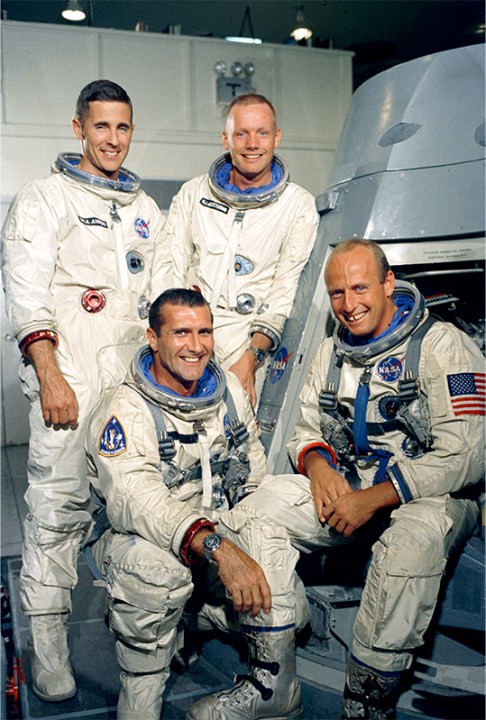

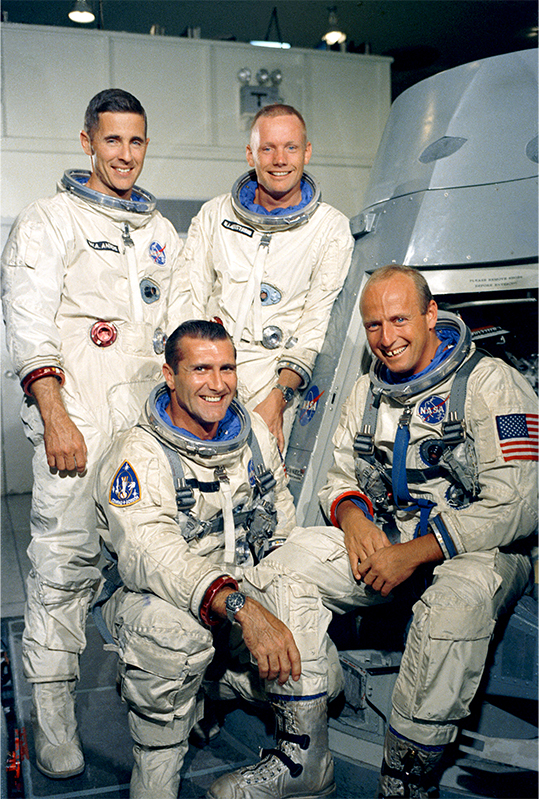
On March 16, 1966, Neil Armstrong and David Scott became the first astronauts ever to dock with another spacecraft when they linked their Gemini 8 capsule to the uncrewed Agena target ship. However, the cheers had barely died down at Mission Control Houston when Scott realized they had a problem. The conjoined spacecraft had begun a gentle leftward pitch.
Armstrong and Scott watched in horror as the capsule’s gentle pitch became a tumbling motion that increased, turning the craft into a centrifuge. In desperation, Scott undocked the two ships before gravity ripped them apart. But Gemini 8 continued to spin faster. At 60 revolutions per minute, the astronauts began to slip into unconsciousness. Fighting the rising G-forces, Armstrong shut down the faulty maneuvering thrusters and fired the reentry thrusters. Slowly, the rotation eased. With the craft now very low on fuel, the two men just had to achieve one more first: the first emergency reentry in history.
The Space Race started with the Soviet Union’s launch of Sputnik 1 on October 4, 1957, the Earth’s first artificial satellite. Thereafter, the two superpowers competed with their rival Vostok and Mercury space programs for headline-grabbing “firsts,” and initially it seemed Moscow was winning. In an attempt to regain momentum, president John F. Kennedy promised on September 12, 1962, that the US would land a man on the Moon before the end of the decade. It was quite the commitment. Before Neil Armstrong’s “giant leap for mankind” could take place, NASA’s astronauts had to master the skills needed to reach and land on the Moon. They did so on ten crewed missions launched between the Mercury and Apollo projects: Project Gemini, the overlooked “middle sibling.”

In Gemini: Stepping Stone to the Moon, the Untold Story, veteran journalist and author Jeffrey Kluger tells the thrilling story of one of “mankind’s greatest adventures.” Following on from his previous books such as Apollo 13 (1994), which was the basis for the 1995 movie, and Apollo 8 (2017), Kluger weaves together detailed research, technical precision and cinematic set pieces to immerse the reader in his definitive account of Project Gemini.
Space exploration doesn’t exist in isolation. Kluger is largely successful in captivating the reader by setting the progress of Project Gemini against a backdrop of the Space Race and the broader turbulence of the 1960s, and by showing how the socio-political turmoil threatened Kennedy’s promise to land a man on the Moon by the end of the decade.
The challenge for anyone depicting the overshadowed story of Project Gemini is that they must start by retelling the familiar story of Project Mercury, itself immortalized by Tom Wolfe in his 1979 book The Right Stuff. However, Kluger narrates the Mercury story in a genuinely fresh and gripping manner. He does this by intercutting better-known stories such as America’s “Sputnik surprise” or the exploits of the Mercury 7 astronauts with more obscure ones, including the rise of ambitious Soviet engineer Sergei Korolev – the USSR’s “homegrown von Braun” – or the secret disgrace of astronaut Scott Carpenter, who disobeyed commands and put his life in jeopardy in the process. These anecdotes help turn what could have been a predictable slog into a page-turner.
In Kluger’s skillful hands, a shocking event such as the 1960 explosion at the Baikonur Cosmodrome that destroyed a giant Soviet rocket and killed more than 100 people becomes a memento mori for the reader, reminding them that glory and tragedy were never far apart in the race to the Moon.
Amid this fire and fury, Kluger captures the birth of Gemini with the eye of a moviemaker. From the realization by NASA’s mission controllers that the launch pads had to continue going between the Mercury and the Apollo projects, and that practically, they had to start training the Apollo astronauts in the skills needed – down to the engineer who drew the constellation Gemini on plans for a “hot rod of a space ship” that he didn’t think would ever be built – Kluger brings this key part of the story vividly to life.
Gradually, however, the intercutting storylines fade away, and the book morphs into a detailed retelling of Project Gemini’s crewed missions in a more straightforward and slightly less satisfying fashion than previous chapters.
This approach unfortunately exposes Gemini’s lack of character arcs and diminishes the stakes for the reader; it sometimes feels as if the author was struggling to balance his desire to write the definitive technical account with the demands of a compelling human story.
For all its flaws, however, Gemini also ensures that no reader will view the history of space exploration in the same way again. As Kluger observes, every step taken by an Apollo astronaut on the lunar surface, every space shuttle flight and every docking of a SpaceX Dragon capsule with the International Space Station “flows directly and indirectly” from lessons learned on the Gemini missions 60 years ago. One day, surely so will our first steps on Mars.






Comments