The Frieze fairs are the biggest event in London’s art calendar, and this year I managed to miss them. The reason for my non-attendance was the riotous opening of a group exhibition at a townhouse on Bloomsbury’s John Street. It was a blast but I awoke the next day feeling like I’d been hit by a freight train, and was thus ill disposed to pass the afternoon at yet another iteration of the capital’s silliest trade show.
Her work is scary – I’ve yet to see a Pritchard sculpture that doesn’t emit pronounced hints of bad juju
The party was great, but the art was better. The main draw was the work of a sculptor called Helen Pritchard, who is, I think, one of the most interesting artists working in Britain today. It’s not saying much, but Pritchard (b.1975) really is special. She follows in the time-honoured tradition of the scavenger-artist, amassing the shoddiest detritus imaginable and alchemising it into awkward, spooky forms that nod to canonical modernism on the breeziest of terms. She picked up this gleaning mania on the streets of her native Durban and subsequently made a seamless transition to London.
Here in England, she picks up any old crap – Styrofoam, fag butts, breeze blocks, abandoned strands of rebar – and bashes them together to create pieces that, more often than not, are truly beguiling. Most of them are small enough to sit comfortably within the confines of a bookshelf, many styled as moquettes for unrealised (or unrealisable) public sculptures. She does not attempt to disguise the fact that these things are de facto fleurs du mal, hewn from the worst materials she could possibly source.

But this does not render them inelegant: they resemble the kind of structures Tito built across the former Yugoslavia in commemoration of the partisan victories and have a grace that recalls Brancusi at his most polite. If you think this all sounds a bit YBA, remember that Pritchard isn’t from these parts. There is something slightly cursed to her style, which distinguishes it from the institutional maledictions that have for so long hobbled British art. In short, her work is scary – I’ve yet to see a Pritchard sculpture that doesn’t emit pronounced hints of bad juju.
The show will run for a few weeks after this article appears, and I thoroughly recommend it. But for sensations yet weirder, get yourself to Oxford. The artist Mike Nelson (b.1967) was one of my heroes as a teenager; a beardy type who looked much like William Blake’s visions of God, he transformed spaces into Stygian environments that invariably suggested that hell, or a version of it, lay just around the corner.
For example, Nelson repurposed institutional corridors as fleapit cinema foyers, Turkish buses as shrines for Grateful Dead-worshipping biker gangs: the work, back then, seemed like multiple imaginings of the Room from Tarkovsky’s Stalker, sandwiched between the walls of familiar gallery spaces. All of this was eerie, involving, open-ended and entirely engrossing. Yet it was all atmosphere: fine then, but a real, contemporary critic might well dismiss it as a gussied-up analogue to the ‘immersive experiences’ staged by the likes of Punchdrunk.
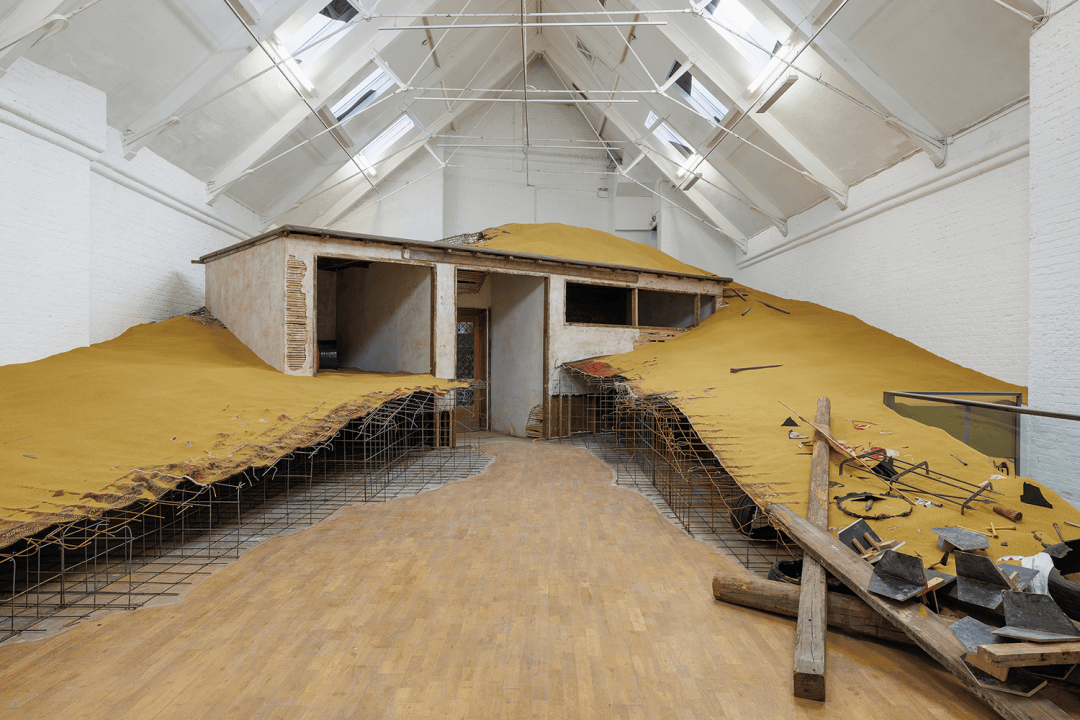
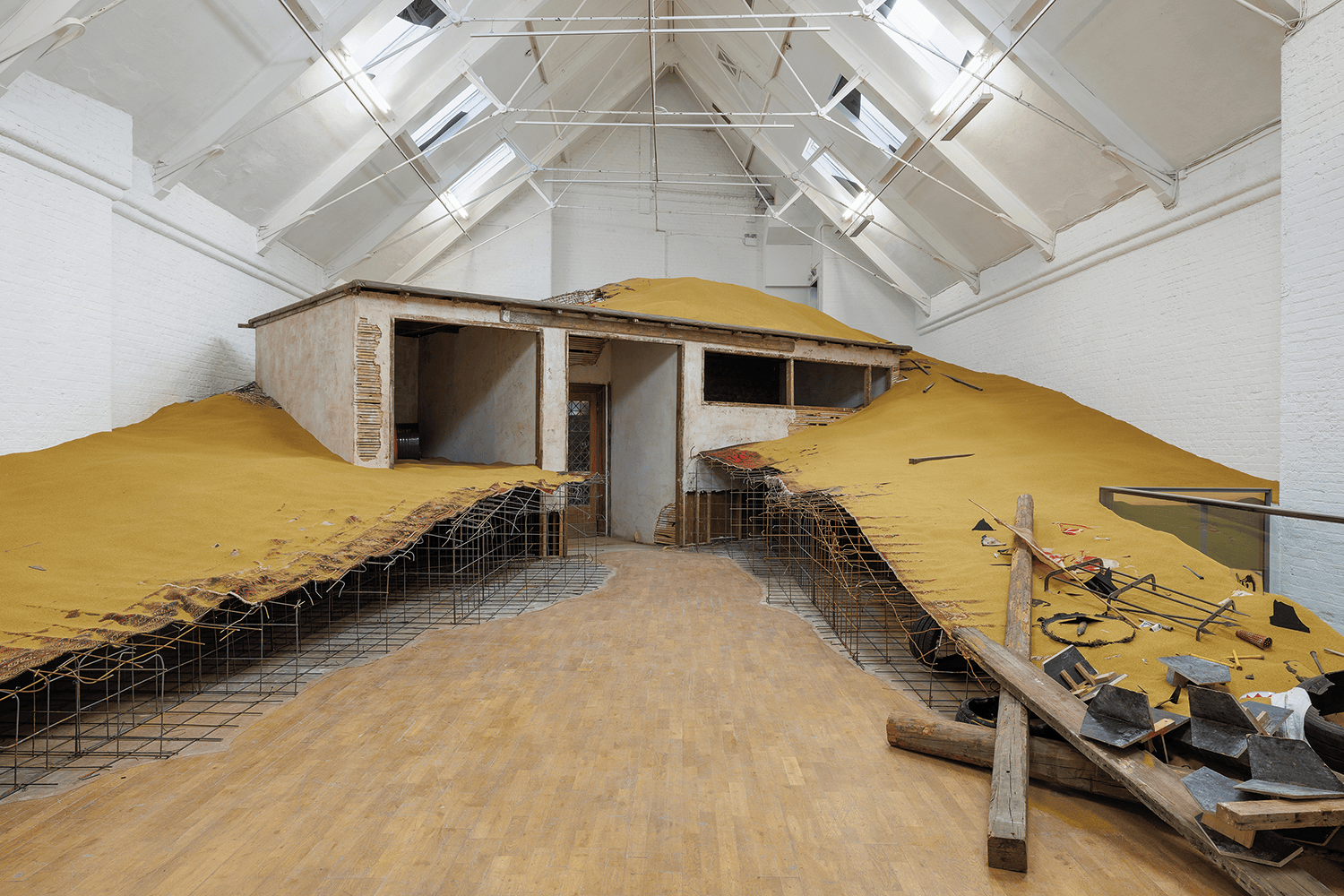
The artist’s current show, at Modern Art Oxford, assuages all doubts as to his berserk brilliance. Nelson has essentially smashed through the architecture of the place, substituting corridors with jerry-built miners’ tunnels and interstitial spaces with alarming cinematic environments that draw directly on his past work. There’s a desolate room full of Lonely Planet guides, a recreation of a south London studio he rented in the early 1990s, and an update of a previous show in the same venue, wherein a lonely woodshed – a nod to the American land artist Robert Smithson – was half-buried in mounds of sand. Here, the haboob-struck cabin remains present and correct, like some bunker long-abandoned by Saddam Hussein’s army.
The artist’s current show, at Modern Art Oxford, assuages all doubts as to Nelson’s berserk brilliance
But the sand dunes are visibly supported atop carpets mounted on a steel armature. It’s entirely intentional that we notice the artifice: the sands are studded with the ephemera of the artist’s past. Salvaged fragments from English social movements, tyres and arcs of steel; there’s even a little effigy of Saddam himself, glimpsed on an old Iraqi banknote flapping from the lower ends of this conjured dune. They stick out from the deep end of this sand pit, reflecting Nelson’s own concerns.
All this, we might intuit, stems from Mike Nelson’s psychoanalytical read on… Mike Nelson. Clearly, he is concerned at the state of the world – you too, Mike? – but also at the fact that he can do sweet FA to change anything. Ageing, too, seems to be gnawing at him: that we see him recycling tropes and styles from his past should not be taken as creative deficit; it is, rather, a farewell to his younger and more exciting years. Or something like that… However self-involved it all seems, his efforts are, believe me, astonishing.





Comments