
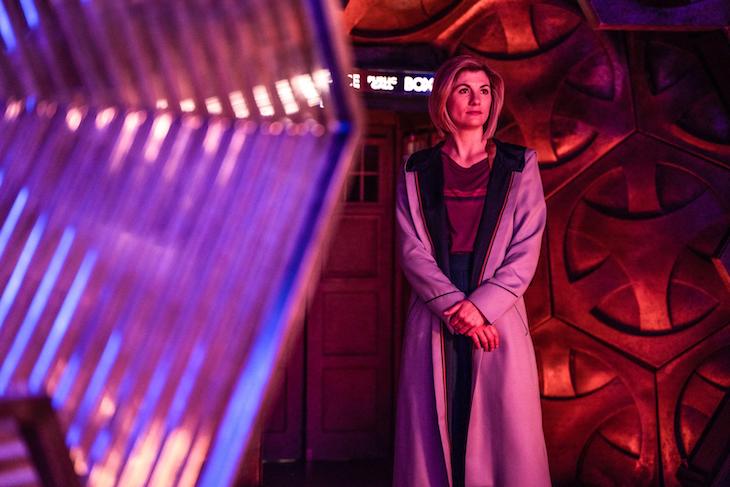
The BBC has binned its planned Doctor Who Christmas special and put the show ‘out to tender’. This is a face-saving TV industry term for saying you’ve kicked an ailing show into the longest of grass, but don’t want to enrage its most rabid fans. Good luck with that, chaps. Essentially it translates as ‘Somebody please, please take this nightmare off our hands’. It’s like one of those Facebook ads you see for a dog that needs rehousing because it barks all night, gnaws on toddlers, and has no control of its bowels, but is a total sweetie, honestly.
I’d put Doctor Who on ice for at least a decade
If by some bizarre quirk of circumstance I found myself the unwilling owner of the tender, I’d put Doctor Who on ice for at least a decade. Much has been written in the past few days about what happened to poor old Doctor Who, how the thing was revived in glory and then retoxified in shame. As a former writer on Doctor Who, I was actually in the room when some of the mistakes were made. I offer the following suggestions – in a reflective but constructive spirit – for anybody barmy enough to take the thing on. (And yes, I broke many of these ‘rules’ myself, but I know better now.)
1. The character is called Dr Who, but nobody in the fiction knows that, probably not even him, so within it he’s referred to as ‘the Doctor’. But his name is Dr Who. The public know this, and the public is always right. Correcting the public on this obvious point – and billing him as ‘The Doctor’ on the end credits – makes a production look quite mad. Similarly, those who travel with Dr Who are his friends, or his assistants. Not ‘companions’, which is positively Victorian and cringe-inducing.

2. Doctor Who is a British show aimed squarely at a British audience. Everybody else prefers it that way.
3. This is always, primarily, a children’s show for ages five to 12. Everybody else is there on sufferance. Adults may well enjoy the innovation, playfulness and whimsy, but teenagers must never be appealed to. That way lies disaster.
4. Similarly, ‘sci-fi’ fans in general must be totally ignored. It is not for them.
5. There should be no mention of any previous Dr Who or assistant. This episode – the one people are watching right now – is what’s important.
6. Doctor Who must be fun, but there must be no breaking of the fourth wall or self-referential humour.
7. The tone of the stories should be as varied as possible. The variety should clash, each new situation should be fresh and different.
8. A story should never begin in media res. The stepping out from the Tardis and exploring and finding out is a major part of the thing. That should never feel ordinary, casual or routine.
9. Nobody should ever be revived from the dead. There must be no parallel universes or alternative realities, or time trickery. Everything counts – and the normal laws of drama, cause and effect, life and death, always apply.
10. There is no magic. Dr Who is a scientist, and the fictional world is solid and explicable in scientific terms, even if far in advance of ours.
11. As in the 1960s, it should be the case that Dr Who cannot steer the Tardis. At all. Ever. This immediately solves nearly all of a writer’s narrative problems, and raises the stakes of every story and situation. Being able to pop home or zoom about where you fancy on a whim makes the scenario mundane.
12. Stories about Dr Who himself, the Tardis and the Time Lords, the series mythos etc, and overarching narratives in general, are boring and a turn-off. Every story must be excellent in itself.
13. Dr Who is a character part, not an acting part (Patrick Troughton, Tom Baker and Matt Smith knew this in their souls). He is loveable and elusive and naughty and fascinating, and most of all fun. Any attempt to make him brooding and dark – or worse, maudlin – is embarrassing and adolescent, except in the tiniest, rarest doses.
As a former writer on Doctor Who, I was actually in the room when some of the mistakes were made
14. Dr Who does not have a moral mission and he does not make plans. He is an improviser. His motivation comes from just being a kind and civilised man who helps out because he feels that … well, anybody would help out, wouldn’t they?
15. He is never funky, with-it or down wiv da kids. Equally, he is not a stuffy fossil. He is beyond either of those things, as he is beyond sex, money, religion, politics and most other things that children are not interested in. He never ever peacocks or grandstands and is never pious or self-pitying.
16. There should be one (female) assistant only, and she should always be someone the audience can identify with i.e. someone from planet Earth. The assistant’s purpose is to keep everyone’s feet on the ground. She should not be ‘special’ or significant in herself, as every kid watching needs to feel they could be the assistant. She should usually be the only person under thirty around. Children are absolutely forbidden.
17. Spectacle is nice but totally unnecessary. Invention, fun, scares, and loveable main actors are worth far more.
18. Monster concepts and designs are, however, incredibly important. This is where money should be spent. Children don’t care about pretty views or beautiful direction. The only production value they do care about is being convincingly spooked. Everything else must bow to that. A spooky tunnel is worth a hundred CGI panoramas.
19. Attempts at profundity and social commentary should be resisted as strongly as attempts at sentimentality.
20. The big emotion should be joy: the joy of adventure, excitement, frights and laughs. The viewer must feel elated. Doctor Who should be a delicious helping of trifle that anybody and everybody can enjoy.




Comments