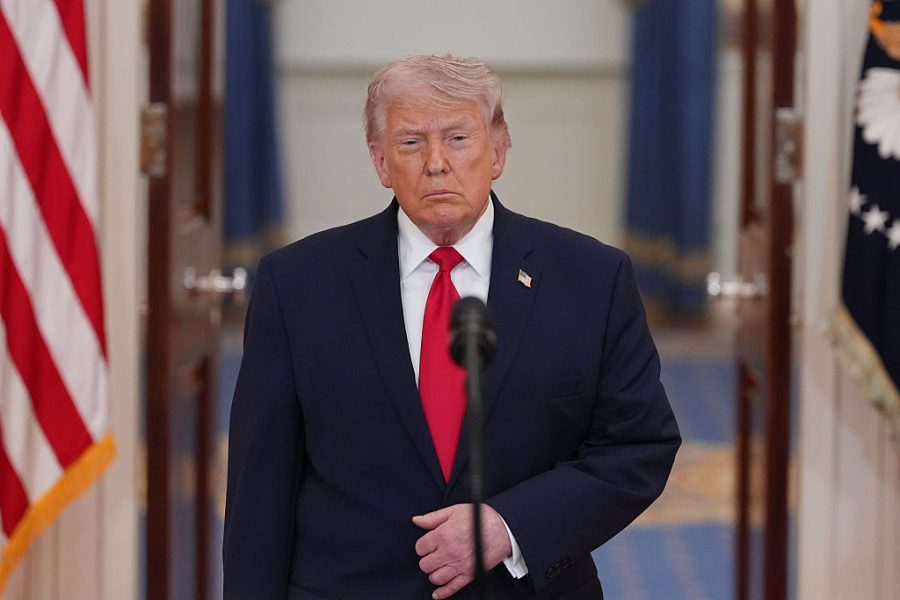
President Trump has now told us something very important about the war with Iran. Ponder his address to the nation this week and you discover how he defines victory. Nothing that happens from here on out will change that.
As Trump sees it, he is the winner, having achieved all his goals. He has accomplished regime change in Iran by eliminating the men who led the regime when the war started. America has so damaged the country’s military infrastructure that it will not be able to produce or deliver a nuclear weapon for at least a decade, by which time it will be up to a future American president to take the needed action. So, no need to cart away or destroy Iran’s enriched uranium. The Strait remains closed, but that is a problem for the EU to solve, by force if necessary, or by buying oil and LNG from the US, where they are in ample supply.
Iran sees things differently. The aim of the Iranian regime has always been survival. And despite Trump’s claim to have achieved regime change, in a policy sense the regime remains quite the same as it was before the bombs fell.
That regime will retain its enriched uranium, enough for 11 nuclear bombs. Despite major damage to its missile sites, Iran retains the ability to rain death on Israel and reach Berlin if it chooses. It retains control of the Strait of Hormuz, with little fear of the EU, which has neither the will nor the means of prying the Strait open as French President Emmanuel Macron has made clear. It can allow transit to nations of its choosing, probably excluding any that play host to American installations or continue to trade oil in dollars. Perhaps most important, Sunni domination of the Gulf is now shifting to Shia Iran, free to destroy its neighbors’ energy, water and other infrastructure without fear of retaliation by American forces that will soon be returning home.

Yes, Iran faces a major rebuilding program, especially of its military and weaponry. But note: it has not abandoned its claim for reparations from nations within reach of its missiles and/or desperate for access to the Strait. This might not mean winning in the sense of the second world war, when the winners walked off with signed surrender documents, but it doesn’t look like losing.
Other winners include Russia, a steadfast ally of Iran, which supplied it with vital intelligence that helped it locate American bases and with an apparently limitless supply of drones. In an effort to rein in politically damaging gas prices resulting from the war, Trump attempted to increase supply by removing sanctions on Russian oil. Sales increased, and the price obtained jumped from about $50 per barrel to $100. The resulting windfall enabled Putin to cancel plans for unpopular tax increases.
There are losers. Prime among them is Israel. It remains exposed to an enemy that is sworn to destroy it and has the weaponry to do it serious damage, while its own ability to ward off death from the skies is not what it once was. It faces an enemy in Lebanon – Hezbollah – that continues to take guidance and receive aid from Iran, and an enemy in Yemen – the Houthis – who swing into action against Israel when Iran directs them to do so. And it remains sufficiently dependent on America to worry that its political support there is not what it once was.
The next major losers from a war they insisted was not their war, and in which they loudly proclaimed they would not get involved, are Europe and the UK. Both refused to allow Trump to use American bases operating from their territory or to transit their airspace and then doubled down by refusing to provide requested help in clearing the Strait, at least until the shooting stopped.
Trump considers it bizarre that the EU and Britain – “cowards” – should expect him to continue to help them in their struggles against Putin in Ukraine and who knows wherever next.
If we can no longer use those bases to defend America’s interests, then NATO is a one-way street; then NATO is about us keeping troops in Europe to defend Europe… Then why are we in NATO?
So asked Secretary of State Marco Rubio during an interview with Fox News this week. If Trump does redeploy military assets now in Britain, Prime Minister Miliband, oops, Starmer, can convert US air bases in Britain to wind farms.
So done and dusted and back to domestic affairs in triumph, with share prices rising and gas prices falling, to shore up the fading chances of Republicans emerging from the midterms with control of congress.


Comments