
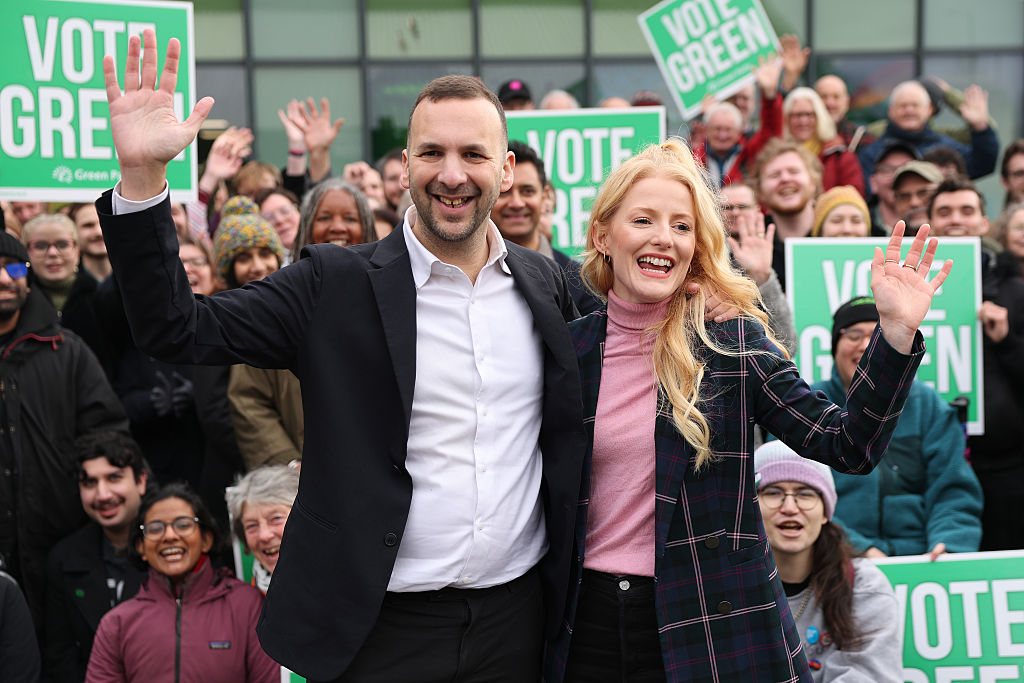
So Gorton and Denton has become another of those parliamentary seat names which enters the collective memory of British politics – a name which will stand alongside Glasgow Hillhead, Brent East, Clacton and Bermondsey in the annals of great by-election wins. Divining what it all means could take months or years, but here is my list of winners and losers.
BIG WINNER: Zack Polanski and the Green party
Before last night, the Greens had never won more than 10 per cent (and change) in a British by-election. In Gorton and Denton they topped 40 per cent and won easily. They benefited both from becoming the protest vote of choice against a woefully unpopular government and from hoovering up the ‘stop Farage’ votes on the left. Other parties claimed the Green campaign was ‘run out of the back of a van’ but it was helped by a sparky candidate, 34-year-old plumber Hannah Spencer. She is now their first ever northern MP.
BIG LOSER: Keir Starmer
This was Labour’s sixth-worst by-election defeat ever, in a seat where Labour has not lost since 1931. The Prime Minister vowed to ‘fight on’ in that tetchy tone of voice he uses at PMQs when he thinks he’s not getting the credit he deserves. But Starmer is beginning to resemble the Black Knight from Monty Python and the Holy Grail, swinging aggressively like a drunk outside a pub while he bleeds out on the pavement. I ran into a cabinet minister on Tuesday evening who said a Labour victory would be nice, and failing that, a Reform victory would be tolerable ‘because then we can argue that if you vote Green you get Farage.’ That argument is now defunct. The Greens are immediately a serious challenger in the 39 seats where they are currently second to Labour. They are likely to take chunks out of the Labour vote in other seats this May and in the general election. The perception in the Labour party is that blocking Andy Burnham from standing was a costly and vindictive mistake.
LOOKS LIKE A WINNER BUT IS ACTUALLY A LOSER: Andy Burnham and Wes Streeting
The Manchester mayor and his allies believe that if he had been allowed to stand he would have won, but this is at least questionable given the Greens’ margin of victory. The fabled Manchester Labour machine boasted about knocking on 15,000 doors, but as a rival strategist put it: ‘How many people told them to fuck off?’ Burnham’s cheerleaders see Starmer weakened and think their man is well-placed to lead if the PM is ousted after May’s elections. But what Gorton and Denton actually shows is that virtually nowhere would be safe. Burnham has no seat and very little hope of becoming leader. Nor does Streeting. The PLP has decided Labour needs to lurch left and he’s not the man for that. The Health Secretary is also massively more likely to lose his seat in 2029 than he was yesterday morning, and if Starmer thinks he’s on the way out he may just sack Streeting anyway.
WINNER: Angela Rayner
The former deputy prime minister is not yet in the clear from the tax men of HMRC but if Labour wants to pivot left it is easy to see how MPs rationalise her as the authentic voice of the party.
BIG WINNER: Anyone who likes using by-election results to convince themselves they were right all along
Emily Maitlis said voters had been driven to the Greens because they were ‘terrified’ of ‘racism’ on the right. Rayner proclaimed that Labour’s failure was a ‘wake-up call’ (CLICHÉ KLAXON) and that ‘voters want the change that we promised’. Kemi Badenoch said Labour was reaping the whirlwind of ‘harvesting Muslim community bloc votes’. Peter Kellner, the Labour-supporting pollster said it was proof the party needs to move left. So far, so familiar.
BIG WINNER: Multi-party politics
The traditional two big parties secured just 27.3 per cent of the vote in the by-election, continuing a trend which has been developing nationally for some time. This is the first by-election in modern history where neither Labour nor the Tories finished in the top two. Chuck in the two nationalist parties, the SNP and Plaid Cymru, and there are now seven meaningful parties in British politics.
LOSER: The pollsters
No one got close to accurately predicting the result. Individual seat polling is notoriously difficult and expensive and is particularly vulnerable when voters are in hard-to-reach communities, but everything is going to be difficult to call going forward since a percentage point here or there could make a massive difference to results this May and in 2029.
BIG WINNER: Sectarian politics
It wasn’t the only reason the Greens won but they did in part by mobilising Muslim votes with a campaign video in Urdu showing Keir Starmer with the Indian prime minister, Narendra Modi. Democracy Volunteers, a group of election observers, claimed its team had witnessed ‘concerningly high levels’ of family voting at polling stations yesterday, where men and women go into the booth together.
LOSER: Labour MPs in urban seats with a significant Muslim population
A large section of the cabinet risks losing its seats if the sectarian vote switches wholesale from red to green, and a number of urban MPs, who were not fearful of losing their seats to Reform, are now panicking that they will go down to the Greens.
WINNER: Rival attack units
With victory comes greater scrutiny. The Greens are successfully hoovering up votes from those who hate the government, those who hate Israel, those who are keen to see hard-left economics, those who care about the environment and those who believe passionately in trans rights – perhaps even those voters who believe their boobs could be hypnotised bigger.
Keeping this coalition together is not straightforward, however. Polanski is gay and Jewish and wants to legalise drugs, not an obvious political pin-up for radical Muslims, who are similarly ill-disposed to the trans community. The Greens still enjoy the support of middle-class folk who care about recycling and saving the planet, though that is hardly a focus of Green party politics now. How long will they remain supportive of a party which believes everything can be funded by printing money? The imams who urged their community to back Polanski’s party will doubtless now find themselves in the crosshairs of the Labour and Reform attack units, who will dig out any unsavoury views.
LOSER: Labour MPs with a white working-class population
If Labour lurches left, Shabana Mahmood’s crackdown on asylum seekers could be a casualty, which would pull the rug from under the Blue Labour MPs in the old Red Wall seats.
LOOKS LIKE A WINNER BUT IS ACTUALLY A LOSER: The Labour left
Labour MPs are already responding to their humiliation in the by-election by arguing that it was wrong for Starmer to become, in the words of lefty permacritic Clive Lewis, a ‘pound shop Reform’. In the short term they will likely get what they want – more taxing and spending, less focus on migration – but voters may just conclude that if they want something truly radical they might as well back Polanski, and Labour MPs seem to mistake toughness on immigration for being right-wing. In fact it is the mainstream position of most voters. Mahmood’s reforms are backed by 70 per cent of Labour supporters, 57 per cent of Lib Dem voters and even 49 per cent of Green backers.
LOSER: The British economy
The future seems certain to see a more left-wing Labour party and a powerful Green party which believes, frankly, in voodoo economics.
LOOKS LIKE A LOSER AND IS A LOSER: The Liberal Democrats and Ed Davey
What for years was the third party of British politics (and remains so in the House of Commons) is no longer the chosen vessel for protest votes. The Libs and their leader, who even their own MPs regard as lacklustre, seem limited to the old Tory blue wall seats in the South.
LOOKS LIKE A LOSER BUT MIGHT NOT BE: Kemi Badenoch and the Tories
This was the Conservatives worst by-election performance in history, with a lost deposit. But if Labour keeps being squeezed by populists to the left and right, there may be slightly more space to operate as an economically prudent alternative.
LOSER: Matt Goodwin
Reform’s candidate was the archetypal angry man and probably drove some ‘stop Reform’ votes. He was not local and had a far bigger back catalogue of controversial statements than the average by-election candidate. He still seems to have the support of Farage and co., so a safer seat beckons.
LOOKS LIKE A LOSER BUT IS PROBABLY A WINNER: Nigel Farage and Reform
There are two bits of bad news. Reform hoped to win in Gorton and Denton and did not, despite adding 15 points to their 2024 vote share. For the second time in a row, they were pushed into second because voters of the left voted tactically for another party. In Caerphilly it was Plaid; this time the Greens. However, Reform spent an age talking up the Greens and with good reason. For every seat which Reform now lose to tactical voting there are likely to be two or more which they will now win, because a vote for the Greens is no longer seen as wasted and this will leech votes from Labour. Farage is determined to present a plan for government so he looks like a credible PM. The spectre of a left-wing coalition of Labour and Greens in 2029, with all that likely means for wild spending, could drive cautious middle-class voters into his arms.






Comments