
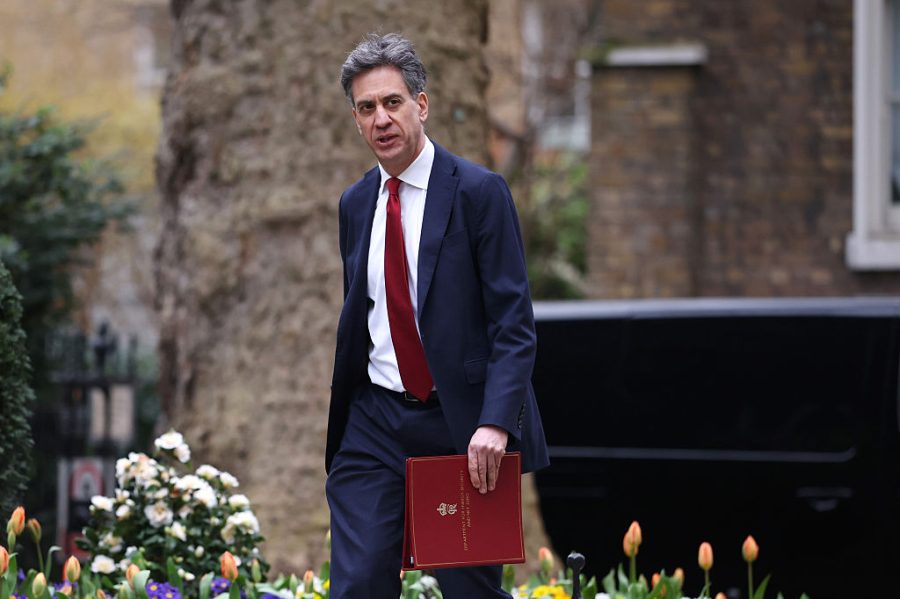
At first sight it might seem like the triumph of reason over ideology. The Times is reporting that Ed Miliband has given way and is poised to announce that he will, after all, grant a licence for extraction from the Jackdaw gas field 250 miles east of Aberdeen. It has been a long time coming.
For weeks, the Secretary of State for Energy Security and Net Zero has been holding out, insisting that more oil and gas drilling in the North Sea won’t make any difference to Britain’s energy security or energy prices. Meanwhile, even RenewableUK, the trade body for wind and solar, has been backing more drilling. On Wednesday, Rachel Reeves made it quite clear that she was in favour of approving new licences for the North Sea.
The final straw for Keir Starmer may well have been the change of heart by the SNP, whose leader John Swinney yesterday announced its support for developing the Jackdaw field. In a few weeks’ time, Labour looks like it will suffer a hefty reversal in the Scottish parliament and local elections. The last thing Labour will have wanted is to be seen as the party promising to destroy jobs in Scotland’s oil industry.
Miliband’s reported reversal over Jackdaw is one small victory for reason over ideology
If Jackdaw now goes ahead, it will be a case of better late than never. Contrary to what the anti-North Sea brigade likes to make out, Jackdaw contains very significant quantities of gas: it is projected that in its first year it could be producing the equivalent of 40,000 barrels of oil per day – 6 per cent of the UK’s North Sea gas production. And no, it won’t all be sold abroad at Miliband’s fantasy global gas price – it will be linked by pipeline to the UK, helping to exert downwards pressure on our very high wholesale prices.
While Britain does export some gas – to Belgium, the Netherlands and Ireland – the bulk of Jackdaw’s gas will be fed into the UK grid, relieving us of the need to import so much expensive liquefied natural gas (LNG). It will also reduce overall carbon emissions because there are more emissions involved in the process of liquifying and regasifying LNG.

The only shame is that Jackdaw is not up and running already. When Shell submitted its plans to regulators in 2021 it was in the expectation that Jackdaw would be producing gas by 2025. How timely that would have been.
But before we celebrate the government’s change of heart, it is worth remembering why Jackdaw is not yet producing gas. It was granted a licence by Rishi Sunak’s government. The general election result of 2024 should not have made any difference because Labour had promised to honour existing licences, even if it didn’t want to grant any more. But then Greenpeace and another anti-oil pressure group, Uplift, took the government to court. They argued that the licence had been granted unlawfully because the decision had not properly taken into account the carbon emissions from the gas which would be extracted, or how these emissions would sit with Britain’s legally binding commitment to reach net zero by 2050. In January last year, the Court of Session in Edinburgh ruled in the activists’ favour, and the licences were rescinded.
That is why the decision over Jackdaw has come into Miliband’s hands and why he was able to block it for so long. But however much we might cheer his change of heart, the net zero target remains and continues to be a considerable obstacle for any government which wants to promote energy security through more drilling in the North Sea. The closer we come to 2050, the more the activists are going to win – because, frankly, no increase in North Sea production is going to be consistent with a legally-binding target to eliminate net emissions in just 24 years’ time. Nor, by the way, is any new road, runway, gas power station – or virtually any form of new infrastructure.
Miliband’s reported reversal over Jackdaw is one small victory for reason over ideology, but so long as the net zero target remains in place, the fanatics are going to be in charge. We cannot have a logical energy policy until the Climate Change Act is repealed.






Comments