
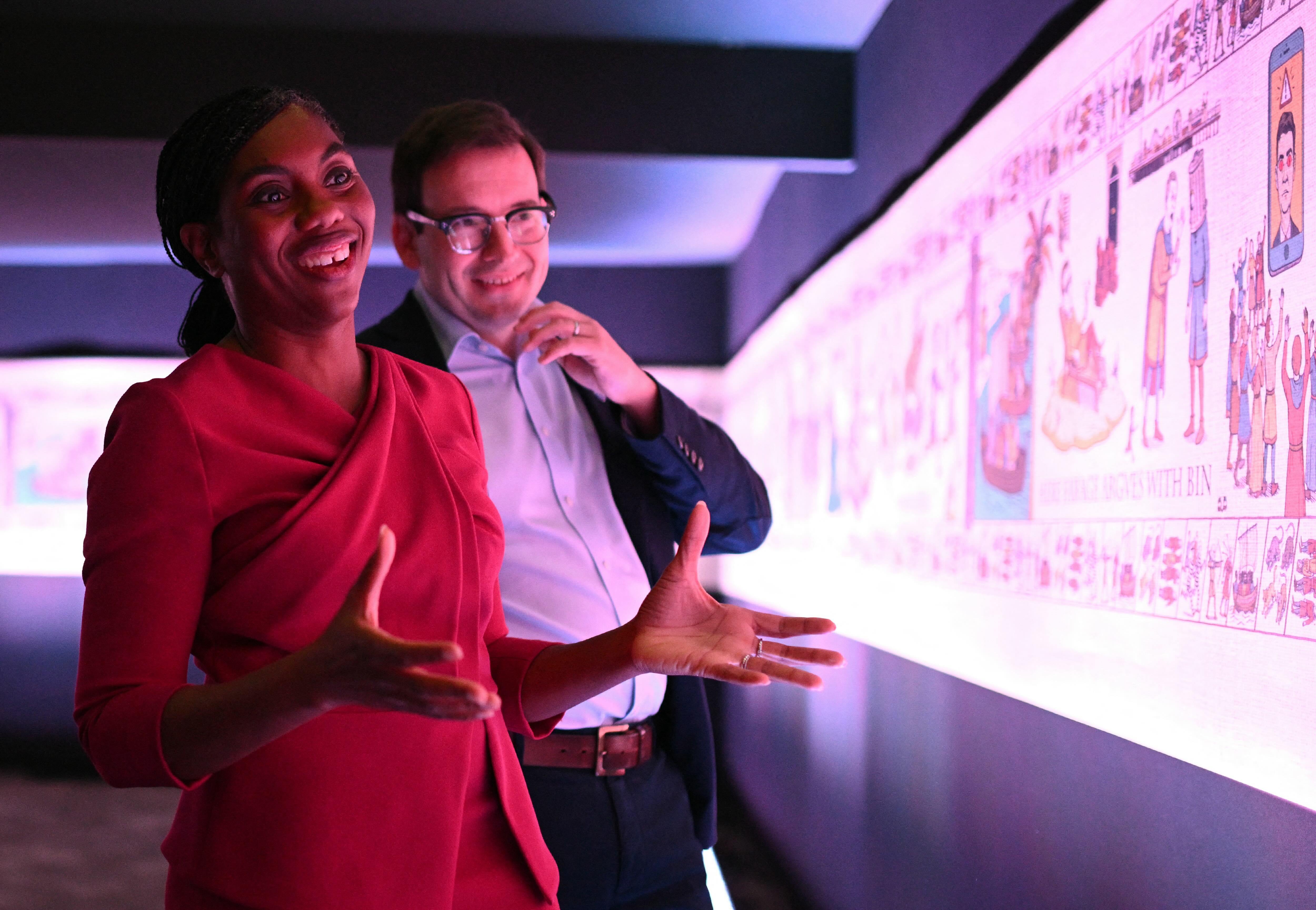
At the Conservative party conference in Birmingham, the Tories have mounted an 88-foot, AI-assisted parody of the Bayeux Tapestry, accompanied by a mock museum display of political relics. Among them are a pair of spectacles purporting to belong to Keir Starmer and a set of handcuffs labelled for Peter Mandelson. Vision and restraint are not qualities one usually associates with a party conference, but here they are at last, displayed together.
I should probably admit that I have not seen it in person. This does not seem to put me at much of a disadvantage. Jeremy Clarkson observed that the conference audience had come disguised as empty chairs, and I have reconstructed the tapestry from photographs, reports and the testimony of those who did make it into the room. This is, I suppose, how most medievalists work.
The real Bayeux Tapestry is currently rather harder to see. Public tickets for its British Museum exhibition disappeared amid online queues reportedly lasting nine hours. Peter Thiel managed a private viewing, although founding Palantir seems an unnecessarily elaborate way of securing museum access. Between them, the two tapestries have achieved perfect exclusivity: the Tory version because hardly anyone goes to political conferences any more; the original because hardly anyone can get in.
The Birmingham version was put together by the Conservative Research Department, with contributions from deputy leader Alex Burghart, who has a doctorate in history. This may explain how the project reached 88 feet without anybody suggesting that perhaps 40 would do.
The length does, however, make you look at the original Bayeux Tapestry slightly differently. Bad news, political intrigue and slaughter, all unspooling in sequence, a literal doom scroll. The technology has changed. The appetite plainly has not. The Birmingham version begins its history two years ago, with Labour taking office. Even the Conservatives, apparently, decided that asking artificial intelligence to make sense of the previous fourteen was pushing it.
The cast is extensive, and the treatment is not especially subtle. Rachel Reeves weeps. Nigel Farage appears as a baby in a pram and later in dispute with Count Binface. Robert Jenrick has been reduced to something approaching marginalia. Andy Burnham is preserved for posterity in those ill-judged running shorts. Kemi Badenoch, as the heroine of a history written by her own party, gets the traditional privilege of looking rather better in it. She even gets a tank. The tank is where one remembers this was made by artificial intelligence. A human artist would have known to draw it delayed until 2037.
The cast is extensive, and the treatment is not especially subtle.
AI is remarkably well suited to the form. Medieval art and generative AI already have much in common: a relaxed attitude to perspective, intermittent difficulties with anatomy and no firm commitment to the correct number of fingers. Both are also perfectly comfortable making important men different sizes according to status. A king may tower over his followers; an enemy may shrink conveniently towards the border. Medieval artists were perfectly happy to resize people according to importance, so Jenrick’s unusual dimensions cause no particular difficulty. He is less a figure than an annotation.
Farage is easier to identify. He has his pram. Burnham has his shorts. Saints had haloes, martyrs had arrows; British politicians must make do with whatever history has issued them. Then Count Binface appears. Poor Harold. Kingdom lost, arrow in the eye, corpse mutilated, and 960 years later this is what has become of the iconographic tradition. Future historians will stare at the bin-headed figure and assume, quite reasonably, that he was important. A king, perhaps. A household god. A ritual vessel?
We should probably leave them to it. Even the lobby makes an appearance. Around a dozen political journalists have been worked into the scene, a thoughtful precaution against the possibility that nobody in Westminster would otherwise mention it. They are not the only things hidden in it. The Conservatives also make great play of 254 rats scattered through the design, presumably a reference to Birmingham’s bin troubles. Why precisely 254 is less obvious. It is the sort of number that suggests somebody, somewhere, had to count them.
This is probably where I should make some serious point about propaganda, AI and the instant manufacture of political memory. No doubt the catalogue essay will do so, somewhere between ‘liminality’ and contested narratives of nationhood. Somebody has to justify the lighting. Personally, I am still wondering who counted the rats.





Comments