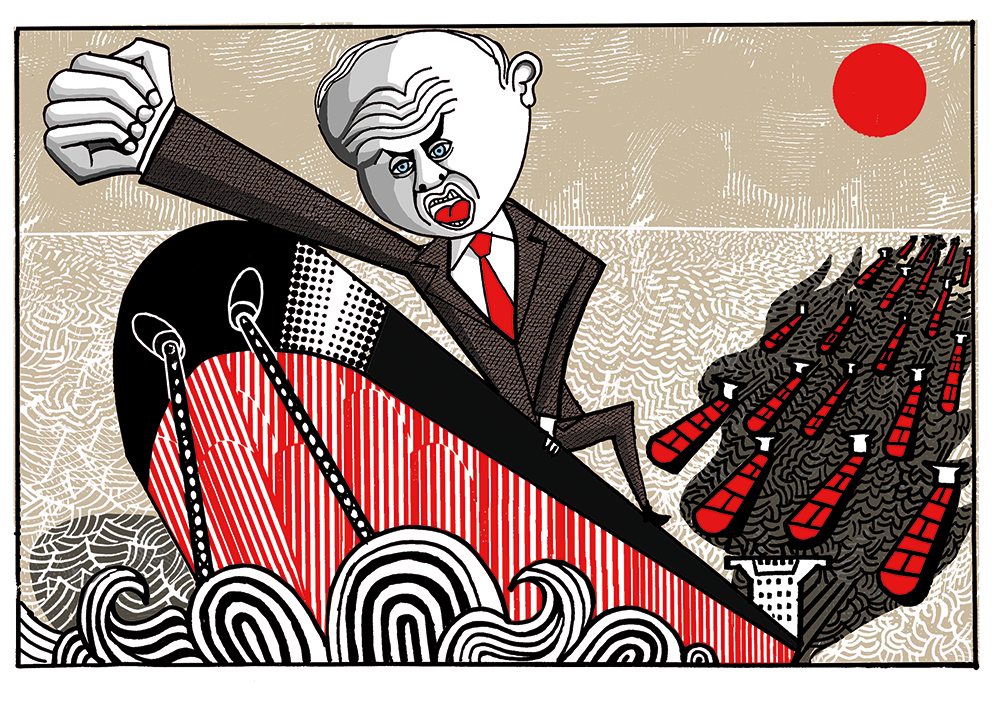


Of all the weapons in Vladimir Putin’s arsenal, the most strategically crucial has proved to be not hypersonic missiles but the motley fleet of oil tankers that have allowed Russian oil to keep flowing to international markets. Oil dollars have been the lifeblood of Russia’s war economy during four years of conflict. And the West’s failure to shut that export business down has, so far, been the single most important factor behind Putin’s continued military resilience.
Economic sanctions were supposed to be the West’s superpower to punish the Kremlin for invading Ukraine in February 2022. So how come Russia now exports more oil by sea than it did at the beginning of the war? And why have Europe and the US proved powerless to stop Russia’s so-called “shadow fleet” from operating?
There are signs Europe and the US are ready to get serious about shutting down Putin’s oil lifeline
Part of the answer is that until very recently the West has shied away from actually banning the buying and selling of Russian oil and gas. Russia produces around 10 million barrels of oil a day and exports half of that, making it second only to the US and Saudi Arabia as an international supplier. That’s far too large a volume for the West simply to try to ban. Fearful of creating a price spike, the Biden administration imposed a floating price cap about 15 percent below market prices to try to suppress the Kremlin’s profits from exporting oil without strangling world supply. The result was that Russia was able effectively to shrug off western sanctions.
The other reason is that the operators of shadow fleet tankers quickly became adept at bamboozling international watchdogs by regularly changing the nationality of ships (known as re-flagging), falsifying paperwork on prices paid by end users (known as attestation fraud), switching off location transponders, and transferring dodgy Russian oil into other tankers at sea.
Russia’s insurers Rosgosstrakh and Ingosstrakh (plus some Indian insurers) also began writing policies for tankers that respectable London firms refused to cover. By September 2022, vessels carrying western-issued insurance fell from 95 percent to under 68 percent of global shipping. At the same time, the number of shadow fleet tankers serving sanctioned oil from Venezuela, Iran and Russia rose from under 300 before Putin’s invasion to more than 750 today, more than 400 of which transport Russian crude. As a result of these sanctions-busting measures, in 2024 the Kremlin was able to export more than 9 trillion rubles ($116 billion) of oil vs 7.5 trillion before its invasion of Ukraine.
“Russia’s so-called ‘shadow’ fleet is not in any kind of shade … we know which ships are doing the dirty work to fill the Kremlin’s coffers,” complained Lithuania’s former defense minister Gabrielius Landsbergis last July, frustrated by Europe’s lack of action. “If we can block another 10 percent of them then we can block all 100 percent of them.”
This year, there are signs that Europe and the US are, belatedly, ready to get serious about shutting down Putin’s oil lifeline. Sanctioning individual tankers and their owners has stepped up pace, from 225 in 2024 to 623 last year. Last month, 14 European countries around the Baltic and the North Sea, among them the UK, Germany, France and the Netherlands, signed a pledge to detain tankers concealing their origin, whether by changing flags, switching off transponders, or operating without proper documentation.
The strategy also includes applying pressure to nations that offer so-called “flags of convenience,” such as the Comoros Islands, Guyana, the Gambia, Aruba and Benin. They will be required to provide quick access to their shipping registers by western law enforcement. And while under maritime law legally flagged merchant vessels enjoy the “right of innocent passage” (including
through territorial waters), tankers with dodgy paperwork can be treated as “vessels without nationality” and can be detained (in theory at least) without legal risk.
The US and Europe are also stepping up their sanctions game in other areas. Last October, Washington took the major step of directly sanctioning Russia’s two largest oil exporters, Rosneft and Lukoil, as well as imposing secondary sanctions on companies or countries doing business with them. Last month, the European Union imposed a ban on the import of any oil products refined from Russian crude. It is intended to squash a massive European trade in importing Russian oil via third countries – notably Turkey, India and China. And Brussels is also mulling a switch from an oil price cap to a blanket ban on providing services to shadow fleet vessels, starting with insurance but also including financial and other services.
Most visibly, European navies have also begun to get much more aggressive on enforcement. The captain and crew of the Comorian-flagged tanker Grinch found out just how much the rules have changed on January 22, when French commandos descended from helicopters off the southern coast of Spain and took over the ship. The Grinch’s registration papers turned out to be false, and the vessel and its 730,000 barrels of Russian oil were impounded near Marseilles. It marked a significant escalation from previous detentions of tankers by French and Estonian coast guards, which resulted merely in a couple of days’ delay while dodgy lawyers lined up new paperwork.
Of course, the fundamental problem with such legally based measures is that they catch only the sloppiest fly-by-night shado fleet operators. They are easily avoided by simply spending a few thousand dollars more to get registration, insurance and bills of lading paperwork straight.
Such attacks are, legally speaking, acts of war. But they are also effective
The Ukrainians, however, have been less scrupulous about maritime law. Since November, six tankers have been attacked in the Black Sea by Sea Baby, the unmanned surface vessels developed and operated by Ukraine’s SBU military intelligence. A Turkish tanker was badly damaged by four explosions off Dakar, Senegal on December 2 and an Omani tanker was blown up in the Mediterranean two weeks later. Euphemistically known as “long-range” or “kinetic sanctions,” such attacks lie, legally speaking, somewhere between piracy and terrorism. But they are also effective.
Just hours after its tanker was crippled in Senegalese waters, the Turkish company Besiktas Shipping said that it was “ceasing all shipping operations involving Russian interests.” Shipping tracking websites show tankers hugging the Georgian and Turkish coasts in the hope that Ukrainian sea drones won’t dare target them. Insurance premiums for tankers carrying Russian oil have reportedly more than doubled since the attacks.
There is one serious danger with armed confrontation, and that is the risk of Russian escalation. Ukrainian civilian shipping in the Black Sea, especially of grain and agricultural produce, is vulnerable to attack. And last May, when the French navy deployed the 102-meter intelligence ship Dupuy de Lôme to the Baltic Sea, Russia responded by escorting tankers with warships and fighter jets.
“If you want a flash-point for conventional warfare between Russia and NATO states, it’s probably going to happen in the Baltic Sea,” warns Bob Seely, the former Tory MP and author of The New Total War. “It’s the most dangerous place in the world right now.”
According to maritime law, blocking free passage by sea is an act of war. The Kremlin may be tempted to make a point by responding to shadow fleet detentions with firepower, “just to see how much they can push NATO’s Article 5,” says Seely.
There are signs that increasing sanctions pressure is having an effect on Russia’s economy. The discount between Urals crude and the international benchmark Brent has grown to nearly 30 percent, according to Argus Media. Add to that plunging world oil prices, and it all adds up to real economic pain for Putin. “Tankers with Russian oil need to be stopped – and so that you can keep it, not stop it for a while and then let it go,” Ukraine’s President Volodymyr Zelensky recently told delegates in Davos. “It will definitely become more difficult for the Russians.” The crucial question, though, is whether the West’s belatedly tough sanctions on Russian oil are too little, too late.



Comments