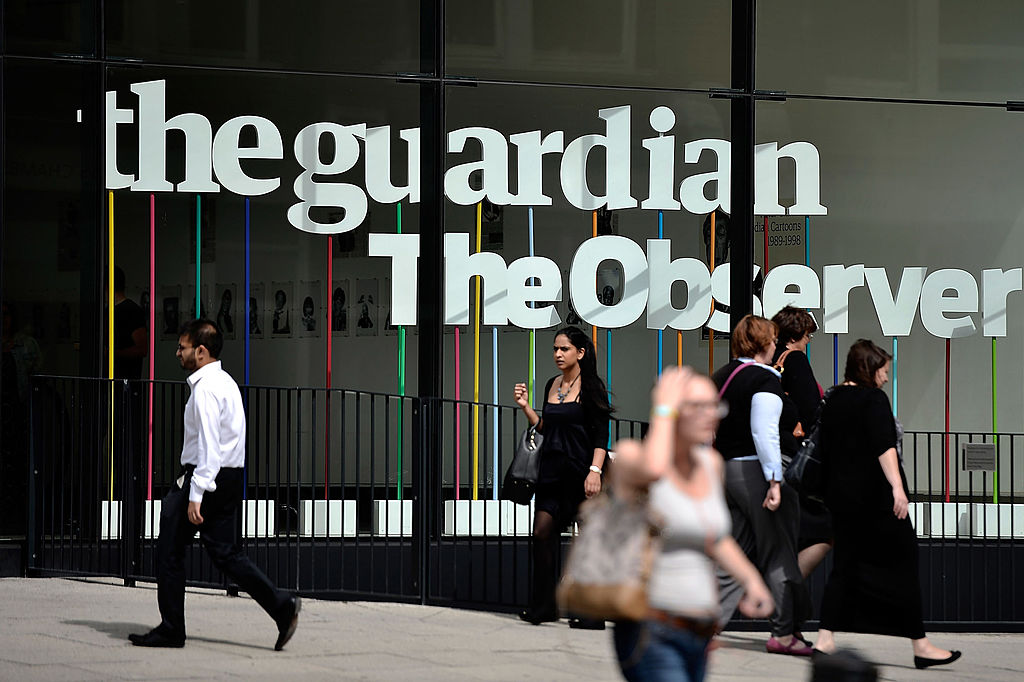
The Guardian has asked a panel of authors and critics to nominate their favourite novels to make up a ‘Top 100’, and to nobody’s surprise the highest places were bagged by that well-known half-back line: Proust, Tolstoy and Joyce. ‘Reigning supreme’, as Fluff Freeman might have said, was George Eliot. Yes, Middlemarch, the supreme novel of provincial England, was number one.
Great writers, all. Yet how flat it seems. Ulysses, for instance, is a remarkable book, even if it is savoured more by writers than readers. It is long, self-consciously clever, and assumes a familiarity with the ancient world. But not everybody has the patience to last the course.
When a ‘Hot Hundred’ finds room for Nervous Conditions by Tsitsi Dangarembga, as the Guardian’s list does, and no place anywhere for Evelyn Waugh, one wonders about the judges’ sanity
This is part of the problem with ‘approved lists’ compiled by experts. There’s no denying that we all love to show off, and that some voices are worth hearing. Yet when critical responses harden into perceived wisdom, it can end up being tiresome.
As can reading when it is presented as a civic duty rather than a personal pleasure. If we determine a novel’s value by the writer’s ethnicity or social background – as in the case of the Guardian list – it can feel like you are trapped in an undergraduate lecture room.
There are always going to be notable omissions, because no list can represent 250 years of novel writing in a way that satisfies all tastes. But when a ‘Hot Hundred’ finds room for Nervous Conditions by Tsitsi Dangarembga, as the Guardian’s does, and no place anywhere for Evelyn Waugh, one wonders about the judges’ sanity.
Waugh – it has been said so often, it is now the stuff of cliché – wrote the most beautiful prose in English in the 20th century. To exclude him from a list of this sort is like writing a history of jazz without reference to Duke Ellington.
Most popular
Steven Edginton
Invented claims of lynchings and racist violence are irresponsible — and dangerous
Miss Dangarembga may be a good writer, though it’s unlikely her book, which sits at position 74, should be higher placed than Hardy’s The Return of the Native (at 95), DH Lawrence’s The Rainbow (77), and Mann’s Buddenbrooks (81). But what do Hardy, Lawrence and Mann matter when you’re trying – as the Guardian is – to rewire the imagination of your readers?
It brings to mind Saul Bellow’s response to a colleague at the University of Chicago, who said he was getting a taste for the literature of sub-Saharan Africa. ‘Remind me’, Bellow allegedly replied, ‘who is the Tolstoy of the Zulus?’
Bellow is not on this list, and we need shed no tears. Neither are Philip Roth and John Updike, which may nudge some readers into revisiting American Pastoral and Rabbit at Rest, modern masterpieces by any reckoning.
There’s no Mark Twain, nor John Steinbeck, nor Robert Louis Stevenson. The judges overlooked European classics like The Radetzky March and Effi Briest, as well as too many great English novel to mention, though The Old Wives’ Tale and Point Counter Point are a couple to be getting on with.
Beloved, by Toni Morrison, is placed second, behind Eliot. Yet there is no Balzac, and no Turgenev. How is it possible to draw up a list that does not include Fathers and Sons? It beggars belief.
Virginia Woolf appears five times, four times more than Muriel Spark. Penelope Fitzgerald and Iris Murdoch do not appear at all. Gabriel Garcia Marquez is there, of course, though there is no room for Mario Vargas Llosa.
Lonesome Dove, Larry McMurtry’s western fable, was ignored. Far too entertaining. Two modern Irish novels failed to find favour. Colm Toibin’s The Master and That They Might Face The Rising Sun by John McGahern are works of rare beauty.
Two omissions are unpardonable; one old, one young. Tom Jones, that most loved of rollicking adventures, is nowhere, and V. S. Naipaul’s The Enigma of Arrival fails to make the cut, in favour of A House for Mr Biswas. Perhaps Naipaul has been punished for holding the ‘wrong’ views on colonialism, but he will have the last word. The Enigma of Arrival is the book of a lifetime. Our lifetime.
We have been here before, and will certainly come here again. In 1983, when a list was drawn up of ‘the best 100 novels in English since the war’, there was scepticism about Angel, by Elizabeth Taylor. It was not, someone suggested, ‘important’.
Kingsley Amis, in a letter to this magazine, declared that ‘importance in literature is unimportant – good writing is.’ Which is why this latest approved list, endorsed by many well-read people, misses the point. Either read for pleasure, or not at all.


Comments