
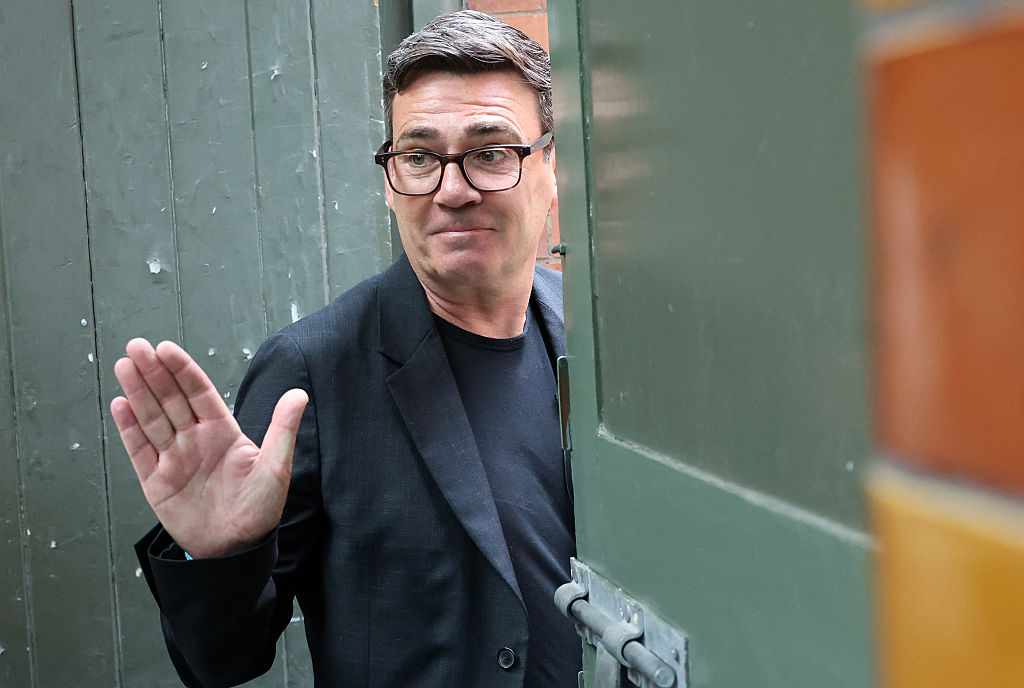
Andy Burnham used his big speech this week to unveil his spiffing new idea to solve all the country’s terrible problems: moving its head office somewhere slightly different. This he calls ‘place-based collaboration’. Apparently, all the collaboration we’ve been doing up till now has not been place-based, and has presumably been in a mysterious, spooky void outside the normal realm of space and time.
I wish politicians would can this talk of collaboration and playing nicely. If anything, politics should be more confrontational
But along the way, he also found time to inform us how he intends to ‘reach out to other political parties, to find as much common ground as we can and build that more collaborative approach.’ There will be an end to ‘finger pointing’ and ‘point scoring’, because Andy intends to furnish parliament with love, and grow apple trees and honeybees and snow-white turtle doves. From No. 10 North in Manchester, AKA the cloud kingdom of Care-a-Lot, Andy and Labour’s Care Bears will establish a new kind of politics.
Our kid Andy is not the first, not by a long chalk, to announce a new dawn of polite politics. Let’s take a look back at similar announcements from previous prime ministers and party leaders. Sick bags at the ready!
In the early days of the coalition, David Cameron waxed lyrical about the Lib Dems. ‘We recognised something really important. We could work together… Reasonable debate, not tribal dividing lines. Give and take. Respect when you disagree with each other. Trust. A sense that politics actually shouldn’t be so different from the rest of life, where rational people do somehow find a way of rubbing along together, getting on together, overcoming disagreements and actually getting things done. One love. One heart. Let’s get together, and feel all right’. (I may have made that last bit up.)
He also said that people ‘are fed up with the Punch and Judy politics of Westminster, the name calling, backbiting, point scoring, finger pointing’. His buddy Nick Clegg similarly tutted at ‘stylised adversarial conflict’.
The fabulously crabby Jeremy Corbyn was next, telling the press on his elevation, ‘I want a kinder politics, a more caring society. Cut out the personal abuse… let’s get on with bringing real values back into politics…Treat people as you wish to be treated yourself. Listen to their views, agree or disagree… There is going to be no rudeness from me.’ This was, of course, the very same Corbyn who later refused to share a platform with Cameron on the referendum Remain ticket, and stalked silently alongside Boris Johnson, with a face like a slapped behind, as they entered the Commons after the 2019 election.
Boris himself was another advocate of political niceness, his spokesperson telling the press in 2021, ‘The Prime Minister is urging everybody to be civil and kind to each other when debating matters that clearly matter greatly and passionately… The key thing… is that we all remember to be civil and respectful to each other’.
Why must we endure this guff nearly every time a new leader pops up? I suspect that ‘Punch and Judy politics’ is one of those things both politicians and the public pretend that they don’t like but which they actually bloody love. It puts me in mind of the audience research we used to get when I worked on Coronation Street, which told us that Tracy Barlow was universally loathed. Which was strange, because the ratings soared whenever she reappeared on the cobbles.
To his credit, Keir Starmer didn’t try this angle and seemed to relish a scrap with all four of his Tory opponents during his tenure as Labour leader. It took Kemi Badenoch a little while to find the right button to push on Starmer, and I suspect Burnham may be an even trickier job. Amiable passive-aggression is a very difficult thing to handle. You go in with your dander up and run smack into a disarming wall of charm and injured innocence. But you have to keep your head against the tsunami of schmaltz. There is nothing to be gained by smiling and nodding back. It feels like kicking Bambi in the face, but you must press on.
A good sign for Kemi is how thin-skinned Burnham can be, frequently snapping back on social media when people do not roll over and offer their bellies up. When Dominic Cummings scoffed at him as ‘so rubbish I told the team “just ignore him”’ at the Department for Education, he replied testily ‘I wasn’t there long but it was long enough to force you and Michael [Gove] into a big U-turn on school sport – because you both knew sod all about it’, adding a crying-laughing emoji to this diatribe, unconvincingly. Like Corbyn, Burnham cannot let things lie.
I wish politicians would can this talk of collaboration and playing nicely. If anything, politics should be more confrontational. It is precisely when matters are not scrutinised, opposed or indeed laughed to scorn – when all parties trudge together as one to vote for something – that we get into our biggest troubles. Net zero and the Equality Act 2010 were both implemented with cross-party agreement.
Burnham’s call for gentler words comes after Kemi Badenoch told Starmer and company some home truths at last week’s PMQs, causing much tutting and huffing from Labour and – rather bizarrely – from the Speaker. It might seem churlish to leap on Burnham in the same way straight off, but the national situation is too serious and his proposals too ludicrous to spare any time. Kemi must not indulge his nonsense for a second. She needs to give him and his place-based collaboration both barrels.




Comments