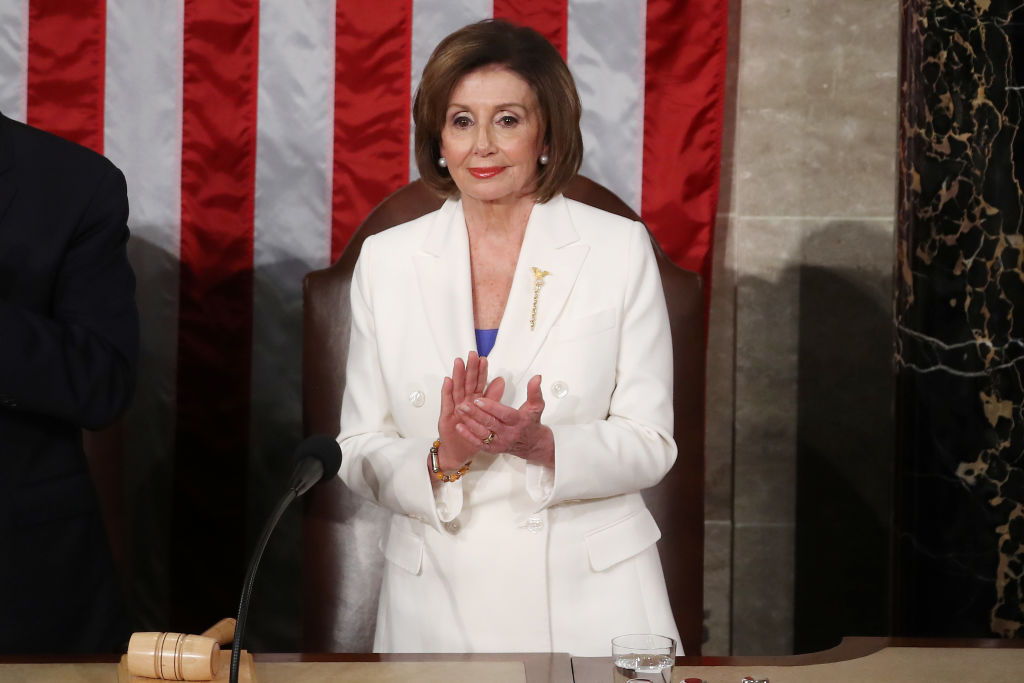
Former speaker of the House, Representative Nancy Pelosi, who will retire from Congress this year is lending her name and her leadership to the University of California Berkeley to create the Nancy Pelosi Institute. She explains that it will help to “train leaders for our future.”
The National Association of Scholars, being a non-partisan organization with a strong commitment to civic virtue, is delighted to see another prominent politician contribute to the realization of important principles in higher education. Admittedly, we have not always agreed with the former speaker on how best to advance the public good on campus, but Pelosi says she was drawn by the “notion of a bipartisan academic center” at Berkeley, “the epitome of public education.” Her role at the Center will be “a liberation for me from the political, not politics, but partisanship.”
There is, of course, a very long tradition of colleges, academic centers and other academic institutions named after American statesmen. We can think of George Washington University, James Madison University, Brandeis University, Sam Houston State University, the Woodrow Wilson School, not to mention the James Buchanan Middle School in Mercersburg, Pennsylvania; the Andrew Johnson Elementary School in Kingsport, Tennessee; the Biden School of Public Policy and Administration at the University of Delaware, and Franklin Pierce School of Law in Concord, New Hampshire
Occasionally, these names don’t last forever. Alas the former Millard Fillmore Academic Center at the University at Buffalo (renamed in 2020); the John Tyler Community College in Chester, Virginia (renamed Bluepoint Community College in 2021); and Yale’s Calhoun College (renamed Grace Hopper College in 2017).
It is perhaps too soon to say exactly what the Pelosi Center will do to “train leaders for our future.” This goal is presumably easier to attain than training leaders for our past, but it is rather broad. Berkeley explains that the Center will focus on “four pillars.” These are “America’s democratic institutions; overcoming challenges to society, the economy and the planet; promoting human and civil rights, and ensuring political leadership that represents the full spectrum of perspectives and background.” More specifically, the Institute will “address climate change and wealth inequality and which electoral changes could be made to reduce voter polarization.”

These are wholesome and definitely non-partisan matters. The challenge of addressing climate change, for example, involves how to unwind the vast skein of regulations, crony capitalist agreements and dependency on China that has grown up over nearly 40 years of scientific error and misrepresentation. Now that the Intergovernmental Panel on Climate Change has renounced its doomsday predictions, and we have a much better understanding of the limited role of human influence over global temperatures, a mountain of work lies ahead in revising public policies based on alarmist positions.
Nancy Pelosi is in the perfect position to lead this effort. Her 40-year career in Congress coincided almost perfectly with the epoch of global warming hysteria. Moreover, before she was elected to Congress, Pelosi chaired the San Francisco Democratic National Convention Host Committee and later served on the delegation celebrating the 30th anniversary of San Francisco’s sister-city agreement with Shanghai, which focuses on climate change and green technology. The National Association of Scholars’ recent report, Behind the Climate Curtain: China’s Hidden Role in California’s Energy Mandates and University Partnerships, provides a useful roadmap to institutional arrangements that deserve the kind of review the Pelosi Center promises. And as it happens, UC Berkeley is an excellent place to begin to unravel the web of dependencies.
Berkeley also mentions “wealth inequalities” as among the matters the Pelosi Institute will take up. Again, this seems timely and important. Pelosi herself knows a great deal about the topic, having grown her personal fortune to something between $245 million and $278 million though wise stewardship of her investment portfolio, at least $130 million of which came from stock profits. When she entered Congress she and her husband had a net worth of less than $800,000. To have realized such stratospheric gains while also performing in her demanding public position demonstrates her extraordinary grasp of markets and financial opportunities.
We need this understanding now in higher education not least because of the undue influence of big money foundations including the Mellon Foundation ($1.4 billion) with its opaque focus on the humanities. The Gates Foundation ($9 billion), Lilly Foundation ($2 billion), Gordon and Betty Moore Foundation ($1.6 billion) and the Bloomberg Family Foundation ($1.4 billion) play a part in this.
The American Enterprise Institute has recently launched a tool, the Searchable Open University Records for Charitable Expenditures (SOURCE) that will expedite this kind of inquiry. The academic left has expressed concern for many years about the influence of supposedly conservative foundations. These include the Charles Koch network of foundations ($788 million since 2005) and the Sarah Scaife Foundation ($29 million). Those are not small numbers but they are plainly dwarfed by left-wing expenditures. The Pelosi Institute’s focus on “wealth inequalities” is plainly warranted.
The Pelosi Institute’s third focus, on electoral changes that could be made to reduce voter polarization is likewise timely. Polls consistently show that about half of Americans are concerned about the dangers of electoral fraud (Marist poll: 50 percent; Ipsos/ Reuters poll: 46 percent). Reducing voter polarization will require convincing the skeptical half of the country that our elections are clean, even while many politicians are working hard to enlist the votes of illegal aliens. It is a heavy task, but there is no reason to think that Nancy Pelosi isn’t up to it.
Several reports about the new Pelosi Institute suggest it is being created to counter the rise of campus “civics centers” in many states. So far, 45 such centers have been founded in 25 states. They are not – or at least not yet – replacements for the public colleges and universities in which they are situated, but they do represent the strength of a national movement that favors significant reform of American higher education. The direction of that reform is toward teaching classical liberalism, the American founding, and Western civilization. How well they will succeed no one knows, but the National Association of Scholars is on record supporting the venture.
Let me also be on record supporting the creation of the Pelosi Institute. I’ve outlined the important work it should undertake, and I look forward to seeing Nancy Pelosi roll up her sleeves and get to the tasks at hand.






Comments