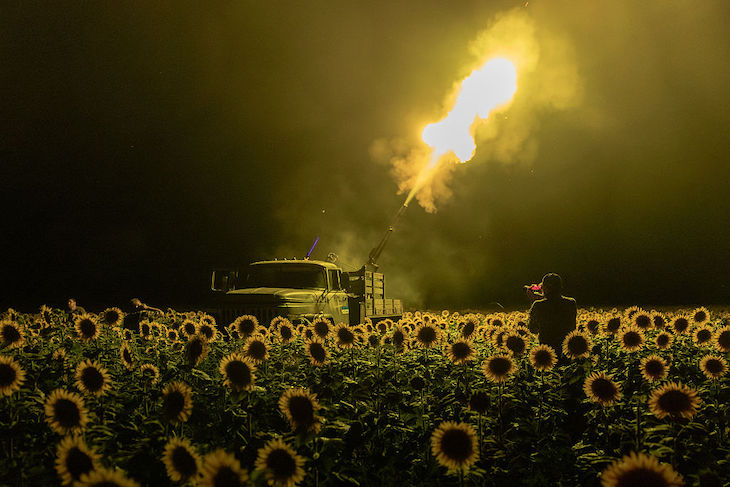
When he came to write of 1942-3 in his magisterial, if idiosyncratic, “History of the Second World War,” Winston Churchill called that period, “The Hinge of Fate”: it was the turning of the tide, when from El Alamein, to Stalingrad, and to Midway in the Pacific, the Axis Alliance ground to a halt. There was much hard fighting to be done and the contours of victory were still unclear but as Churchill declared, in November ’42, “…this is not the end. It is not even the beginning of the end. But it is, perhaps, the end of the beginning.” So too in Ukraine.
Ukrainians have been able to reach-out beyond this extended ‘No-Mans Land’
The much vaunted Russian Spring Offensive has achieved nothing except thousands more Russian dead. At the beginning of the year, the Ukrainian Defense Minister, Mykhailo Fedorov, stated that his aim, given him by President Zelensky, was to increase Russian casualties from 35,000 to 50,000 per month, so that, “…the cost of war for Russia [is] one it cannot sustain, thereby forcing peace through strength.”
Instead of the expected ratio of dead to wounded, which Nato used to calculate as ten wounded for every dead enemy, the Ukraine has reversed this so that the majority of Russian casualties are dead. Mostly through First Person View (FPV) drones, there is now a 20-25 mile “death zone” along the frontline, through which it is all but impossible to move, concentrate and overcome the enemy. Ukraine is grimly succeeding.

Ukraine is, of course, also taking casualties. But being on the defensive, it has the advantage of interior lines of communication and resupply, as well as familiarity with the terrain. It can also, employing the military principle of Economy of Force, control large areas with fewer men. The Russians simply cannot concentrate their forces sufficiently to generate the kind of force ratios required, usually regarded as an absolute minimum of 3:1, attacker to defender, to overcome the Ukrainians. But neither, of course, can the Ukrainians.
What is different is that the Ukrainians have been able to reach-out beyond this extended “No-Mans Land,” with long-range drones, and hybrid drone/cruise missiles to strike Russian targets in the latter’s operational, and strategic, depth. Up to 190 miles from the “death zone,” they are hitting Command and Control nodes, troop and logistic concentrations, fuel and key infrastructure, such as railways and bridges; this is paralyzing the Russians’ ability to organize, let alone, conduct major maneuvers.
Even further out, Ukraine’s long-range strikes on oil refineries and military targets in both the St.Petersburg and Moscow areas, some 500-600 miles distant respectively from Kyiv, are not only knocking-out oil refining and storage capacity but with their dramatic, and unmissable, plumes of smoke, are bringing home to the Russian people that they are not immune from the consequences of Putin’s Special Military Operation.
Zelensky, in describing such attacks, calls them “long-range sanctions,” directly linking them to the other, only partially successful, efforts to close down the Russian wartime economy; the real impact, however, is likely to be in the minds of ordinary Russians and how they view the war.
In Crimea, the pressure is even more intense. The first territory to be seized by Putin in 2014, it was a major Russian tourist destination and, perhaps surprisingly, has remained such throughout the conflict. But repeated attacks on the Kerch Bridge, the “Unity Bridge” that Putin himself opened, have now effectively closed it for military supply purposes, and the regional governor has imposed fuel restrictions on the civilian population.
Angering such an important close neighbor seems crass, bordering on hubristic
President Zelensky has also launched a propaganda effort in the Crimea, aimed at the Crimean Tartar population, assuring them that he will not forget their interests. Having already chased the Black Sea Fleet from their anchorages in Crimea, the Ukrainians are now on track to deny it as a major logistics hub for Russian operations in southern Ukraine too, inflicting both an operational and further psychological blow to Russia.
Zelensky’s confidence is clearly growing. On 9 May, Russia’s VE Day, he sarcastically gave permission to the Kremlin to hold its traditional Red Square parade; traditional, except this year, there were, tellingly, no tanks or missiles on display. In the last fortnight, he threw down the gauntlet to Belarus’s president Lukashenko: switch-off the relay stations that are being used to guide Russian drones and cease to construct assembly areas and infrastructure that could enable a Russian assault from the North. To emphasize the point, and the threat, Zelensky has established a new Drone command on Ukraine’s northern borders: Lukashenko has, meekly, complied.
The tide has turned, but as in 1942-3, the lineaments of the future post-war world are still emerging. Zelensky has offered face-to-face talks with Putin, but the latter is currently refusing; President Trump has also changed his mind and now describes the boiler-suited Zelensky as, “courageous”, and “..doing pretty well’: a marked change from the angry exchanges in the White House.
And with the glimmers, however feeble, of peace, some of the region’s unresolved tensions, occluded in the determination to stop Putin, are also emerging. Unwisely, Zelensky picked a fight with the Poles by naming a unit, “Heroes of the UPA”, commemorating the Ukrainian Insurgent Army (UPA). At different times, and with apparent total disinterestedness, the UPA fought both the Soviets and Germans in WW2, but were also responsible for the murder of some 100,000 Poles. Zelensky was stripped of his Polish honors as a result, but more substantively, Ukraine, post-war will need Polish support to reconstruct its economy; angering such an important close neighbor seems crass, bordering on hubristic.
Talking about a post-war world may seem premature and the route to a settlement, even a simple ceasefire, will be bumpy and cannot be taken for granted. General Hodges, the former commander of US Forces in Europe, has warned, “Do not take your foot off the gas pedal. Now is the time for the West to push the pedal straight to the floor.” In other words, there is still a war to be won and Ukraine needs our support. We can all applaud that sentiment but, as we edge closer to peace, perhaps we can also perceive that the peace is likely to be messy and complicated: it will require all of our attention to make it succeed.





Comments