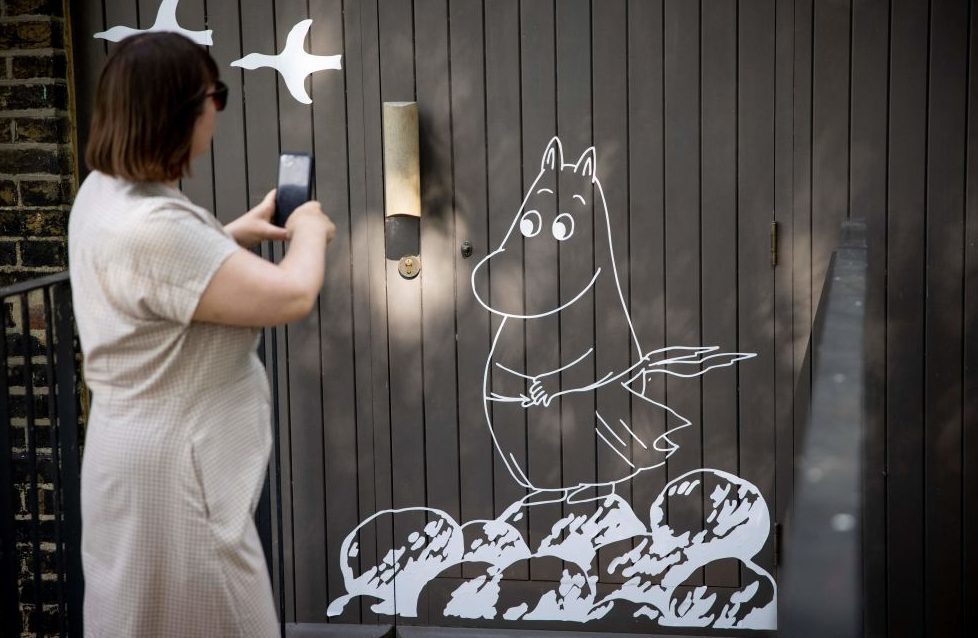
Finland’s biggest cultural exports are an unlikely mix. The main ones are death metal, videogames… and, er, Moomins? Brand recognition of Tove Jansson’s eccentric creations in her native country stands at 100 per cent. There’s scarcely a Finnish home that doesn’t have at least one Moomin mug in it. Every street corner seems to have a poster or a statue of a Moomin. And they’re huge all over Northern Europe and Japan, have dedicated fans in Russia and are starting to get a toehold in America. But they are not like every cartoon franchise you find on an oven glove, as I discovered on a recent Moomin-focused trip to Helsinki and Tampere.
The Moomin stories are much more complex and interesting than you’d know from the tea towels and collectible mugs.
Tove Jansson (1914–2001) occupies a peculiar place in the culture. She was a first-rank fine artist and literary writer who was also the inadvertent creator of a franchise in the Hello Kitty or Mickey Mouse mould. The contradiction was one she noticed herself. ‘Those damn Moomins,’ she once complained. ‘I don’t want to hear about them any more. I could vomit on the Moomintrolls.’
Unlike Sir Arthur Conan Doyle, though, she didn’t go so far as to chuck Snufkin off the Reichenbach Falls. She was a serious artist, but she was also a damn good hack and ‘very commercially minded’. As a child, after all, she had watched her illustrator and cartoonist mother keep the family finances afloat with commercial work, while her sculptor father’s financial fortunes rocketed and plummeted.
Through her career this elfin figure – described by her niece as ‘a small woman who lived on cigarettes, salt gherkins and vodka’ – wrote books, poems and lyrics, designed sets, painted murals for factory walls, and illustrated books. A version of The Hobbit that she illustrated on a commission from her friend Astrid Lindgren has only just been published for the first time in the UK: the Tolkien Estate forbade its publication for years (J.R.R. thought she drew Gollum too big, apparently). At the Helsinki Art Museum you can see the frescoes she made in 1947 for the town hall – one includes a self-portrait, smoking moodily at a café table (on which a tiny Moomin sits) while her female lover dances with a male partner behind her.

In Jansson’s airy atelier in Helsinki, not usually open to the public, the most fascinating thing is the bookshelves. As well as collections of folklore in three languages (Jansson spoke and read Swedish, English, Finnish and – having studied in France in her youth – a bit of French), the shelves contain well-thumbed works by Graham Greene, Carson McCullers, Dorothy Parker, Muriel Spark and Arnold Bennett, plus a whole lot of SF, including Frederick Pohl, August Derleth and a surprising number of deep cuts from Ray Bradbury and J.G. Ballard.
The Moomin stories themselves are much more complex and interesting than you’d know from the tea towels and collectible mugs. They don’t follow a formula. The third book (and the first to be published in the UK), The Finn Family Moomintroll, is cheery and whimsical; the first two, written in the shadow of the Second World War, saw Moominvalley threatened with annihilation by an asteroid strike and a Biblical flood. Moominland Midwinter – is it going too far to see it as the kiddie version of Anna Kavan’s Ice? – is a chilly existential fable. Jansson drew the first-ever image of Moomintroll on a toilet door after an argument with her brother about Kant. The marginal characters are outcasts, wanderers, philosophers. They’re much sadder than you’d generally expect zillion-selling children’s books to be.
‘Tove wasn’t trying to create some kind of nice fairy tale,’ says her niece Sophia, until recently Creative Director of the company Moomin Characters Oy. ‘I think also Finnish culture has a lot of very melancholy elements to it. In Finland, melancholy is actually quite a good thing. It’s the core of who we are. So melancholy is perceived quite differently, I think, in Finland.’ She adds: ‘And if you go further east, you get to… you know, the real drama.’
Yet that seems to be part of their appeal. They weren’t, at least initially, cute. That first image of Moomintroll was supposed to be ugly; his features softened over the years into their present hippo-like form. ‘There’s something in the stories that really is comforting to people who feel a little bit sort of on the side of mainstream, for whatever reason, they don’t really fit in – of course they want to, and somehow they fit into the Moomin universe,’ says Sophia.
The Jansson family retains control of the characters and their images. They never took the Disney dollars and ran. Every new piece of merch, every new illustration, has to be run past them for approval. The specifications are exacting: woe betide the illustrator who carelessly puts Snorkmaiden’s anklet on her right leg. And mouths – the Moomins never have visible mouths in Jansson’s drawings – are a bone of contention. ‘We don’t always get our way,’ says Sophia. ‘In every single animation I’ve ever seen, they always need to put a mouth on them somewhere, and it looks absolutely ridiculous. But yet all animators are convinced they need to have mouths, and we’re like, okay, if you say so.’ What’s the weirdest merch request they’ve ever turned down? ‘Condoms,’ she says. ‘Hattifattener condoms.’
Moomin Characters, then, is at once a commercial juggernaut and the keeper of a particular sort of artistic flame. ‘I often get asked the question […] how do you reconcile all the commercial things and her cultural legacy? Aren’t they sort of somehow at opposite ends of what you should be doing? I try to explain: actually the commercial side finances all the cultural things that we are able to do. I think now we have achieved – not yet maybe fully – a situation where people do know that she’s more than just the Moomin books.’
The Hobbit: Illustrated by Tove Jansson is out now. Tove Jansson and her Families opens at the Quentin Blake Centre for Illustration on 21 November 2026.






Comments