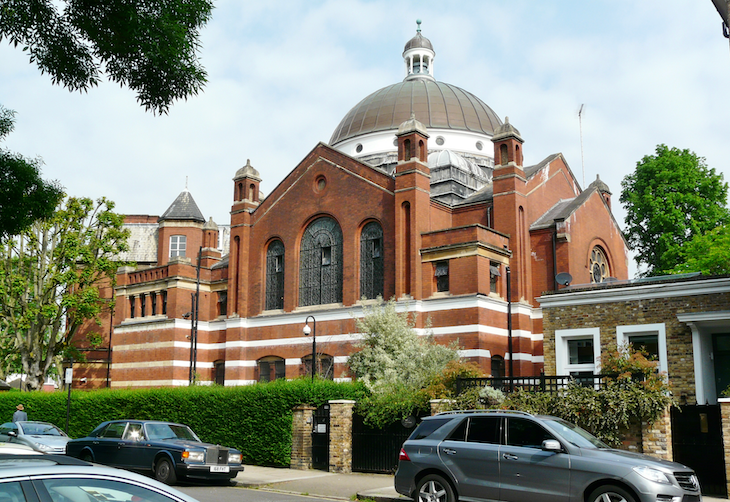
On Sunday afternoon, five young people in hoodies walked up to Lauderdale Road Synagogue in Maida Vale. One kept lookout. Two fired rocket fireworks at the building, and in the smoke and the bangs all five ran off. It was the second day of Rosh Hashanah. The building was empty as the service had finished. Nobody was hurt. No damage, as the community’s message put it, ‘beyond the incident itself’.
That is my synagogue. I had my bar mitzvah there. I sang in its choir as a boy. I go there to pray, and I go there to be with my community. I go there to celebrate a friend’s new baby, an acquaintance’s wedding, or to mark the passing of a year since a familiar stranger’s mother’s death. But this year, for the first time, I was not there for Rosh Hashanah.
Something got out on 7 October, and it has not gone back in
It was the first New Year I have ever spent away from my community: I was in Israel. It was the first I have spent away from my family, and I heard the news from afar and phoned home to check everyone was all right. It was the year my own government chose the run-up to the high holy days to announce sanctions on Israel, promising us it would have no negative effect on our safety. It was almost exactly a year since Adrian Daulby and Melvin Cravitz were murdered outside their synagogue in Manchester on Yom Kippur. And this year, the Jewish new year began on 11 September, 25 years to the day since I watched the twin towers come down in fire and smoke, and much of my world around them too. I thought about that a lot as historic video clips, answerphone recordings from people facing their own death, and images of laughing American politicians chased me round the Internet.
These things are unrelated. A religious festival fixed by the moon. A historic anniversary fixed by the sun. Teenagers in London with fireworks. A Jewish politician with a trade ban on the Jewish state. A murderer with a car and a knife. None caused the others.
And yet they are all related. Everything joins up. As I paused for thought in Israel, looking back, the dots make a picture. Looking forward, they had just been dots: noise, disorder.
From afar, you can see it. This was ‘just’ some youths. ‘Just’ a firework, as some random X account told me when I reported it there. Nobody hurt, this time. But the Hatzola ambulances burned in Golders Green in March. Petrol bottles at Finchley Reform Synagogue in April; a firebomb at Kenton the week after. Two men stabbed in Golders Green. Two men killed in Manchester. A massacre at a Hanukkah party on Bondi Beach. Every one was ‘just’ something, until it wasn’t.
So: am I surprised? Why would I be? How could I be? Surprise needs a first time, and we are long past ours. We stopped being surprised somewhere between the marches and the ambulances and the Green party and Tucker Carlson and Zohran Mamdani and the people hiding who they are in NHS hospitals. What replaced it is sense: the thing you feel in the stomach before you let it into the head, because the head has been trained to say: don’t exaggerate.
And that is the loop in every one of our minds. Are we exaggerating? Jumping to conclusions? Safe, or in danger? A firework, or a warning? Each nudge pushes us to the next dot, the next quiet conversation about what we should do, and when. Wouldn’t we be stupid not to?
Because something got out on 7 October, and it has not gone back in. The murderers filmed themselves, and a part of the world watched and felt not revulsion but appetite. Jews had been made to look weak again: people who could be slaughtered in their beds. And weakness, in a certain kind of mind, is not pitiable. It is exciting. It suggests the job might be finishable. That excitement reaches a hooded teenager in Maida Vale as surely as it reached a man with a knife in Crumpsall. It is the oldest trap we know: look weak and you whet the appetite; look strong and you are punished for spoiling it. Israel is being punished this month for strength. My synagogue was attacked for looking weak. If I must be, I know which I would rather be punished for.
Edward Miliband stood up in the Commons this month, as a ‘proud British Jew’, to announce £250 million for Jewish security, as if that would distract us from the ‘reset’ he instigated on our country’s relations with the Jewish nation. The money had already been announced in July, and it felt even more useless the second time it was thrust at us as a deflection from our very real concerns for our safety. Imagine paying for more fire hoses as you throw accelerant on the flames, feigning bafflement or blindness as the heat keeps rising. Perhaps Miliband was the Jew his friend had once thought of when he said we don’t understand British irony.
Jew-hatred has always been useful: it lets a country avoid looking at itself too hard. A government with a by-election to lose finds it far easier to talk about far-off settlements than about a growing climate of furious conspiracy and aggression aimed at its own Jewish citizens. Or about immigrants from places where they hate us lot, and hate Britain, too. This is one climate change Miliband and Burnham don’t care to try to halt. If we Jews feel things getting hotter, they’ll just promise us more fans.
How did I come to be away this year, I wondered? Who knows. Consciously, I had travelled to be with my in-laws, and for work. But I couldn’t help but notice that unconsciously I had chosen to be in a place designed for my safety, even if it cannot always guarantee it. Maybe Israel’s founders hoped a state would make the hatred fade. It changed its clothes instead. But the state changed something else: what Jews can do about it. Nobody there has to ask a minister, politely, to care.
In an email trying to keep itself calm, my community told us there was no reason to change our plans. We will be back in the pews this Shabbat, and again on Yom Kippur. We have sensed exactly what is going on, but will be there anyway.
Real human evaluation comes in our actions and behaviour, not our thoughts and hopes. That goes for governments too. We feel it. We sense it. Then we act: some by staying, some by going, all of us by no longer pretending. Joining the dots and looking behind us to trace the picture is not hysteria. It is the minimum intelligence required to stay alive.




Comments