
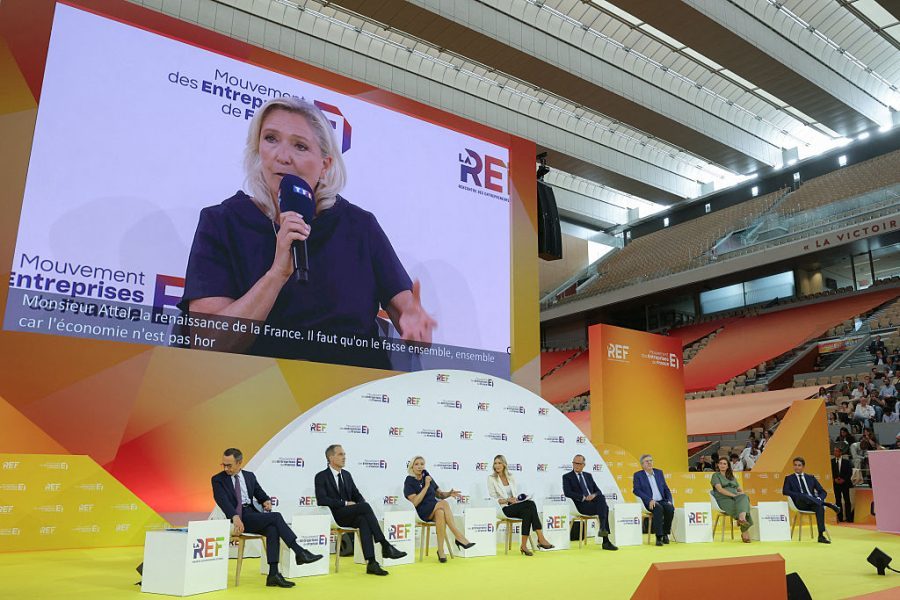
The fight for France is underway. The 2027 presidential campaign began last night as the leading candidates clashed in a live debate on the center court of Roland Garros.
Yesterday’s confrontation came on the same day a poll confirmed that Marine Le Pen is streets ahead of her rivals in the court of public opinion. The leader of the National Rally boasts an approval rating of 33 percent, more than twice that of the left’s Jean-Luc Melenchon. He is on 16 percent with the centrist former prime minister Edouard Philippe 2 percent behind. Fourth, on 11 percent, is Raphael Glucksmann, the leader of the center-left Place Publique.
The host of the debate was MEDEF, the largest employer federation in France, so the audience was composed of men and women more anxious than most about the dreadful state of the country’s economy. France’s public debt is running at more than 117 percent of GDP and borrowing costs are nearing crisis point. With unemployment rising and a record number of businesses folding, the mood at Roland Garros was as flat as an old tennis ball.
No one does blah-blah better than Emmanuel Macron
Audience members had the opportunity to quiz the candidates about their plans to address five areas: debt and public spending, labor costs, red tape, reindustrialization and taxation. What business leaders heard in the three hours of debate left them unimpressed. “It’s always the same old blah-blah,” one entrepreneur told Le Figaro. Another, Jean-Claude Lafrasse, CEO of a commercial vehicle distribution company, said, “We’re leaving this debate no less concerned than before.” In his view the candidates are “good at commenting on reality, but not at taking concrete action.”
It’s been true of France’s political class for decades – and no one does blah-blah better than Emmanuel Macron. Business leaders backed him to the hilt when he ran for the presidency in 2017, buying into the myth that Macron was the “Mozart of Finance.”
But it’s been one bum note after another from the current President, which is why the country’s business leaders are so pessimistic. A recent poll revealed that 82 percent of them are gloomy about France’s economic prospects. “The warning lights are flashing red, from the poverty rate to the sustainability of our debt,” said Patrick Martin, the president of MEDEF. He warned that the 2027 presidential campaign will be a simple choice “between growth and decline. MEDEF is in favor of responsible growth.”

Of the seven candidates, Bruno Retailleau of the center-right Republicans was probably most in tune with the audience. He blamed France’s ills on “the bureaucratic state, the red-tape state, the voracious state, which devours more than 57 percent of the French people’s wealth.”
Le Pen also took aim at the state, declaring that it “must drastically cut back on its spending.” She told delegates that her party will soon unveil its plan to restore public finances by making €125 billion ($145 billion) in savings, which will include slashing spending on the “European Union, immigration, and numerous obscure institutions.”
Jean-Luc Melenchon arrived at Roland Garros as the pantomime villain. He and his party make no secret of their anti-capitalism. At an LFI rally last weekend, one of the party’s prominent figures, Manon Aubry, told a cheering audience:
We must not only tax the rich, but ban billionaires. If there are no more billionaires, then there will be no one left who owns the media, no one left who is destroying the planet.
Melenchon has promised to cancel part of France’s debt if he becomes president. On Thursday he vowed to “disobey anything that comes from Europe which runs counter to the interests of the French people.”
Melenchon inhabits “another planet,” according to one business leader who dined with him earlier in the summer. “He doesn’t think like the rest of us…we had to explain the basics of economics to him.”
Critics level a similar charge at Le Pen. She shares Melenchon’s Euroscepticism and that is a significant reason why the pair are leading the polls – and why one of them is likely to be the next president of France.
The pessimism of the country’s business leaders is unlikely to lift anytime soon.




Comments